Written put options and forwards
Written puts and forwards, as discussed in this narrative, are those that may require an entity to purchase its ordinary shares. Typically, these instruments are in the scope of IAS 32 Financial Instruments: Presentation.
This narrative builds on the basic principles introduced in EPS or earnings per share, and sets out the specific basic and diluted EPS implications of the following types of instrument(s).
Under IAS 32, a written put or forward that contains an obligation for an entity to purchase its own ordinary shares in cash or other financial assets generally gives rise to a financial liability for the present value of the redemption amount. Subsequent to initial recognition, the liability is measured in accordance with IFRS 9 Financial instruments. [IAS 32.23]
This narrative covers written put options over an entity’s own shares. For additional considerations about written put options over NCI in the consolidated financial statements of the parent entity, see Written puts over NCI.
EPS implications
Generally, in general shares that are subject to written puts or forwards are not regarded as outstanding in basic EPS but do impact diluted EPS. Understanding the accounting for these instruments is also relevant, because it determines whether their assumed conversion would have a consequential effect on profit or loss.
|
Potential impact on basic EPS |
Potential impact on diluted EPS |
|
The numerator might or might not be affected and the denominator is affected. |
The numerator and the denominator are affected. |
|
In general, ordinary shares subject to written puts or forwards should be excluded from the denominator, similar to unvested shares and shares subject to recall (see Unvested ordinary shares – EPS Implications). If the ordinary shares that are subject to the written puts or forwards are also entitled to profit, then in general the numerator should also be adjusted for any non-forfeitable dividends and any undistributed earnings attributable to these shares, to the extent that these amounts have not yet been recognised in profit or loss (see Unvested ordinary shares – EPS Implications). [IAS 33.24] Written put options and forwards Written put options and forwards Written put options and forwards Written put options and forwards Written put options and forwards Written put options and forwards Written put options and forwards |
Although ordinary shares subject to written puts or forwards should be excluded from basic EPS, their potentially dilutive effect should be considered. [IAS 33.63, IAS 33.A10] The potential adjustment to the numerator depends on the accounting for the written puts or forwards. For those that are accounted for as financial liabilities, the post-tax remeasurement income or expense is included as an adjustment to the numerator. [IAS 33.35] The potential adjustment to the denominator is determined using the reverse treasury method (see below). [IAS 33.63, IAS 33.A10] In general, any adjustments to the numerator for basic EPS for non-forfeitable dividends and undistributed earnings attributable to shares subject to written puts or forwards (see left) should not be reversed in diluted EPS. This is consistent with the assumption in determining the denominator under the reverse treasury method that shares subject to the written put or forward will remain outstanding after the settlement of the written put or forward (see below). |
Dilutive or anti-dilutive?
Generally, written puts or forwards are dilutive if they are in-the-money – i.e. the exercise or settlement price is higher than the average market price of the ordinary shares. [IAS 33.63]
However, if these instruments are accounted for as liabilities under IAS 32, then the numerator adjustment could vary and could therefore affect whether the instruments are dilutive.
IAS 33 prescribes a specific method, commonly referred to as the ‘reverse treasury share method’, for determining the dilutive effect of written puts and forwards. This method is similar to the treasury share method that applies to written calls (see the treasury share method), but with an opposite assumption: instead of assuming that the assumed proceeds from the exercise of options are used to acquire ordinary shares at the average market price, as in the treasury share method, the reverse treasury share method assumes that additional ordinary shares are issued to raise enough proceeds to satisfy the exercise or settlement price. The dilutive effect – i.e. the bonus element – is therefore calculated as the difference between:
- the number of ordinary shares that would have to be issued at the average market price during the period to raise sufficient proceeds to fulfil the written puts or forwards; and
- the number of shares that would be repurchased under the terms of the written puts or forwards. [IAS 33.63, IAS 33.A10]
The following diagram summarises the reverse treasury share method.

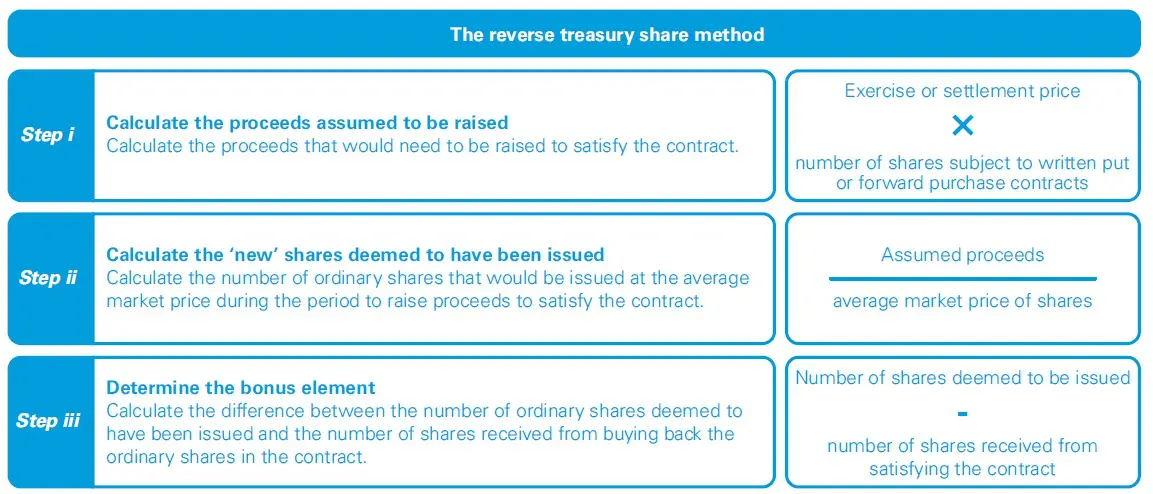
Consistent with the treasury share method (see the treasury share method), the average market price should be determined based on the full reporting period or, in general, the period for which the written puts or forwards are outstanding if this is shorter. Additional consideration on the average market price is set out in the treasury share method).
Case – Written puts |
||||||||||
|
The following basic facts relate to Company P.
The following facts are also relevant for Year 1.
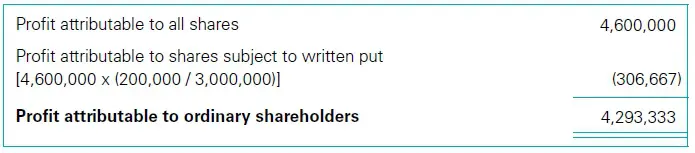
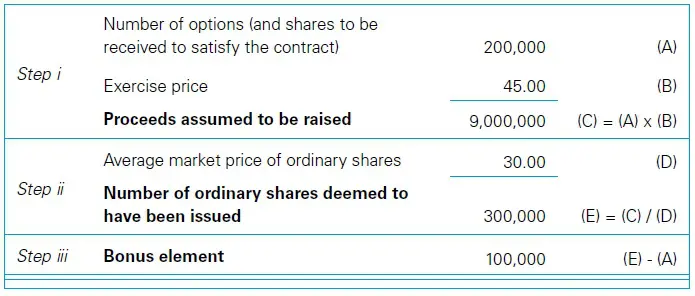
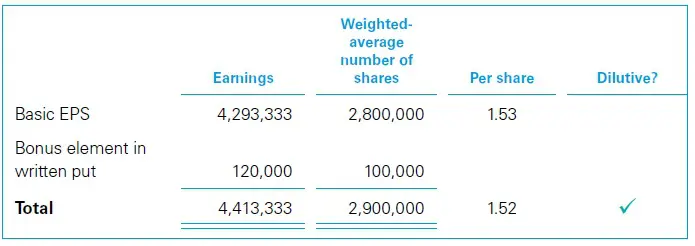
WorkingsThe EPS computations for Year 1 are as follows.
|



Annualreporting provides financial reporting narratives using IFRS keywords and terminology for free to students and others interested in financial reporting. The information provided on this website is for general information and educational purposes only and should not be used as a substitute for professional advice. Use at your own risk. Annualreporting is an independent website and it is not affiliated with, endorsed by, or in any other way associated with the IFRS Foundation. For official information concerning IFRS Standards, visit IFRS.org or the local representative in your jurisdiction.