1. Why Wendy’s closures are a governance story, not just a burger story
show
Wendys store closures corporate governance – When a global fast-food chain announces it will close “a mid-single-digit percentage” of its U.S. restaurants, it sounds like operational housekeeping. For Wendy’s, that number translates into roughly 300 U.S. locations out of about 6,011, starting in Q4 2025 and continuing into 2026.
But this is not a one-off event. In 2024, Wendy’s had already announced the closure of around 140 underperforming restaurants by year-end, on top of roughly 100 earlier closures that same year. Taken together, you don’t just see a tough call in a bad quarter – you see a multi-year governance pattern: what the company itself calls “system optimization” and what governance professionals should recognise as a full-scale rethink of the business footprint.
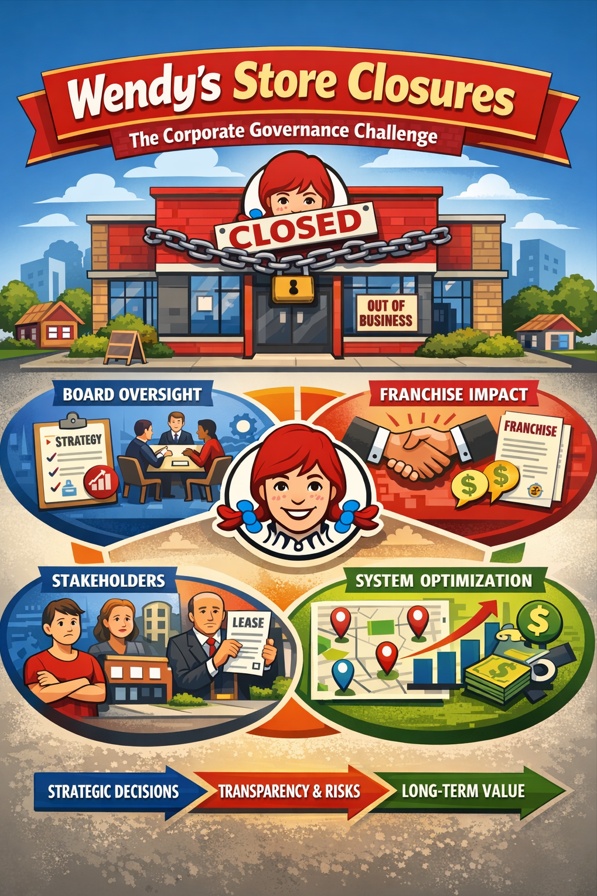
Behind every shuttered restaurant are governance decisions about:
-
the board’s appetite for tough strategic calls;
-
how a predominantly franchised business model is steered and overseen;
-
which stakeholders are prioritised and who bears the pain;
-
how transparent the company is in its annual report, risk factors and investor communications.
In other words: Wendy’s closures are a live case study in how corporate governance actually works when a listed, heavily franchised consumer brand has to shrink to survive.
2. The fact pattern: from growth engine to “system optimisation”
To understand the governance implications, you need the basic timeline.
2.1 2024: Turning off the weakest engines
In late 2024, Wendy’s CEO Kirk Tanner announced the company would close around 140 “lower-volume” or “underperforming” restaurants, mostly in weaker trade areas or outdated formats. The message was clear:
-
the network had accumulated a tail of restaurants that no longer fit the economics or the brand experience;
-
those units were becoming a drag on system health and on the ability to fund growth;
-
closures were paired with new openings in better locations, keeping net unit growth roughly flat and framing the move as rationalisation rather than retreat.
So the story starts in 2024: a classic “prune to grow” message.
2.2 2025–2026: System optimisation goes from pruning to surgery
Fast-forward to November 2025. Interim CEO Ken Cook tells investors that Wendy’s will close a “mid-single-digit percentage” of its 6,011 U.S. restaurants, beginning in Q4, as part of a bid to “halt falling profit” and make the remaining stores more appealing.
Analysts quickly translate that phrasing into an approximate number: around 300 restaurants if 5% of the U.S. system is affected. Cook frames the closures as:
-
targeted at consistently underperforming or outdated locations;
-
designed to boost traffic and profitability at nearby remaining stores;
-
part of a broader response to slowing sales, particularly among lower-income consumers cutting back on dining out.
By this point, the market has also seen:
-
U.S. same-restaurant sales slipping in 2025 after years of modest growth;
-
heightened sensitivity around pricing, value platforms and promotional strategy;
-
a consumer environment in which fast food is no longer immune to inflation and real-wage pressure.
What began in 2024 as a tail-trim is, in 2025–2026, clearly a network redesign.
Read more from CBS News: Wendy’s to close hundreds of U.S. stores as low-income consumers cut back.
3. The governance context: a highly franchised, highly leveraged system
If you read the 2024 Form 10-K, one phrase jumps out quickly: Wendy’s is a “predominantly franchised business model”.
By December 29, 2024, the Wendy’s system comprised 7,240 restaurants, of which 5,933 were in the U.S. and only 381 were company-operated. The remainder – 5,552 U.S. restaurants – were run by about 207 franchisees. Company-operated restaurants accounted for roughly 5% of the total system. SEC
In its risk factors, Wendy’s explicitly warns that this model “may also impact the ability of the Wendy’s system to effectively respond and adapt to market changes” and lists multiple franchise-specific risks:
-
the ability to identify and retain qualified franchisees;
-
financial health of franchisees and their ability to meet commitments;
-
the system’s ability to transfer restaurants among franchisees and get buy-in for brand strategies;
-
the fact that franchisees are independent third parties responsible for day-to-day operations.
Combine that with a securitised debt structure and fixed-rate notes tied to the performance of the restaurant system, and the governance picture becomes clear:
-
The board does not “own” most of the restaurants, but it owns the system-wide brand, standards, capital structure and risk profile.
-
Network health is the lifeblood of both the brand and the debt investors; unit count, quality and profitability are not just operational metrics – they are governance metrics.
In that world, closing large numbers of restaurants is not an incidental real estate decision. It’s a test of how well governance mechanisms can align a web of independent actors around a painful but necessary change.
Read more from the New York Post: Wendy’s quietly confirms 300 store closures next year and read from Wendy’s themselves: Getting Started as a Wendy’s Franchisee.
4. Board-level governance: from denial to deliberate shrink-to-strength
Seen through a governance lens, the multi-year closure wave raises a set of fundamental questions about the board’s role and quality.
4.1 Was the board early, realistic and data-driven?
The 2024 closure announcement already shows a board and management team willing to:
-
run a “robust review of individual restaurants” to test whether each unit meets expectations for sales, profitability and brand experience;
-
designate and act on locations that are “outdated and located in underperforming trade areas”;
-
accept flat or lower net restaurant growth in the short term in order to strengthen the portfolio.
For governance professionals, that’s exactly what you want to see: a board that doesn’t confuse physical expansion with value creation, and is willing to shrink where the numbers and customer experience require it.
By 2025, the stakes have risen: same-store sales declines in the U.S., hundreds of additional closures, and more vocal investor scrutiny. A board that still leans into the “system optimisation” story, rather than quietly letting underperformance linger, suggests a certain governance maturity.
4.2 Did the board balance short-term shock and long-term value?
Closing hundreds of restaurants in a heavily franchised system inevitably causes:
-
short-term revenue declines;
-
restructuring-type charges and contract terminations at franchise and landlord level;
-
potential loss of local presence and customer goodwill in communities where stores disappear.
At the same time, the board is framing closures as a route to:
-
better unit economics and higher average volumes at surviving locations;
-
a cleaner, more investable network that allows capital to flow to stronger sites and modern formats;
-
preservation of brand integrity by removing chronically underperforming stores that degrade the customer experience.
Good governance is about that time horizon: accept the pain now, explain it clearly, and anchor it in a long-term value narrative. The Wendy’s case invites investors to judge whether the board has earned the right to be believed.
4.3 Is there credible, independent challenge at board level?
Another governance test is whether the board’s independent directors and committees (especially audit and risk) are:
-
challenging management’s assumptions on which units to close and how fast to proceed;
-
testing whether closures are addressing structural issues (e.g. format, brand positioning, pricing strategy), or merely masking them;
-
probing the integration of capital allocation decisions (dividends, buybacks, growth capex) with the realities of a shrinking U.S. footprint.
A board that simply rubber-stamps closures is not doing its job. A board that actively interrogates the strategy, insists on scenario analysis and demands transparent reporting is turning a crisis into a governance proving ground.
5. Franchise governance: steering an ecosystem, not a hierarchy
Because 95% of Wendy’s restaurants are operated by franchisees, almost everything about these closures is mediated through franchise governance.
5.1 Franchising risk as a core governance theme
Wendy’s 10-K explicitly highlights that franchisees’ financial health, compliance and buy-in are central risk factors. It notes that franchisees must meet royalty, advertising, development, re-imaging and other commitments, and that the company must manage transfers and disposals of restaurants between franchisees.
When a chain announces multi-year closures of underperforming units, that risk narrative turns real:
-
franchisees may be asked to exit sites they once believed in;
-
in other cases, they may be offered the chance to take over closed or closing locations in stronger hands;
-
some franchisees will struggle to finance remodels or relocations;
-
others might fear they are being squeezed out in favour of larger, better-capitalised operators.
The governance question is: how does Wendy’s structure the decision-rights, incentives and dispute mechanisms so that “system optimisation” does not fracture the network?
5.2 Franchise contracts, guarantees and risk-sharing
The 10-K also notes that Wendy’s guarantees certain leases and obligations, often on former company-operated restaurants now in franchise hands, with lease commitments stretching to 2045.
In a closure wave, this matters:
-
who bears the economic loss when a location is shuttered – the franchisee, the landlord, the brand via guarantees, or some combination?
-
how are termination and transfer clauses in franchise contracts used – and is there a risk of litigation or perceived unfairness?
-
how is brand consistency managed during a period of churn, where some sites close and others are re-imaged?
Mature franchise governance means:
-
transparent criteria for closures and transfers;
-
objective performance metrics shared with franchisees;
-
robust franchise advisory councils or forums where concerns can be raised;
-
clear communication that places system health above short-term individual gain, but without ignoring individual franchise equities.
When “system optimisation” is handled well, closed units are the sacrifice that allows the rest of the system to thrive. When handled poorly, they become the origin story for years of franchise conflict.
6. Stakeholder governance: the human cost of optimisation
A restaurant closure is not just a line item in a slide deck. It is also:
-
a team that loses its workplace;
-
a community that loses a local employer and meeting point;
-
suppliers and landlords whose own business models may be affected.
From a governance perspective, the critical question is: how visible are these stakeholders in board-level decision-making?
6.1 Employees and communities
Fast-food jobs are often low-wage and precarious. When Wendy’s decides to close several hundred locations, corporate governance should ask:
-
is there a clear policy on redeployment to nearby restaurants where possible?
-
are transition arrangements (notice periods, support, basic fairness) explicitly considered, or left entirely to franchisees?
-
does management report to the board on the social footprint of closures – not just the financial one?
For a company whose brand rests partly on community presence, these questions go directly to reputation risk – something Wendy’s itself calls out as a key risk factor: “impacts to our corporate reputation or the value and perception of our brand”.
6.2 Landlords, lenders and suppliers
In a heavily securitised, asset-light model, landlords and lenders are not peripheral actors:
-
they are counterparties in long-term lease and financing chains;
-
major disruptions to the network can affect their own financial exposures;
-
the board must ensure that closure plans are consistent with debt covenants and securitisation assumptions, and that communication with bondholders and banks is timely and honest.
Suppliers – from food distributors to marketing agencies – also experience closures as volume shocks. Governance that treats the supply chain purely as a cost line risks missing longer-term resilience issues: can suppliers adapt, or will the brand eventually suffer from weaker partners?
A stakeholder-aware board does not just approve closures. It asks for a stakeholder map and mitigation plan.
7. Disclosure and transparency: what good governance communication looks like
Wendy’s has already used earnings calls and media statements to explain the high-level logic of closures: underperforming units, system health, shifting consumer behaviour, and reinvestment in better sites.
For annual reporting and corporate governance, that communication needs to go deeper and more structured.

7.1 Risk factors and “system health” narratives
The 10-K already contains extensive risk language around:
-
competition and poor customer experiences;
-
adverse economic conditions and discretionary spending;
-
brand reputation and marketing effectiveness;
-
the predominantly franchised business model and its specific risks.
As closures unfold, good governance demands that:
-
references to store closures and network optimisation appear explicitly in risk factors and MD&A, not just in conference calls;
-
management explains how closure decisions interact with risk appetite – is the board taking more strategic risk to avoid long-term decline?
-
the notion of “system health” is not just a slogan, but supported by metrics (average unit volumes, franchise financial health indicators, store age and format mix, etc.) – even if disclosed in aggregated or directional form.
7.2 Capital allocation and consistency of the story
In early 2025 Wendy’s emphasised its 14th consecutive year of same-restaurant sales growth for 2024 and updated its capital allocation policy with a target dividend payout of 50–60% of adjusted earnings and up to $200 million of share repurchases in 2025.
As closures ramp up, investors will ask:
-
is it still appropriate to return so much capital while also undertaking a costly footprint rationalisation?
-
does the board explicitly show how dividends, buybacks and system optimisation fit into a coherent long-term plan?
-
or does the mix of financial engineering and network shrinkage feel inconsistent?
From a governance standpoint, additional detail in the annual report on the interplay between capital allocation and network strategy would strengthen credibility.
8. Wendy’s as a governance mirror for other boards
The Wendy’s case will not be unique. Across the U.S. and globally, restaurant and retail chains are reviewing networks that were built for a different era: cheap money, cheap labour, and seemingly endless demand. We now see a wave of chains closing underperforming locations to “rationalise” their footprint.
For boards elsewhere, Wendy’s becomes a mirror:
-
Have we defined “system health” clearly?
Not just in marketing language, but in concrete metrics the board reviews regularly. -
Do we know where our network is structurally weak?
Weak trade areas, outdated formats, systematically poor unit economics – or do we just manage by averages? -
Is our governance model truly designed for franchising or partnership?
If most of the network is not company-operated, have we adapted oversight, risk management and disclosure to that reality? -
Do we have a credible shrink-to-strength plan before a crisis forces it?
Wendy’s acted while system-wide sales were under pressure but not collapsing. Waiting too long turns “system optimisation” into “fire sale”. -
Can we explain our decisions in a way that non-specialists understand?
Employees, communities and retail investors do not read footnotes; they read the narrative. Governance must ensure that narrative is honest, coherent and accessible.
9. A practical governance checklist for boards facing network closures
To make this case actionable, here is a board-room checklist for any company considering large-scale site closures:
-
Strategic anchor
-
What is the explicit strategic rationale (not just “underperformance”)?
-
How does this decision fit into a multi-year plan pictured to investors and stakeholders?
-
-
Decision architecture
-
Who owns the criteria and analytics for closures (management vs. independent oversight)?
-
Is there a structured challenge process before decisions become final?
-
-
Franchise/partner dynamics
-
How are franchisees or partners involved in the analysis and sequencing?
-
Are there appeal mechanisms or review points for disputed cases?
-
-
Stakeholder impact mapping
-
Have we explicitly mapped employees, communities, landlords, lenders and suppliers affected?
-
Is there a lightweight but real mitigation plan – redeployment, early communication, community engagement?
-
-
Risk integration
-
How do closures interact with existing risk appetite statements and risk dashboards?
-
Are there second-order risks – e.g. legal, labour, political – that need board-level visibility?
-
-
Disclosure and narrative
-
Is the closure programme clearly reflected in risk factors, MD&A and governance reporting?
-
Are we willing to show non-financial indicators of system health over time?
-
-
Capital allocation coherence
-
Are dividends, buybacks and growth investments aligned with the story of a shrinking or reshaping footprint?
-
Can we explain this coherently in a single slide – to both bondholders and frontline staff?
-
-
Feedback loop
-
What metrics will tell us within 12–24 months whether the closures actually improved system health?
-
Is the board committed to revisiting and adjusting the strategy in light of those outcomes?
-
If Wendy’s – or any chain in a similar position – can answer “yes” to most of these questions, then closures may be painful but governance-sound. If not, the story risks becoming yet another example of short-term fixes that never address the deeper strategic misalignment.
10. Conclusion: Wendy’s as a governance stress-test
Between 2024 and 2026, Wendy’s will likely close well over 400 U.S. restaurants across multiple waves, while simultaneously talking about system optimisation, better locations and renewed growth.
For corporate governance, the important point is not the exact number of closed units. It is whether the board, management, franchisees and stakeholders can:
-
treat the closures as part of a long-term, data-driven strategic repositioning;
-
govern a highly franchised system through difficult change without tearing its social fabric;
-
communicate the logic of the decisions in a way that builds rather than erodes trust.
In that sense, Wendy’s is not just a fast-food story. It is a real-time stress-test of modern governance in an asset-light, highly levered, multi-stakeholder business model – the kind of model that defines much of today’s consumer economy.
For boards, audit committees and governance professionals reading the next Wendy’s annual report or listening to its earnings calls, the key is to look past the headlines and ask:
Does the governance we see on paper truly match the discipline, courage and transparency required to close hundreds of restaurants – and still claim to be building a stronger system?
If the answer is yes, then Wendy’s will have turned a painful chapter into a governance case study worth citing. If the answer is no, the closures may one day be remembered as the moment the brand began to hollow out.

Wendys store closures corporate governance Wendys store closures corporate governance Wendys store closures corporate governance Wendys store closures corporate governance Wendys store closures corporate governance Wendys store closures corporate governance Wendys store closures corporate governance Wendys store closures corporate governance Wendys store closures corporate governance Wendys store closures corporate governance Wendys store closures corporate governance Wendys store closures corporate governance Wendys store closures corporate governance Wendys store closures corporate governance Wendys store closures corporate governance Wendys store closures corporate governance Wendys store closures corporate governance Wendys store closures corporate governance Wendys store closures corporate governance Wendys system optimisation franchise governance case study store closure strategy board oversight
FAQ’s – Wendy’s restaurant closures
Why is Wendy’s closing so many restaurants between 2024 and 2026?

Wendy’s is closing a significant number of U.S. restaurants as part of what management calls “system optimisation”. After years of expansion, the network includes a meaningful tail of underperforming or outdated locations in weak trade areas. In 2024 the company announced roughly 140 closures, on top of earlier shutdowns that year, and in late 2025 interim CEO Ken Cook signalled a further “mid-single-digit percentage” of the 6,011 U.S. restaurants – roughly 300 – would close from Q4 2025 into 2026. The stated goal is to remove chronic drag on the system, protect profitability, and focus capital and management attention on stronger sites and formats, rather than chasing unit growth at any price.
Is this just a financial restructuring, or a deeper corporate governance issue?

It is both. On the surface, Wendy’s is reacting to slowing sales, underperforming locations and a tougher consumer environment. But underneath, the closures are a governance stress-test: can the board and management of a predominantly franchised, securitised system make tough strategic calls, align independent franchisees, protect brand integrity and remain transparent with investors and other stakeholders? The company’s own risk disclosures highlight the challenges of a franchised model and the need to adapt to market changes. When hundreds of restaurants close over multiple years, that risk narrative becomes operational reality – and investors can judge whether governance structures, board oversight and stakeholder management are fit for purpose.
What does Wendy’s predominantly franchised model mean for governance of closures?

Because about 95% of Wendy’s restaurants are franchised, the company cannot simply issue a top-down order to shut sites and expect frictionless execution. Franchisees are independent businesses, with their own capital constraints, contractual rights and local relationships. Wendy’s 10-K warns that its franchised model creates specific risks, including dependence on franchisee financial health, the need to manage transfers between franchisees, and the challenge of aligning franchisees with brand strategies. In the context of closures, governance must therefore manage decision-rights, incentives and dispute resolution mechanisms carefully. Criteria for closure, timing, compensation and opportunities for relocation or transfer all need transparent communication and fair processes to avoid long-term damage to the franchise network.
How should Wendy’s communicate these closures in its annual report and governance sections?

Best practice suggests three layers of communication. First, risk factors should explicitly reference network rationalisation, not only macro and competitive pressures, and connect closures to risk appetite and strategic responses. Second, the MD&A and business overview should move beyond headline numbers and explain the logic of “system health”: how closure decisions are made, how they interact with capital allocation, and what metrics will be used to track success (e.g. average unit volumes, franchisee health). Third, governance disclosures should clarify the board’s role: which committees oversee network strategy, how often they review footprint and franchise performance, and how stakeholder impacts (employees, communities, suppliers, landlords) are considered. In doing so, Wendy’s can turn a painful restructuring into a demonstration of disciplined, transparent governance.
What lessons does the Wendy’s case offer to other boards in retail and hospitality?

The key lesson is that growth models age. Networks built for pre-inflation, pre-digital consumption patterns may become structurally misaligned. Boards should not wait for crisis to ask: which parts of our footprint are structurally weak, and what is our shrink-to-strength playbook? Wendy’s shows the importance of rigorous unit-level analysis, willingness to accept short-term pain, and honest communication with franchises and communities. It also highlights the need to adapt governance structures for franchised or partner-heavy models: oversight, risk dashboards and board agendas must reflect the reality that most economic activity is executed by independent operators, not corporate employees. Finally, Wendy’s demonstrates that capital allocation (dividends, buybacks, growth capex) must be consistent with the narrative of network rationalisation; otherwise, investors will question whether governance is truly focused on long-term value.
Are Wendy’s store closures a sign of long-term decline or disciplined governance?

That depends on execution and transparency. Multi-year closures can signal decline if they are reactive, poorly explained and unaccompanied by a credible strategy for brand positioning, format innovation and digital engagement. They can also signal disciplined governance if they are positioned as part of a clear long-term plan, underpinned by data and subject to robust board oversight. In Wendy’s case, the language of “system optimisation” and the pairing of closures with new openings in better locations suggest an attempt at the latter: do less, but do it better. Whether the market ultimately sees this as decline or discipline will depend on the quality of governance: how well the board handles franchise relationships, how open the company is about risks and trade-offs, and whether subsequent performance metrics show a healthier, more resilient system rather than simply a smaller one. SEC+3
Wendys store closures corporate governance
Wendys store closures corporate governance Wendys store closures corporate governance Wendys store closures corporate governance Wendys store closures corporate governance Wendys store closures corporate governance Wendys store closures corporate governance Wendys store closures corporate governance Wendys store closures corporate governance Wendys store closures corporate governance Wendys store closures corporate governance Wendys store closures corporate governance Wendys store closures corporate governance Wendys store closures corporate governance Wendys store closures corporate governance Wendys store closures corporate governance Wendys store closures corporate governance Wendys store closures corporate governance Wendys store closures corporate governance Wendys store closures corporate governance