Unvested ordinary shares

Unvested ordinary shares (and ordinary shares subject to recall)

Unvested shares are commonly granted in exchange for services from employees or non-employees. Generally, if an entity receives services as consideration for its own equity instruments, then IFRS 2 Share-based Payment applies. Under IFRS 2, vesting conditions are either service conditions or performance conditions. Service conditions require the counterparty to complete a specified period of service. Performance conditions require the counterparty to complete a specified period of service and to meet specified performance targets while rendering the services; a performance condition can be either a market condition or a non-market performance condition. [see IFRS 2 Definition]

Ordinary shares that are subject to recall – i.e. contingently returnable – are dealt with in the same way as unvested ordinary shares for EPS purposes. [IAS 33.24, IAS 33.48]

This chapter covers unvested ordinary shares whose vesting is conditional only on satisfying service conditions. Unvested shares subject to performance conditions are regarded as contingently issuable ordinary shares for EPS purposes and are subject to specific requirements (see Contingently issuable ordinary shares).

This chapter does not deal with:

  • shares that are issuable for more than little or no cash consideration (see Options, warrants and their equivalents); or
  • contracts that may be settled either in shares or in cash (see Contracts that may be settled in shares or in cash).

Additional considerations in the context of share-based payment arrangements are set out in EPS Impact of share-based payments.

EPS implications

The EPS implications of ordinary shares issued in exchange for services depend on when the ordinary shares are granted and vested.

Consider when the ordinary shares are granted or vested

Include in basic EPS the fraction entitled to dividends

Include as equivalent of options in diluted EPS the fraction not entitled to dividends

Potential impact on basic EPS

Potential impact on diluted EPS

The numerator might or might not be affected, the denominator is not affected.

The numerator might or might not be affected, the denominator is affected.

Unvested ordinary shares are not regarded as outstanding until they are vested. Ordinary shares issued as compensation for services received are included in the denominator as the services are received. [IAS 33.21(g)]

Ordinary shares may be entitled to non-forfeitable dividends during the vesting period. If this is the case, then to the extent that these dividends have not been recognised in profit or loss, in our view the numerator should be adjusted for these dividends and any undistributed earnings attributable to these shares, in accordance with their participating rights. This is because the numerator is intended to reflect amounts that are attributable to outstanding ordinary shares, and unvested shares are not regarded as outstanding. [IAS 33.10, IAS 33.24, IAS 33.A13–A14]

Unvested ordinary shares are treated as options in diluted EPS.

Generally, no adjustment is necessary in the numerator because unvested ordinary shares and shares subject to recall are classified as equity. However, to the extent that these shares are entitled to dividends, adjustments to basic EPS (see left) are added back to the numerator in diluted EPS.

The potential adjustment to the denominator is determined using the treasury share method. [IAS 33.48]

.u87b533b6e3669b38a5c22b5093b7676c { padding:0px; margin: 0; padding-top:1em!important; padding-bottom:1em!important; width:100%; display: block; font-weight:bold; background-color:#ECF0F1; border:0!important; border-left:4px solid #141414!important; box-shadow: 0 1px 2px rgba(0, 0, 0, 0.17); -moz-box-shadow: 0 1px 2px rgba(0, 0, 0, 0.17); -o-box-shadow: 0 1px 2px rgba(0, 0, 0, 0.17); -webkit-box-shadow: 0 1px 2px rgba(0, 0, 0, 0.17); text-decoration:none; } .u87b533b6e3669b38a5c22b5093b7676c:active, .u87b533b6e3669b38a5c22b5093b7676c:hover { opacity: 1; transition: opacity 250ms; webkit-transition: opacity 250ms; text-decoration:none; } .u87b533b6e3669b38a5c22b5093b7676c { transition: background-color 250ms; webkit-transition: background-color 250ms; opacity: 1; transition: opacity 250ms; webkit-transition: opacity 250ms; } .u87b533b6e3669b38a5c22b5093b7676c .ctaText { font-weight:bold; color:#8E44AD; text-decoration:none; font-size: 16px; } .u87b533b6e3669b38a5c22b5093b7676c .postTitle { color:#7F8C8D; text-decoration: underline!important; font-size: 16px; } .u87b533b6e3669b38a5c22b5093b7676c:hover .postTitle { text-decoration: underline!important; }

Something else –   EPS Calculation – IAS 33 Best complete read

Dilutive or anti-dilutive?

Because unvested ordinary shares are treated as options in diluted EPS, they are generally dilutive if the average market price of ordinary shares during the period exceeds the assumed proceeds (generally, the fair value of services to be supplied to the entity in the future).

However, to the extent that these shares are entitled to dividends, the numerator may also be impacted by the adjustments in basic EPS that are added back to the numerator for diluted EPS (see above). In such cases, the shares may be anti-dilutive even if the market price of ordinary shares exceeds the assumed proceeds.

Case – Unvested ordinary shares – Without dividend entitlement

The following basic facts relate to Company P.

  • Net profit for Year 1 is 4,600,000.
  • The number of ordinary shares outstanding on 1 January Year 1 is 3,000,000.

The following facts are also relevant for this example.

  • On 1 January Year 0, P grants 150,000 unvested ordinary shares to its employees. The shares vest rateably in three tranches of 50,000 after each year of service, and are not entitled to dividends during the vesting period. The transaction is an equity-settled share-based payment under IFRS 2.
  • The grant-date fair value of each tranche of unvested shares under IFRS 2 is as follows.

Tranche

Grant-date fair value

1 (vesting on 31 December Year 0)

6.50

2 (vesting on 31 December Year 1)

5.75

3 (vesting on 31 December Year 2)

5.00

  • The share-based payment expense recognised under IFRS 2 is as follows.

Tranche

Year 0

Year 1

Year 2

Total

1

325,000

325,000

2

143,750

143,750

287,500

3

83,333

83,333

83,334

250,000

Total

552,083

227,083

83,334

862,500

  • The average market price per ordinary share in Year 1 is 6.

Workings

The EPS computations for Year 1 are as follows.

Basic EPS

Diluted EPS

1. Determine the numerator

No adjustment is necessary because unvested shares are not entitled to non-forfeitable dividends or undistributed earnings. The numerator is 4,600,000.

1. Identify POSs

Unvested ordinary shares are POSs throughout the year, because they are treated as the equivalent of options until they are vested.

2. Determine the denominator

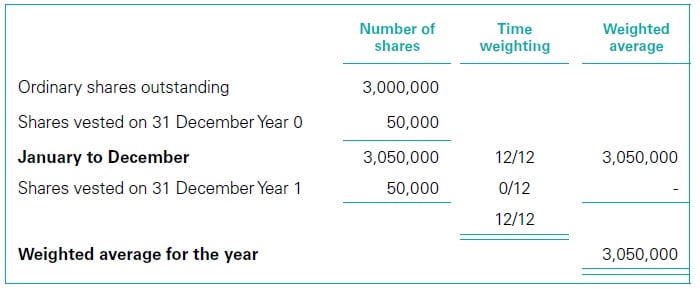
The first tranche of shares, vested on 31 December Year 0, is included in the denominator from the beginning of Year 1. The second tranche only vests on 31 December Year 1, and therefore carries a weighing of 0/12 in the year.

Unvested ordinary shares

Unvested ordinary shares

The denominator is therefore 3,050,000.

2. For each POS, calculate EPIS

Potential adjustment to the numerator for EPIS: No adjustment is required because the unvested shares are classified as equity (see 5.17.60).

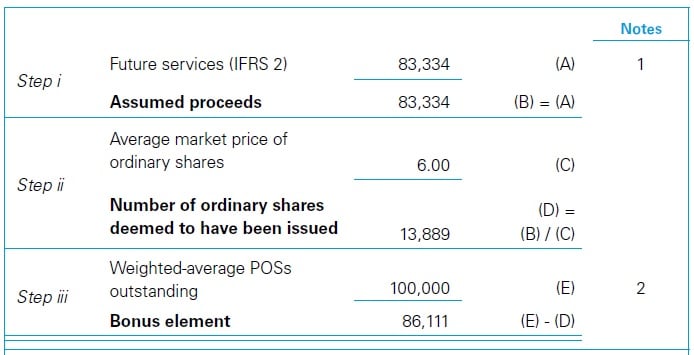
Potential adjustment to the denominator for EPIS: The adjustment is determined using the treasury share method (see 5.9.40), as follows.

Unvested ordinary shares

Unvested ordinary shares

Notes

1. In this step, the proceeds are those from future services to be rendered by the employee for the remaining period not vested. P applies Approach 1 in Example 5.17 and the assumed proceeds are the unearned IFRS 2 expense at 31 December Year 1: 83,334.

2. POSs outstanding is the weighted average for the period (see 5.17.60) [Tranche 2 (50,000 x 365 / 365) + Tranche 3 (50,000) = 100,000].

3. Determine basic EPS

Basic EPS = 4,600,000 / 3,050,000 = 1.51

3. Rank the POSs

This step does not apply, because the unvested shares are the only class of POSs.

4. Determine basic EPS from continuing operations

Basic EPS is 1.51 (see Step 3 of basic EPS computation).

5. Identify dilutive POSs and determine diluted EPS

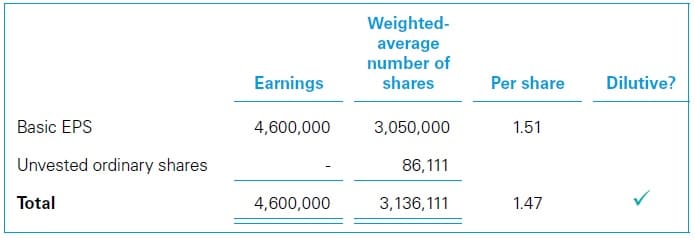
The unvested shares are dilutive because no adjustment to the numerator for EPIS is required.

Unvested ordinary shares

Unvested ordinary shares

Accordingly, P includes the impact of the second and third tranches of unvested shares in diluted EPS.

Diluted EPS = 1.47

.u4086078613e6529830d44e7d89b402ea { padding:0px; margin: 0; padding-top:1em!important; padding-bottom:1em!important; width:100%; display: block; font-weight:bold; background-color:#ECF0F1; border:0!important; border-left:4px solid #141414!important; box-shadow: 0 1px 2px rgba(0, 0, 0, 0.17); -moz-box-shadow: 0 1px 2px rgba(0, 0, 0, 0.17); -o-box-shadow: 0 1px 2px rgba(0, 0, 0, 0.17); -webkit-box-shadow: 0 1px 2px rgba(0, 0, 0, 0.17); text-decoration:none; } .u4086078613e6529830d44e7d89b402ea:active, .u4086078613e6529830d44e7d89b402ea:hover { opacity: 1; transition: opacity 250ms; webkit-transition: opacity 250ms; text-decoration:none; } .u4086078613e6529830d44e7d89b402ea { transition: background-color 250ms; webkit-transition: background-color 250ms; opacity: 1; transition: opacity 250ms; webkit-transition: opacity 250ms; } .u4086078613e6529830d44e7d89b402ea .ctaText { font-weight:bold; color:#8E44AD; text-decoration:none; font-size: 16px; } .u4086078613e6529830d44e7d89b402ea .postTitle { color:#7F8C8D; text-decoration: underline!important; font-size: 16px; } .u4086078613e6529830d44e7d89b402ea:hover .postTitle { text-decoration: underline!important; }

Something else –   Weighted average number of shares outstanding

Case – Unvested ordinary shares – With dividend entitlement

The basic facts are the same as in the above case – Unvested ordinary shares – Without dividend entitlement.

The following facts are also relevant for Year 1.

  • On 1 January, Company P issues 300,000 shares to an employee.
  • The shares are contingently returnable to P if the employee does not complete a required two-year service period.
  • The shares are entitled to non-forfeitable dividends and undistributed earnings while they are subject to recall.
  • The grant-date fair value per share subject to recall is 5.75.
  • The average market price per ordinary share in Year 1 is 9.

Workings Year 1

The EPS computations for Year 1 are as follows.

Basic EPS

Diluted EPS

1. Determine the numerator

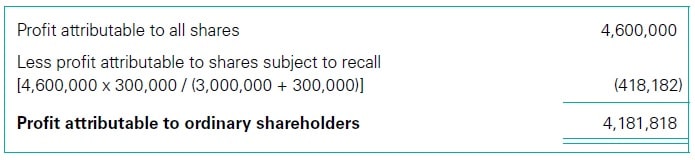
Ordinary shares subject to recall are not considered outstanding (see Step 2); however, the numerator is adjusted for their participating rights (see 5.8.20).

Unvested ordinary shares

Unvested ordinary shares

Accordingly, the numerator is 4,181,818.

1. Identify POSs

Ordinary shares subject to recall are POSs throughout the year, because they are treated as the equivalent of options until they are no longer subject to recall.

2. Determine the denominator

The ordinary shares issued to the employee are subject to recall throughout the year and are excluded from the denominator. The denominator is therefore the weighted-average number of ordinary shares that are not subject to recall – i.e. 3,000,000.

2. For each POS, calculate EPIS

Potential adjustment to the numerator for EPIS: The numerator is added to the profit attributable to those shares (418,182).

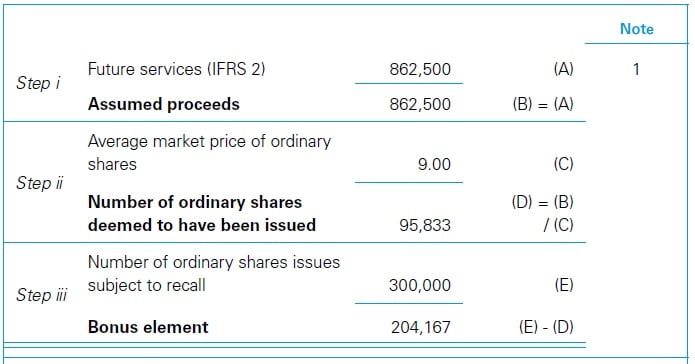
Potential adjustment to the denominator for EPIS: The adjustment is determined using the treasury share method (see 5.9.40), as follows.

Unvested ordinary shares

Unvested ordinary shares

Note

1. In this step, proceeds are those from future services to be rendered by the employee for the remaining period not vested. P applies Approach 1 in Example 5.17 and the assumed proceeds are the unearned IFRS 2 expense at 31 December Year 1: 5.75 x 300,000 x 1/2 = 862,500.

EPIS is calculated as follows.

EPIS = 418,182 / 204,167 = 2.05

3. Determine basic EPS

Basic EPS = 4,181,818 / 3,000,000 = 1.39

3. Rank the POSs

This step does not apply, because shares subject to recall are the only class of POS.

4. Determine basic EPS from continuing operations

Basic EPS is 1.39 (see Step 3 of basic EPS computation).

5. Identify dilutive POSs and determine diluted EPS

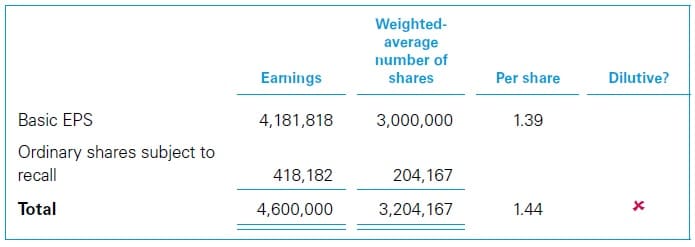
The impact of potentially dilutive instruments is presented as follows.

Unvested ordinary shares

Unvested ordinary shares

To the extent that ordinary shares subject to recall are anti-dilutive, their impact is not considered in diluted EPS, which results in the same amount as basic EPS.

Diluted EPS = 1.39

.ud4001d8c35190800f6249453f6c3b50f { padding:0px; margin: 0; padding-top:1em!important; padding-bottom:1em!important; width:100%; display: block; font-weight:bold; background-color:#ECF0F1; border:0!important; border-left:4px solid #141414!important; box-shadow: 0 1px 2px rgba(0, 0, 0, 0.17); -moz-box-shadow: 0 1px 2px rgba(0, 0, 0, 0.17); -o-box-shadow: 0 1px 2px rgba(0, 0, 0, 0.17); -webkit-box-shadow: 0 1px 2px rgba(0, 0, 0, 0.17); text-decoration:none; } .ud4001d8c35190800f6249453f6c3b50f:active, .ud4001d8c35190800f6249453f6c3b50f:hover { opacity: 1; transition: opacity 250ms; webkit-transition: opacity 250ms; text-decoration:none; } .ud4001d8c35190800f6249453f6c3b50f { transition: background-color 250ms; webkit-transition: background-color 250ms; opacity: 1; transition: opacity 250ms; webkit-transition: opacity 250ms; } .ud4001d8c35190800f6249453f6c3b50f .ctaText { font-weight:bold; color:#8E44AD; text-decoration:none; font-size: 16px; } .ud4001d8c35190800f6249453f6c3b50f .postTitle { color:#7F8C8D; text-decoration: underline!important; font-size: 16px; } .ud4001d8c35190800f6249453f6c3b50f:hover .postTitle { text-decoration: underline!important; }

Something else –   Asset management or investment management

Annualreporting provides financial reporting narratives using IFRS keywords and terminology for free to students and others interested in financial reporting. The information provided on this website is for general information and educational purposes only and should not be used as a substitute for professional advice. Use at your own risk. Annualreporting is an independent website and it is not affiliated with, endorsed by, or in any other way associated with the IFRS Foundation. For official information concerning IFRS Standards, visit IFRS.org or the local representative in your jurisdiction.

.ub818e55518ad3811f0f3dddafd3d8500 { padding:0px; margin: 0; padding-top:1em!important; padding-bottom:1em!important; width:100%; display: block; font-weight:bold; background-color:#ECF0F1; border:0!important; border-left:4px solid #141414!important; box-shadow: 0 1px 2px rgba(0, 0, 0, 0.17); -moz-box-shadow: 0 1px 2px rgba(0, 0, 0, 0.17); -o-box-shadow: 0 1px 2px rgba(0, 0, 0, 0.17); -webkit-box-shadow: 0 1px 2px rgba(0, 0, 0, 0.17); text-decoration:none; } .ub818e55518ad3811f0f3dddafd3d8500:active, .ub818e55518ad3811f0f3dddafd3d8500:hover { opacity: 1; transition: opacity 250ms; webkit-transition: opacity 250ms; text-decoration:none; } .ub818e55518ad3811f0f3dddafd3d8500 { transition: background-color 250ms; webkit-transition: background-color 250ms; opacity: 1; transition: opacity 250ms; webkit-transition: opacity 250ms; } .ub818e55518ad3811f0f3dddafd3d8500 .ctaText { font-weight:bold; color:#8E44AD; text-decoration:none; font-size: 16px; } .ub818e55518ad3811f0f3dddafd3d8500 .postTitle { color:#7F8C8D; text-decoration: underline!important; font-size: 16px; } .ub818e55518ad3811f0f3dddafd3d8500:hover .postTitle { text-decoration: underline!important; }

Something else –   IFRS 9 The SPPI test explained by example

Unvested ordinary shares Unvested ordinary shares Unvested ordinary shares Unvested ordinary shares Unvested ordinary shares Unvested ordinary shares