AI Governance and Ethics: Introduction – Why Every Organization Needs a Brain
Every organism needs a brain: a central place where direction, values, and purpose originate. Muscles may provide strength, and bones may provide structure, but without a brain there is only reflex — movement without meaning.
Artificial intelligence (AI) creates the same tension in organizations. Algorithms can process data faster than any human, but speed without vision is dangerous. Governance must provide the brain that guides AI: a framework where ethics, transparency, and accountability keep technology aligned with strategy and society.
When the brain functions well, AI amplifies human creativity and decision-making. When it fails, AI magnifies bias, accelerates illusions, and undermines trust. The lesson is universal: ethics and governance are not accessories but the neurons of business life.
Science Fiction as a Laboratory of Ethics
Science fiction often captures what boardrooms ignore. In Her, a man falls in love with an AI assistant — a reminder that technology reshapes intimacy and identity. In Ex Machina, a humanoid robot manipulates her creator — a story of power imbalance and accountability.
These are not predictions but experiments in imagination. They expose dilemmas before regulators or directors can define them. Should an algorithm be allowed to set its own priorities? Should a robot have rights? Fiction turns abstract questions into tangible scenarios, forcing governance to prepare.
Boards should treat science fiction as a laboratory of ethics, to build comprehensive AI vision and ethics-system. Just as engineers use crash tests before building cars, directors can use fictional scenarios to stress-test the boundaries of vision and responsibility.
Case Study 1 – Philips: Purpose Without Execution
Philips is famous for presenting itself as a purpose-driven company. Circular design, sustainability, and health technology were framed as the company’s guiding stars. On paper, the brain looked strong.
Then came the massive recall of sleep apnea devices. Millions of patients were affected, regulators intervened, and trust collapsed. The ethical narrative could not survive operational failure.
The governance lesson: a brain cannot live on vision alone. Neurons must connect to muscles and skeletons. Ethics must be embedded in systems, processes, and controls — otherwise purpose becomes illusion.
Read this article on the Philips’recal by MedTechDive.com – 11 key moments in Philips’ massive recall of respiratory devices.
Case Study 2 – Barclays: Bias in the Bloodstream
Barclays experimented with AI in credit scoring. The models promised efficiency but revealed something darker: historical data contained biases that disadvantaged vulnerable groups. Customers felt punished by invisible algorithms.
This was not a technical glitch; it was a neurological disorder. The brain misfired, sending distorted signals through the body. Governance had to step in to rewire the neurons: introducing bias testing, explainability tools, and human oversight.
The Barclays example shows that ethics is not abstract philosophy but circuitry. When it shorts out, the whole organism seizes. So the search for a balanced AI bias and fairness-system should start.
Read the explanation Barclays produced called: Bias in Algorithmic Decision making in Financial Services.
Case Study 3 – Tesco: Vision and Surveillance
Tesco’s Clubcard program is a pioneer of data-driven retail. With AI, Tesco can predict what customers want before they know it themselves. At its best, this is intelligence: the brain anticipating needs.
But brains can also obsess. Customers began to question whether Tesco’s vision was turning into surveillance. Was personalization about serving the customer, or exploiting their habits?
Governance must play the role of the prefrontal cortex — the part of the brain that balances impulse with long-term consequences. AI can guide consumer insight, but only if customers feel respected.
Read this on LinkedIn by Magdalena Rzechorzek – The Future of Retail: How Tesco Uses AI, Big Data & IoT to Revolutionize Supply Chain Operations.
Case Study 4 – Aadhaar: National Brain, Fragile Nerves
India’s Aadhaar project created a biometric identity system for more than a billion people. Its vision was grand: financial inclusion, efficiency, empowerment. In neurological terms, Aadhaar was the attempt to build a brain for the nation.
But when the nerves misfired — faulty scans, technical outages, or wrongful exclusions — millions were locked out of basic services. What began as empowerment became paralysis.
The governance lesson: scale without ethics is fragility. A brain must not only dream but sense, adapt, and protect its body. It shows in developing AI decision-making-systems due care is never to be underestimated.
Read more in this summary by The US’s National Library of Medicine – A Failure to “Do No Harm” — India’s Aadhaar biometric ID program and its inability to protect privacy in relation to measures in Europe and the U.S.
Case Study 5 – Nubank: Explainability as Circulation
Nubank, Latin America’s largest digital bank, thrives on AI-driven credit scoring. Its success depends not just on accuracy but on fairness. Customers must understand why they were rejected.
Explainability is the oxygen of trust. Without it, decisions feel arbitrary, and the heart stops pumping. Governance insists that every neuron must fire transparently. AI can advise, but humans must decide — and they must be able to explain their reasoning.
Here is a video from Nubank’s President explaining the company’s credit strategy.
{“@context”:”http://schema.org/”,”@id”:”https://annualreporting.info/ai-governance-and-ethics-vision/#arve-youtube-f5rroucz40g”,”type”:”VideoObject”,”embedURL”:”https://www.youtube-nocookie.com/embed/f5rrouCz40g?feature=oembed&iv_load_policy=3&modestbranding=1&rel=0&autohide=1&playsinline=0&autoplay=0″}
Want to understand the importance of communication read our blog: Step 4 – Information & Communication: The Nervous System of COSO.
Vision Without Ethics Becomes Illusion
Wirecard in Germany illustrates the extreme risk of vision without governance. Investors bought into the story of unstoppable fintech growth. But behind the vision was fiction: missing cash, fabricated numbers, manipulated reports.
AI has the power to create even more convincing illusions — dashboards, forecasts, narratives — that look intelligent but rest on sand. Without a brain that insists on accountability, companies risk hallucinating their way into collapse.
Explainability by Design – Turning Ethics Into Practice
If AI is the new nervous system of business, explainability by design is the myelin sheath: it insulates every signal so that judgement travels cleanly from data to decision. Without it, outputs jitter and stutter; clever models become clumsy, and trust collapses at the first hard question: “Why did the system decide this?”
Explainability by design means we don’t bolt on a disclaimer after go-live. We architect for clarity from day one—in the choice of models, in how features are selected, in the way user interfaces surface reasons, and in the governance artefacts (logs, decision notes, bias tests) that turn algorithmic hints into accountable, human decisions. It is the difference between a dashboard you can drive by and a tangle of warning lights no one understands.
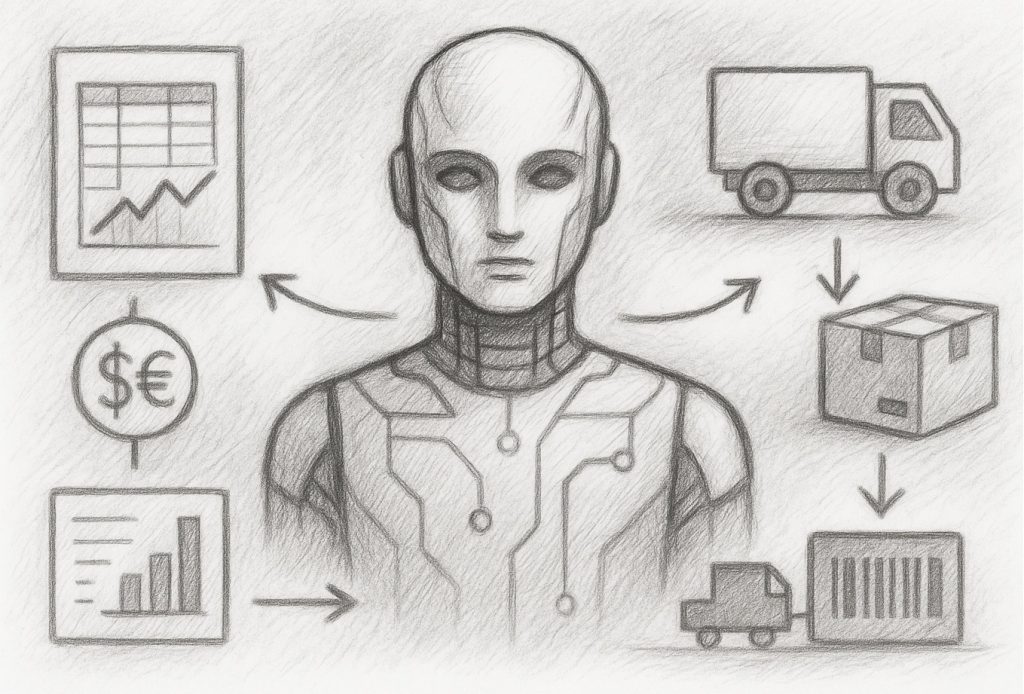
Think of three scenes:
- A banker declining a loan must be able to tell a customer—in plain language—which factors drove the score and how it could change.
- A clinician accepting an AI suggestion must see the evidence: the pixels, signals, and thresholds that led there, not a mysterious probability.
- A planner backing a forecast must carry a narrative to the boardroom: “Demand dips because of seasonality X and promo fatigue Y; here are the levers we tested.”
In each case, the model advises; humans decide. Explainability by design makes that partnership real.
Why Explainability by Design Matters in AI Governance
Trust. Stakeholders grant legitimacy when they can understand, question, and—when needed—contest an outcome. Opaque systems take that agency away. Transparent ones invite dialogue: “We denied credit because of debt-to-income and recent arrears; if either changes, the decision changes.”
Fairness. Bias hides in data and design choices. If you can’t see the pathways from input to output, you can’t spot proxies for protected traits or harmful feedback loops. Explainability is how teams detect, debate, and correct the subtle ways models go wrong.
Accountability. Boards, NEDs, compliance officers, and auditors cannot certify a black box. They need auditable trails, decision rationales, and model cards that answer the two perennial questions of governance: What happened? and Why was that reasonable at the time?
Adoption. The best model unused is value left on the table. People trust tools that show their work. When an AI can “think out loud” in human terms, adoption rises, escalation falls, and the organization learns faster.
Resilience. Markets shift, populations drift, sensors degrade. Explainability exposes drift early and turns surprises into controlled course-corrections instead of public failures.
With those stakes on the table, the rest of this piece sketches five specialist arenas—finance, healthcare, HR, supply chains, and governance roles—as introductions to deeper sub-blogs you can unfold next.
Explainability in Practice: From Finance to Supply Chains and AI decision-making
The value of explainability comes alive when theory meets the realities of daily business. It is not an abstract virtue but a discipline that determines whether AI strengthens judgment or undermines it. In the following sections, we step into boardrooms, trading floors, hospitals, HR departments, and supply chain control towers to see how explainability by design shapes decisions. Each arena reveals the same lesson in a different register: AI can deliver insight at speed, but only explainable AI allows people to act responsibly, document their choices, and carry legitimacy forward.
1. Explainability in Financial Services: Credit Scoring and Trading Models
Finance is where explainability meets the daily test of rights and regulation. Declining a loan, changing a card limit, flagging a transaction—these are not theoretical dilemmas; they land in someone’s wallet tomorrow morning.
Picture a credit desk that has moved from scorecards to gradient-boosting or deep nets. Accuracy improves—until customers and supervisors ask why. Explainability by design reframes the workflow:
- Model choice and feature discipline. Where decisions affect individuals, prefer interpretable families (regularized linear models, monotonic GBMs) or pair complex learners with faithful local explanations (e.g., SHAP summaries that are consistent with the model’s own behaviour). Ban features that act as proxies for protected traits. Document the feature store like a financial chart of accounts.
- Reason codes that mean something. Each decision should surface ranked factors in human language: “High total revolving debt, recent missed payment, DTI above threshold.” Add counterfactuals: “If DTI fell from 47% to 40%, the decision would flip.” That turns a rejection into a roadmap.
- Bias testing as a control, not a campaign. Bake disparate impact tests and stability checks into model monitoring. Trigger a governance review when fairness metrics slip. Treat this like capital ratios: reported, watched, acted on.
- Trading and portfolio models. Portfolio managers won’t own a trade they can’t defend. Provide signal attribution: which macro inputs, earnings surprises, or news embeddings drove the call? Show guardrails in plain view: risk limits, kill-switches, and when the human must override.
The culture shift is subtle but decisive: analysts no longer ask the model to be right; they ask it to be understandably useful. That is a safer target—and a more strategic one.
2. Explainability in Healthcare: Clinical Decision Support and Diagnostics
Healthcare is where explainability meets ethics head-on. A black-box probability can’t substitute for a clinician’s duty of care.
Consider an AI radiology assistant that flags possible lesions. Explainability by design makes three promises:
- Evidence, not edicts. Heatmaps and feature salience show where the model sees risk and which patterns drove it. The clinician reviews the same evidence rather than trusting an oracle.
- Boundaries and confidence. The tool states its competence domain: “High performance on adults; limited paediatric validation.” It shows confidence with uncertainty bars and tells the user when to ask for help.
- Traceable learning. When the clinician agrees or overrides, the system logs the rationale. Over time, that becomes a learning loop—error analysis feeds back into data curation and model updates.
Bias matters here, too. If an algorithm under-detects a condition in a subgroup (due to under-representation or proxy artefacts), only an inspectable pipeline—from imaging protocols to labelling standards to model explanations—will surface and fix it. Explainability is therefore not a UX flourish; it is a clinical safety control.
3. Explainability in Human Resources: Recruitment and Performance Evaluation
HR algorithms touch livelihoods. An unfair shortlist or a opaque performance flag is not just a misprediction; it’s harm.
Explainability by design in HR starts with restraint: strip out protected attributes and their obvious proxies; constrain models to job-relevant signals; ensure outcomes are auditable for each candidate and employee.
Then make three practices non-negotiable:
- Transparent shortlisting. For every ranked CV, show job-relevant reasons: skill matches, certifications, tenure in comparable roles—not school names as prestige proxies or vocabulary quirks that encode bias. Where a candidate asks “Why not me?” provide a respectful, specific response and, where appropriate, a developmental suggestion.
- Structured interviews over black-box psychometrics. If you deploy video analysis or behavioural scoring, disclose it, justify it, and be ready to explain false positives. Better yet, favour structured rubrics and human panels supported (not replaced) by AI checklists.
- Employee evaluation as dialogue. If an AI flags performance risks, it must show why: missed milestones, error rates, customer feedback trends. Managers validate, contextualize, and document. The system becomes a mirror, not a judge.
Done well, explainability makes HR more equitable and more human at the same time—because people can see themselves in the decision logic and respond.
4. Explainability in Supply Chain & ERP Systems: Forecasting and Anomaly Detection
Supply chains live and die on narratives that teams can believe. A forecast without a story is a fight waiting to happen.
Design forecasting AI to carry its own rationale into S&OP:
- Driver analysis at eye level. Every prediction ships with ranked drivers: seasonality, promo lift, channel mix, weather, macro indicators. Planners walk into meetings with facts and levers, not just numbers.
- Scenario probes, not diktats. Let users nudge assumptions—promotion depth, price changes, lead times—and watch the model explain back how the forecast shifts. That interaction is explanation made tangible.
- Local, not only global, insight. Executives need a top-down view; planners need per-SKU, per-region reasons. Design for both. The CFO sees mix and margin pressure; the plant sees a supplier bottleneck.
For anomaly detection (fraud, leakage, breakdowns), pair alerts with why-this-and-why-now context: outlier amounts, counterparties, timing against norms. That’s how operations jump straight to root cause instead of playing whack-a-mole.
In ERP, treat explainability like auditability: immutable logs, data lineage, and reason trails are not nice-to-haves; they’re the only way to trust automated flows when quarter-end pressure arrives.
5. Governance Roles in Implementing Explainability by Design
Explainability is everyone’s job, but not the same job. Clear roles prevent gaps and finger-pointing.
Board of Directors & NEDs — set the tone and the threshold.
Boards don’t choose algorithms, but they do set non-negotiables: any AI that affects customers, employees, investors, or safety must be explainable to the affected audience. They ask: Can we defend this decision in public? Do we have kill-switches when explanations fail? Assign oversight to Risk/Tech committees; demand model inventories, fairness dashboards, and exception logs in board packs.
Here is were is all starts in the Internal Control Framework & COSO ERM – The Control Environment.
Executive Management — own outcomes, not just outputs.
CEOs and business leaders sponsor use-cases but also sponsor guardrails. They sign off on explainability criteria per domain (e.g., reason codes and counterfactuals in lending; visual evidence and confidence in diagnostics). They fund the plumbing—feature stores, model registries, and observability—that makes explanations fast and reliable.
Compliance & Legal — translate law into buildable requirements.
Compliance maps obligations (transparency, fairness, rights to contest) into checklists and patterns engineers can use: approved model families, required disclosures, templated reason codes, retention rules for logs. They negotiate vendor contracts with audit rights and minimum explainability SLAs. If you can’t audit it, you shouldn’t ship it.
Risk & Control — treat opacity as a risk to be monitored.
Risk embeds explainability in the model risk policy: pre-implementation validation, periodic bias tests, drift alerts, challenger models. Controls require that material decisions include a documented rationale—human-readable, reproducible. When thresholds breach, risk escalates to governance with suggested mitigations.
Internal Audit — verify that the story holds under pressure.
Audit samples AI decisions and replays them: do the stored explanations match the outcomes? Are logs complete? Were overrides justified? Are fairness controls operating? They report gaps to the Audit Committee and track remediation. The standard is simple: if we can’t reconstruct and explain, we can’t rely.
For risk & Control and Internal Audit the COSO ERM’s Step 2 – Risk Assessment: The Radar of the Organization is very useful.
Data Science & Engineering — build for legibility.
Practitioners select models that are interpretable enough for the context, document features, and ship explanation services as first-class APIs. They measure explainability UX: do frontline users understand the reasons? Do explanations help decisions improve? They make clarity a performance metric.
Product & UX — make explanations land.
A good explanation is timely, tailored, and actionable. Product teams design reason panels, confidence cues, and “what-would-change-this” hints that respect the user’s reality (a customer service agent’s three minutes, a clinician’s 30 seconds, a CFO’s slide). Explanations should reduce escalations, not create them.
Whistleblowers & Confidential Advisors — keep the arteries open.
Even great systems drift. Make it safe—and expected—for people to speak up when an AI behaves oddly or opaquely. Route these signals to an independent ear (ethics office, ombuds, audit chair). Many governance failures were first seen on the floor; the channel must work.
Metaphor – The Brain as a Compass
Think of the corporate brain as a compass. AI is the powerful magnet: strong enough to move the needle, but also strong enough to distort it. Governance must shield the compass so it points true north.
Without that shield, the organization chases magnetic illusions. With it, AI becomes a force multiplier, guiding ships through storms without losing direction.
Global Governance Lessons
- Ethics is operational. Purpose without controls is illusion.
- Bias is neurological. Left unchecked, it poisons the bloodstream of trust.
- Transparency is oxygen. Without explainability, legitimacy suffocates.
- Vision needs judgment. AI can analyze; humans must decide and document.
- Global, not local. From Philips to Barclays, Tesco to Nubank, the lesson is the same: brains fail when neurons are disconnected.
Conclusion – Keeping the Brain Alive
Every organization faces a choice. Treat AI as a reflex — fast, powerful, but mindless — or treat it as a brain that requires vision, ethics, and oversight.
The companies that thrive will not be those with the most data or the fastest algorithms. They will be those with the strongest governance brains: systems where ethics guide innovation, transparency ensures accountability, and humans remain in charge of decisions.
The real intelligence is not artificial at all. It is the collective wisdom of boards, employees, and stakeholders who insist that AI remain a servant, never a master.
FAQs for AI Vision & Ethics
Why is vision and ethics described as the “brain” of AI governance?

Because vision sets direction and ethics keep the signals honest. Without a brain, AI becomes a reflex: fast but meaningless. Governance ensures the brain aligns technology with strategy and values.
Can AI itself make ethical decisions?

No. AI can provide advice, analysis, and scenarios, but final decisions rest with humans. Employees validate the advice, apply judgment, and document the outcome. This keeps humans accountable and AI in its rightful support role.
How does bias appear in AI systems?

Bias is often hidden in the data. Barclays’ lending models and Aadhaar’s biometric errors show how quickly unfairness can spread. Governance must test models for bias and ensure corrective action before harm occurs.
What is “explainability by design” in practice?

It means algorithms are built to be transparent from the start. A loan decision must state which factors mattered, a medical tool must show which signals triggered a diagnosis. If AI cannot explain itself, it cannot be trusted.
Why are company case studies relevant to AI governance?

Because they show ethics in action. Philips’ recall, Tesco’s privacy dilemmas, or Nubank’s fairness challenges prove that governance is not theory but daily business reality. These lessons make abstract principles concrete.
What should boards remember about AI and ethics?

That AI amplifies whatever culture and systems already exist. If governance is strong, AI strengthens trust. If governance is weak, AI accelerates failure. The brain must therefore remain active: setting vision, insisting on ethics, and keeping people in control.
AI Governance and Ethics
AI Governance and Ethics AI Governance and Ethics AI Governance and Ethics AI Governance and Ethics AI Governance and Ethics AI Governance and Ethics AI Governance and Ethics AI Governance and Ethics AI Governance and Ethics AI Governance and Ethics AI Governance and Ethics AI Governance and Ethics AI Governance and Ethics AI Governance and Ethics AI Governance and Ethics AI Governance and Ethics AI Governance and Ethics AI Governance and Ethics AI Governance and Ethics AI Governance and Ethics AI Governance and Ethics AI Governance and Ethics AI Governance and Ethics AI Governance and Ethics