Last update 27/12/2019
The acquisition method – Assuming that a transaction is concluded to be a business combination, IFRS 3 requires that a business combination be accounted for by applying what is referred to as the acquisition method. The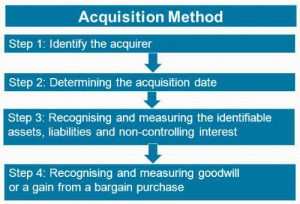
 IFRS/US GAAP replaced the term “purchase method,” which previously was used to describe the method of accounting for business combinations, with the term “acquisition method.” This change resulted primarily from the IASB’s conclusion that a business combination can occur in the absence of a purchase of net assets or equity interests.
The acquisition method
[IFRS 3 4, IFRS 3 5] An entity shall account for each business combination by applying the acquisition method (link to blog). Applying the acquisition method requires:
- Identifying the acquirer The acquisition method
- Determining the acquisition date The acquisition method
- Determining the consideration transferred, which equals: recognizing and measuring the identifiable assets acquired, the liabilities assumed and any non-controlling interest in the acquiree (including intangible assets other than goodwill) The acquisition method
- Recognizing and measuring goodwill or a gain from a bargain purchase The acquisition method
The acquirer must obtain the necessary information to identify and measure the above information within a measurement period, typically less than one year. During the measurement period, adjustments are made to goodwill. After the measurement period, adjustments should only be made to correct an error. The acquisition method
The acquisition date is defined as the date the acquirer obtains control of the acquiree, which typically is the closing date. The acquisition method
The development of IFRS 3 Business combinations in which the acquisition method is defined, was the result of a joint project of the IASB and the FASB aiming at convergence in standards for the accounting of business combinations. The acquisition method
Situations such as purchase of assets, formation of joint ventures are not considered business combinations.
The accounting standards and financial reporting implications for business combinations are covered under the International Financial Reporting Standard 3 (IFRS3). It covers principles for recognizing and measuring identifiable assets acquired, liabilities assumed, and any non-controlling interest in the acquiree. Recognizing and measuring the identifiable assets acquired includes recognizing and measuring identifiable intangible assets and goodwill/badwill. The acquisition method
Identifiable intangible assets acquired in a business combination should be recorded separately from goodwill [IAS 38 11].
There are many types of intangible assets, some of the major examples are explained below: The acquisition method
Goodwill and Brand recognition
Goodwill is a form of intangible asset, which is accounted for when an entity acquires another entity. It is the additional cost or the premium paid by the acquiring company above the fair value of the company’s identified assets or the market value of the shares of the business.
For example, Acacia Ltd. acquired the Beta Ltd. for a lump sum amount of $ 100 million. The fair value of Beta Ltd. net assets is $75 million at the time of acquisition.
The difference or the premium paid by the Acacia Ltd. above the $75 million fair value of the Beta’s assets can be distributed to the goodwill or brand recognition, which in this scenario is $25 million. Goodwill or brand reputation of $ 25 million is the intangible asset and represents the Beta’s business reputation.
Copyrights
Copyrights grant a business the sole proprietorship rights and authority to produce and sale an intellectual property such as software, magazine, book and a journal etc. Copyright protection is available to the persons or organizations that produce original works of authorship in any kind of tangible medium of expression. It means that a person who seeks the copyright protection must be the original writer and has to write record or publish the concept in such a way that it can be reproduced.
In order to better understand let’s consider Company Alpha produces artistic works such as novels, poems, lyrics of songs, photographs, movies, musical compositions, plans for constructing the buildings and sound recordings. Similarly, a company beta deals in IT industry and makes computer software applications, computer software codes for the websites, software codes for managing the database and codes for software applications and programming tools.
Moreover, the database, architectural plans, the complete writings of business plans and marketing plans, annual reports, business proposals, letter or email correspondence of the company with the client and lastly the manual guides of operation of equipment or machinery used in the daily operations of the both organizations are subject to the copy right protection. IAS 38 What are Intangible Assets other than Goodwill?
Patents
Patents protect the rights of a manufacturing and research company by giving the company control over the production, use, and sale of a particular drug, particular design in manufacturing process, a code, etc. There are three main types of the patents namely utility patent, design patent and plant patent which the inventor can use as a protection. The three types are further explained below:
Utility patent
A utility patent is issued by entities to the companies for any new or useful manufacturing, processes, machines, and compositions of matter or any new and beneficial advances and developments thereof. IAS 38 What are Intangible Assets other than Goodwill?
Design patent
A design patent is issued to an organization or any person who has designed or invented a brand new or non-obvious ornamental design to manufacture an article.
Plant patent
As implied by its name, a plant patent issued by the entities to organizations that have designed, innovated, discovered and asexually produced and created any different and new class and variety of a plant.
See also: The IFRS Foundation

