Executive summary – Step 1 COSO Control EnvironmentThis summary discusses the crucial role of the control environment as the cornerstone of the COSO Internal Control – Integrated Framework. It establishes the “tone at the top,” which dictates an organization’s commitment to integrity, ethics, and accountability. Without a strong control environment, even the most advanced risk models and monitoring systems are destined to fail. This is precisely why COSO identifies the control environment as the first step in constructing an internal control framework. The control environment is not merely a procedural checklist. It represents the cultural and governance architecture that fundamentally influences how individuals throughout an organization understand and fulfill their responsibilities. It profoundly shapes decision-making, attitudes toward compliance, and the readiness to report issues. Historically, a deficient control environment has been a central factor in nearly every significant corporate collapse over the past four decades, underscoring its foundational importance. Ultimately, the control environment sets the stage for all other internal control components. It is the intangible but powerful force that determines whether an organization’s stated policies and procedures are merely words on a page or a living, breathing part of its operational reality. |
Where are we? At its core, the COSO Internal Control Framework identifies five integrated components:
These five components function as an integrated system. Weakness in one undermines the others. |
Key Elements of the Control Environment
1. Integrity and Ethical Values
An organization’s culture is revealed in how it responds when profits conflict with principles. Enron and WorldCom, for example, maintained elaborate codes of ethics on paper, yet their leadership fostered a culture of aggressive earnings manipulation. COSO stresses that ethical values must be demonstrated in practice, not only in policy documents.
2. Board of Directors and Audit Committee Oversight
A strong board and active audit committee are essential for governance. The Parmalat scandal (Italy, 2003) showed how a passive board, lacking independence and financial expertise, enabled management to conceal billions in debt. Conversely, boards that demand transparent reporting, frequent internal audit updates, and whistleblower protections create resilience.
3. Organizational Structure and Accountability
Clear reporting lines and defined responsibilities reduce ambiguity. Wirecard exploited a complex web of subsidiaries and opaque governance structures to hide fictitious revenues. A robust control environment requires that accountability is unambiguous and enforceable at every level.
4. Commitment to Competence
Internal control is only as strong as the people operating within it. Recruitment, training, and continuous professional development are not HR luxuries; they are governance imperatives. Organizations that fail to invest in competence invite operational and financial misstatements.
5. Human Resource Policies and Enforcement
Policies on hiring, promotion, compensation, and disciplinary action signal what behaviors are valued. If aggressive growth is rewarded regardless of compliance, as was the case at Enron, employees learn quickly that rules are secondary to results. COSO emphasizes the need for alignment: incentives should reinforce integrity, not undermine it.
Why the Control Environment Is Step 1?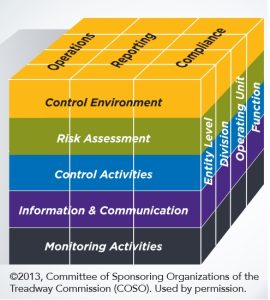
The control environment influences every other COSO component:
-
Risk Assessment: If the culture minimizes concerns, genuine risks are ignored.
-
Control Activities: Policies exist only on paper if employees believe management tolerates circumvention.
-
Information & Communication: A culture of fear or opacity blocks transparency.
-
Monitoring Activities: Oversight is ineffective if leaders dismiss inconvenient findings.
The control environment is like the soil in which internal control grows. Poor soil yields weak plants, regardless of how much effort is invested in watering or fertilizing.
Read more from the Institute of Risk Management – A risk practitioner’s guide to the COSO ERM Frameworks.
International Case Lessons
Enron (United States, 2001)
Enron’s leadership cultivated an environment where aggressive accounting was celebrated and dissent punished. Tone at the top set by executives like Jeff Skilling created pressure to meet unrealistic targets. Despite a detailed code of ethics, the control environment was toxic. Result: bankruptcy, loss of $74 billion in shareholder value, and sweeping reforms (Sarbanes-Oxley Act).
WorldCom (United States, 2002)
The $11 billion fraud at WorldCom stemmed from a culture where loyalty to leadership outweighed accountability. Internal audit staff identified irregularities but lacked authority to challenge management. A weak board and absent ethical backbone amplified the failure. Lesson: without independence, oversight collapses.
Wirecard (Germany, 2020)
Wirecard presented itself as a fintech innovator but operated with opaque structures and a culture that silenced critics. Whistleblowers and journalists raised red flags for years, yet management intimidation and national pride delayed action. The collapse revealed how governance culture—not technology—decides integrity.
Challenges in Building a Strong Control Environment
-
Global Complexity
Multinationals operate across jurisdictions with diverse cultural attitudes toward authority and compliance. Ensuring consistent tone at the top requires deliberate global governance structures. -
Balancing Growth and Control
Fast-growing companies often see governance as a brake. Yet the Wirecard case shows that rapid expansion without cultural discipline creates systemic risk. -
Overreliance on Formal Policies
Boards sometimes mistake codes of conduct for culture. Real culture is measured by behavior in practice: are executives held accountable, or are they excused for results? -
Evolving Risks
Cybersecurity, ESG, and AI-driven decision-making introduce new pressures. Control environments must evolve to include technological ethics and sustainability accountability.
Best Practices for Strengthening the Control Environment
-
Tone at the Top: Boards and CEOs must consistently demonstrate ethical decision-making, even when costly.
-
Independent Oversight: Ensure audit committees have financial expertise and independence.
-
Transparent Accountability: Clear reporting lines, supported by whistleblower mechanisms.
-
Align Incentives: Design remuneration systems that reward compliance and long-term value creation.
-
Continuous Education: Training on emerging risks, ethics, and governance.
One way IFRS has shown its willingness to work on integration and improvement of governance is the introduction of IFRS 18 Presentation and Disclosure in Financial Statements (read a comprehensive post on IFRS 18 here), also regarding Management-Defined Performance Measures.
Conclusion
The control environment is not only the first step in COSO’s framework—it is the most decisive. It determines whether risk assessments are credible, whether control activities are respected, whether information flows honestly, and whether monitoring uncovers the truth. Corporate failures worldwide demonstrate that when the control environment is weak, the rest of the framework collapses.
Organizations that establish robust governance structures, independent oversight, and a culture of integrity create a foundation for resilience and sustainable value. As COSO emphasizes, internal control begins not with paperwork but with people and principles.
In the next article, we will turn to Step 2 – Risk Assessment, examining how organizations identify and analyze risks to achieving objectives.
COSO Control Environment
COSO Control Environment
COSO Control Environment COSO Control Environment COSO Control Environment COSO Control Environment COSO Control Environment COSO Control Environment