Model Context Protocol ERP — why AI keeps failing where ERP dominates
Artificial intelligence has reached a level of linguistic and analytical sophistication that would have seemed implausible only a few years ago. Large language models can interpret questions, summarize complex material, detect patterns, and generate coherent explanations at speed. Yet inside most ERP-driven organizations, AI adoption remains frustratingly superficial. Chatbots are piloted. Copilots are demonstrated. Dashboards are enhanced with natural language search. And then momentum fades.
The problem is not intelligence. It is context.
ERP systems were never designed to explain the business. They were designed to record it. Every transaction is precise, auditable, and controlled — but also fragmented across modules, ledgers, cost objects, time horizons, and authorization layers. AI, by contrast, thrives on semantic clarity and contextual continuity. When those two worlds collide without mediation, the result is confusion, not insight.
Model Context Protocol (MCP) addresses this structural mismatch. Not as a tool, not as a model, and not as a replacement for ERP or BI — but as a governance-aware orchestration layer that allows AI to interact with enterprise systems in a controlled, explainable, and auditable manner.
This article explores MCP as a foundational enterprise concept, applicable to any ERP landscape — SAP, Oracle, Dynamics, Workday, NetSuite, AFAS, Exact, Infor, or hybrid environments — and explains why MCP belongs not only in IT architecture discussions, but in the boardroom.
Read more from the Model Context Protocol: What is the Model Context Protocol (MCP)?
Why AI struggles inside ERP-centric organizations
To understand MCP, one must first understand why AI initiatives struggle in ERP environments despite abundant data.
ERP systems excel at certainty. Every number has a source. Every posting has a timestamp. Every approval has an owner. This is essential for financial integrity, regulatory compliance, and operational discipline. But this strength becomes a weakness when organizations attempt to layer AI on top.
AI does not ask, “What was posted?”
AI asks, “Why did this happen?” and “What does it mean?”
Those questions immediately run into structural barriers:
-
Fragmented context
Revenue, margin, cash flow, and performance are distributed across modules, entities, periods, and definitions. -
Semantic ambiguity
“Sales,” “margin,” or “cost” often mean different things to finance, operations, and commercial teams. -
Authorization complexity
ERP permissions are granular and role-based. AI systems typically are not. -
Static reporting logic
BI tools reflect predefined questions, not exploratory reasoning.
As a result, AI systems are either disconnected from ERP (producing generic answers) or dangerously over-connected (bypassing controls). Neither is acceptable.
What is missing is not another dashboard or model. What is missing is a structured way to manage context.
What Model Context Protocol really is — stripped of hype
Model Context Protocol is an open, system-agnostic communication standard designed to enable AI agents to discover, access, interpret, and act upon enterprise resources in a governed way.
At its core, MCP defines how context is exchanged between AI systems (clients) and enterprise environments (servers). Importantly, MCP does not prescribe what AI should decide — it governs how AI interacts with reality.
MCP consists of three conceptual building blocks:
1. Resources — what the AI is allowed to see
Resources are structured access points to enterprise information: ERP tables, reports, documents, APIs, data models, or external datasets. They are not raw dumps of data. They are governed interfaces.
In ERP terms, resources are equivalent to controlled reporting views, not database tables. They respect existing authorizations, business rules, and data ownership.
2. Tools — what the AI is allowed to do
Tools are actions. They allow AI to execute predefined operations: run a calculation, trigger a workflow, generate a forecast, or prepare a report.
Critically, tools are not autonomous decisions. They are bounded capabilities, comparable to transaction codes or workflow steps in ERP. The AI may request an action, but only within explicitly defined limits.
3. Prompts — how the AI is supposed to behave
Prompts encode interpretation rules, role definitions, and semantic discipline. They answer questions such as:
-
Which definition of “margin” applies?
-
How should conflicting sources be resolved?
-
What level of confidence is required before recommending action?
In accounting terms, prompts function like accounting policies for reasoning.
Together, these three elements form a controlled intelligence loop. MCP does not make AI smarter. It makes AI situationally aware.
MCP and ERP: from “system of record” to “system of context”
ERP systems are rightly described as systems of record. They capture what happened, when, and under which authorization. They are not designed to answer questions such as:
-
Why did margin erode despite stable input prices?
-
Which operational decision caused the cash conversion cycle to deteriorate?
-
Where is performance risk accumulating before it appears in the P&L?
These questions require synthesis across modules, timeframes, and qualitative context.
MCP allows ERP systems to remain what they are best at — precise registries — while enabling AI to operate as a contextual layer on top, without violating control principles.
Crucially, MCP does not require AI to “understand ERP internals.” Instead, MCP translates ERP complexity into structured, permissioned context. The ERP remains authoritative. MCP becomes interpretive.
This distinction matters for governance. AI does not replace ERP logic. It reasons about ERP outcomes, under supervision.
Read more from the Boston Consulting Group: Put AI Agents to Work Faster Using MCP or from our blog: The Data Leader’s Checklist for Leveraging Agentic AI.
ERP-agnostic use cases: decision-grade intelligence, not dashboards
Finance and controlling: explaining performance, not reporting it
Consider a recurring executive question:
“Why is EBITDA declining while revenue is increasing?”
In most organizations, this triggers a sequence of reports, reconciliations, and meetings. The data exists, but the explanation does not.
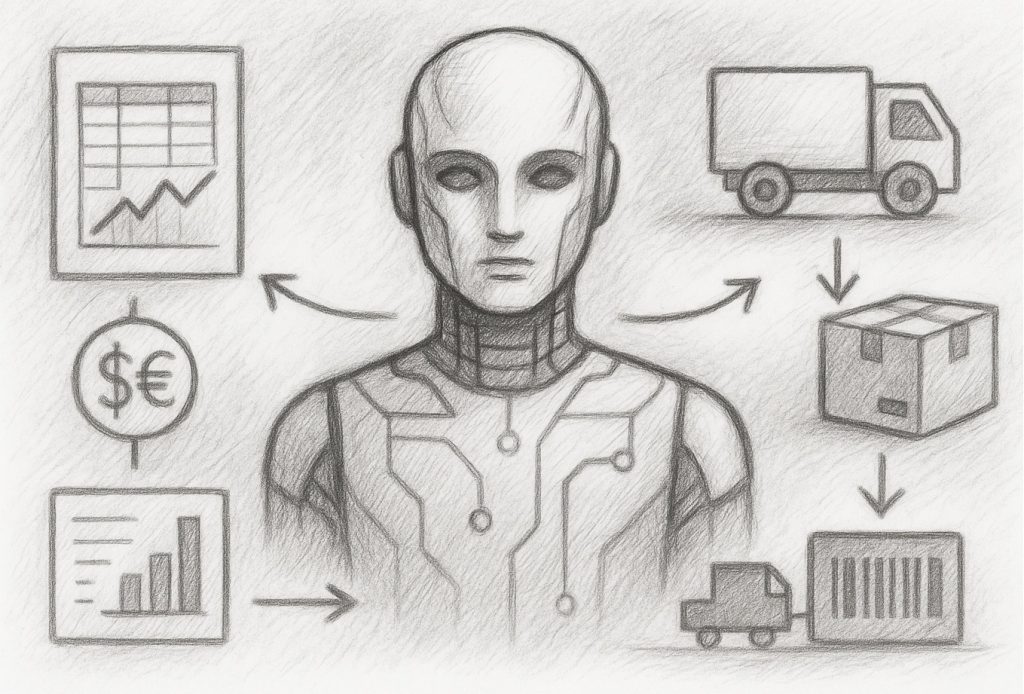
Using MCP, an AI agent can be authorized to combine:
-
Revenue development by product and customer (ERP)
-
Cost absorption and allocation changes (ERP controlling)
-
Project overruns or inefficiencies (project systems)
-
Contractual pricing clauses (documents)
-
One-off operational incidents (qualitative inputs)
The outcome is not a chart, but a narrative explanation that remains fully traceable to source systems. The CFO receives insight, not just information.
ERP remains the book of record. MCP enables interpretation.
Supply chain and operations: anticipating disruption before it hits financials
Operational risk rarely appears first in the general ledger. It surfaces in lead times, supplier reliability, inventory movements, and capacity utilization.
An MCP-enabled AI agent can correlate:
-
Inventory and MRP data (ERP)
-
Supplier delivery performance
-
Maintenance logs
-
External signals such as logistics disruptions or regulatory changes
The question shifts from “What is our stock level?” to “Where will our operations fail next month, and why?”
That is a fundamentally different class of decision — and one ERP alone cannot support.
Read more in our blog on: The Skeleton of AI Governance – Operating Models and Technology.
HR and workforce planning: understanding people risk as a business variable
ERP and HR systems are rich in data but poor in explanation. Attrition, absenteeism, and skill shortages are visible only after they become problems.
With MCP, AI can operate within defined HR governance boundaries to analyze:
-
Workforce composition and critical roles
-
Performance trends
-
Absence patterns
-
External labor market indicators
The result is not surveillance, but early warning — presented in a way that respects privacy, authorization, and ethical constraints.
Governance, auditability, and internal control — why MCP matters to boards
From a governance perspective, AI introduces a new category of risk: unaccountable reasoning. Traditional controls assume humans make decisions. AI disrupts that assumption.
MCP restores control by treating AI as a new type of system user:
-
With identity
-
With authorization
-
With scope limitations
-
With logging and traceability
Every resource accessed, every tool invoked, and every conclusion drawn can be audited.
This is decisive for audit committees and regulators. AI decisions become explainable not because the model is simple, but because the context is governed.
Without MCP, AI is a black box with system access.
With MCP, AI is a supervised participant in enterprise processes.
MCP through a COSO internal control lens
Viewed through the COSO framework, MCP strengthens — rather than weakens — internal control.
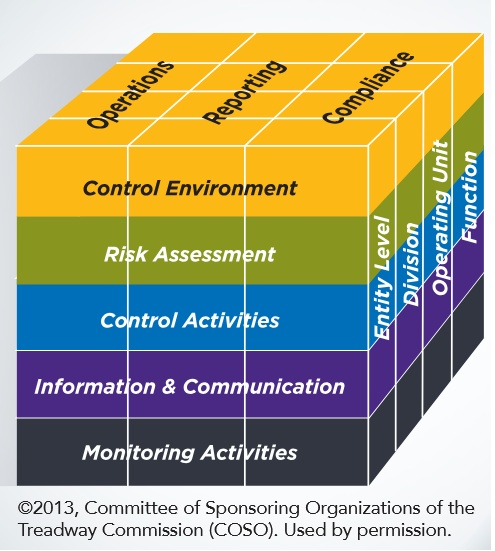
-
Control environment
Clear roles and responsibilities for AI agents. -
Information and communication
Consistent semantics and traceable data flows. -
Control activities
Bounded actions through tools, not unrestricted execution. -
Monitoring activities
Logged access, usage metrics, and exception monitoring.
In this sense, MCP is not an IT protocol. It is control infrastructure.
Implementation strategy: how to introduce MCP responsibly
Successful MCP adoption does not start with technology. It starts with questions.
-
Identify recurring decisions that currently require manual synthesis.
-
Define business semantics before connecting systems.
-
Treat AI as a governed role, not a magical capability.
-
Begin with read-only access; expand cautiously to actions.
-
Involve finance, risk, and governance functions from day one.
This is evolutionary, not disruptive. MCP enhances existing ERP landscapes rather than replacing them.
What MCP is not — and must never become
Clarity on limitations is essential.
MCP is not:
-
A replacement for ERP
-
An autonomous decision engine
-
A shortcut around internal control
-
A justification for removing human accountability
MCP is an enabler of better human decisions, not a substitute for them.
Conclusion — MCP as the nervous system of the enterprise
ERP systems are the memory of the organization.
AI represents its cognitive potential.
Model Context Protocol is the nervous system that connects memory to reasoning, and reasoning to controlled action.
Without it, AI remains either isolated or dangerous.
With it, AI becomes a disciplined extension of enterprise governance.
For organizations serious about AI — and serious about control — MCP is not optional. It is foundational.
FAQ’s – Model Context Protocol
Model Context Protocol ERP Model Context Protocol ERP Model Context Protocol ERP Model Context Protocol ERP Model Context Protocol ERP Model Context Protocol ERP Model Context Protocol ERP Model Context Protocol ERP Model Context Protocol ERP Model Context Protocol ERP Model Context Protocol ERP Model Context Protocol ERP Model Context Protocol ERP ERP AI governance AI ERP orchestration ERP context layer AI ERP integration
Model Context Protocol ERP
Model Context Protocol ERP Model Context Protocol ERP Model Context Protocol ERP Model Context Protocol ERP Model Context Protocol ERP Model Context Protocol ERP Model Context Protocol ERP Model Context Protocol ERP Model Context Protocol ERP Model Context Protocol ERP Model Context Protocol ERP Model Context Protocol ERP Model Context Protocol ERP
FAQ 1 — Is Model Context Protocol (MCP) only relevant for advanced AI or large enterprises?
Model Context Protocol is often associated with advanced AI use cases, but its relevance is not limited to large enterprises or highly mature AI environments. In fact, MCP becomes more valuable as organizational complexity increases, not necessarily as AI sophistication increases.
Any organization that relies on one or more ERP systems already faces a context problem: data is fragmented across modules, definitions differ by function, and decision-making requires manual interpretation. MCP addresses this structural challenge by providing a standardized way for AI to access and interpret enterprise data within existing governance boundaries.
For mid-sized organizations, MCP can reduce dependency on custom integrations and ad-hoc reporting. For large enterprises, it becomes essential to prevent AI initiatives from bypassing internal controls. The protocol itself is lightweight; what matters is the discipline around context, authorization, and semantics.
In other words, MCP is not about “advanced AI.” It is about controlled interaction between intelligence and enterprise reality. Any organization that wants AI to support decisions — rather than generate generic answers — will eventually need a mechanism like MCP, regardless of size or sector.
FAQ 2 — How does MCP differ from traditional BI tools or AI copilots built on ERP data?
Traditional BI tools and AI copilots operate primarily in a query-response paradigm. They retrieve predefined datasets, apply logic, and present results. While useful, they struggle when questions require combining multiple data contexts, interpreting meaning, or triggering follow-up actions.
MCP introduces a fundamentally different concept: orchestration of context. Instead of embedding logic in dashboards or hard-coded integrations, MCP defines how AI agents discover data, respect permissions, interpret semantics, and invoke actions across systems.
An AI copilot without MCP may answer questions, but it often lacks awareness of which definitions apply, which data is authoritative, or whether an action is permitted. MCP enforces these boundaries explicitly. It separates intelligence from access, ensuring that AI reasoning remains anchored in governed enterprise structures.
In short, BI answers known questions. Copilots assist users. MCP enables decision-grade reasoning that is traceable, auditable, and aligned with governance — regardless of which ERP or reporting tools are in place.
FAQ 3 — Does MCP mean giving AI direct access to ERP systems, and is that safe?
No. Properly implemented, MCP does not give AI unrestricted access to ERP systems. In fact, MCP exists precisely to prevent unsafe or uncontrolled access.
MCP introduces an intermediary layer that governs how AI interacts with enterprise systems. Resources exposed through MCP are curated, permissioned views — not raw transactional access. Tools define exactly which actions an AI agent may request, under which conditions, and with which approvals.
From a governance perspective, AI should be treated like a new category of system user. It should authenticate, inherit role-based permissions, and be subject to logging and monitoring. MCP enables this model by design.
Without MCP, AI integrations often rely on technical shortcuts: service accounts with broad access, hard-coded APIs, or shadow data copies. These approaches increase risk. MCP reduces it by enforcing explicit boundaries.
In regulated or audit-sensitive environments, MCP is not a risk — it is a risk mitigation mechanism that allows AI to operate safely within existing control frameworks.
FAQ 4 — How does MCP support auditability and regulatory compliance?
Auditability depends on three elements: traceability, authorization, and explainability. MCP strengthens all three.
First, every interaction between an AI agent and enterprise systems occurs through defined resources and tools. This makes access traceable. Logs can show which data was accessed, when, and for what purpose.
Second, MCP enforces authorization. AI agents operate under defined roles and permissions, just like human users. They cannot access data or execute actions beyond their scope.
Third, MCP improves explainability. Because AI reasoning is grounded in structured context, conclusions can be traced back to source systems and definitions. This is critical for financial reporting, risk management, and regulatory oversight.
From a compliance perspective, MCP aligns well with internal control frameworks such as COSO. It supports controlled information flows, monitored activities, and accountability. Rather than introducing a black box, MCP makes AI a governed participant in enterprise processes.
For audit committees, this distinction is essential: MCP does not weaken control — it formalizes it for the AI era.
FAQ 5 — Can MCP be used across multiple ERP systems and hybrid landscapes?
Yes — and this is one of its core strengths.
Most organizations operate hybrid landscapes: multiple ERP systems, legacy platforms, cloud applications, and external data sources. Traditional AI integrations struggle in such environments because each system requires custom handling.
MCP abstracts this complexity. AI agents do not connect to “SAP” or “Oracle” directly. They connect to contextual interfaces that expose data and actions in a consistent way, regardless of the underlying system.
This makes MCP particularly valuable in post-merger environments, global organizations, or decentralized operating models. Instead of forcing data consolidation upfront, MCP allows AI to reason across systems while respecting local governance.
Importantly, MCP does not eliminate the need for data architecture discipline. It complements it. By standardizing context exchange, MCP enables AI to operate coherently even when the underlying landscape remains heterogeneous.
FAQ 6 — What is the biggest misconception about Model Context Protocol?
The biggest misconception is that MCP is a technology shortcut to autonomous decision-making.
It is not.
MCP does not remove human accountability, nor does it make AI “run the business.” Its purpose is the opposite: to ensure that AI operates within clearly defined human governance structures.
Another common misunderstanding is that MCP is a product or platform. It is not. MCP is a protocol — a way of structuring interaction between intelligence and enterprise systems. Different tools may implement it, but the value lies in the concept, not the vendor.
Finally, MCP is sometimes seen as optional plumbing. In reality, it is foundational infrastructure. Without it, AI initiatives either remain superficial or introduce unacceptable risk.
MCP’s real value is not speed or automation. It is trust — trust that AI-supported decisions are grounded, explainable, and controlled. That is why MCP belongs not only in IT roadmaps, but in governance discussions at the highest level.
