Last update 18/03/2020
IFRS 7 Interest rate risk disclosure example – Interest rate risk is part of the risk disclosures requirements under IFRS 7 Financial Instruments: Disclosures. Interest rate risk is part of market risk (the other market risks being currency risk and other price risk) and is defined as the risk that the fair value or future cash flows of a financial instrument will fluctuate because of changes in market interest rates. IFRS 7 Interest rate risk disclosure example
Management should disclose information that enables users of its financial statements to evaluate the nature and extent of risks arising from financial instruments to which the entity is exposed at the end of the reporting period [IFRS 7 31]. The disclosures require focus on the risks that arise from financial instruments and how they have been managed. These risks typically include, but are not limited to, credit risk, liquidity risk and market risk [IFRS 7 32]. IFRS 7 Interest rate risk disclosure example
Qualitative and quantitative disclosures are required. Management should therefore disclose, for each type of risk arising from financial instruments:
- The exposures to risk and how they arise, and its objectives, policies and processes for managing the risk and the methods used to measure the risk (qualitative disclosure) [IFRS 7 33]; and
- Summary quantitative data about its exposure to that risk at the end of the reporting period (quantitative disclosures) [IFRS 7 34]. Market risk
If the quantitative data disclosed at the end of the reporting period is unrepresentative of an entity’s exposure to risk during the period, management should p rovide further information that is representative [IFRS 7 35].
Table – Overview exposure to financial risks, possible disclosures and management of risk
|
Exposure arising from |
Possible disclosure |
Management of risk |
|
|
Market risk – Currency risk |
Future commercial transactions Recognised financial assets and liabilities not denominated in LC |
Cash flow forecasting |
Foreign currency forwards and foreign currency options |
|
Market risk – Interest rate risk |
Long-term borrowings at variable rates |
Interest rate swaps |
|
|
Market risk – Other price risks |
Investments in equity securities |
Sensitivity of equity financial instruments to equity index benchmark prices (also known as Beta) |
Portfolio diversification |
|
Cash and cash equivalents, trade receivables, derivative financial instruments, debt investments and contract assets |
Credit ratings |
Diversification of bank deposits, credit limits and letters of credit Investment guidelines for debt investments |
|
|
Borrowings and other liabilities |
Rolling cash flow forecasts Maturity analysis |
Availability of committed credit lines and borrowing facilities |
Cases
Case: Aggregated exposures – FX and interest rate risk IFRS 7 Interest rate risk disclosure example
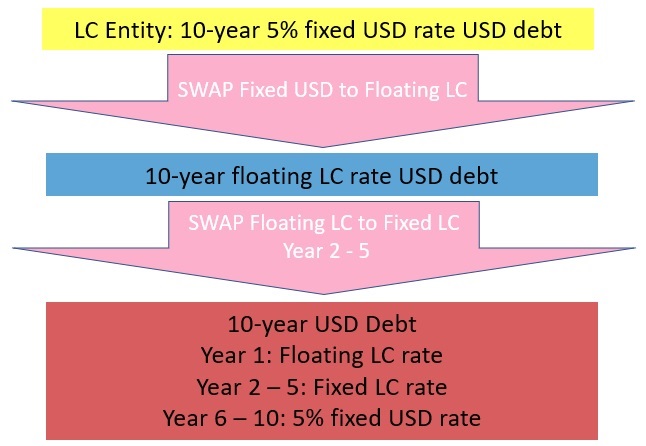
Entity C is based outside the US with a Local Currency (LC) as its functional currency, and issues private placement bonds in the US with a maturity of 10 years and a fixed interest rate of 5%. IFRS 7 Interest rate risk disclosure example
To manage the foreign exchange risk from US dollars (USD) denominated debt, Entity C enters into a 10 year cross-currency interest rate swap. The cross-currency interest rate swap pays floating interest rate payments in LC and receives fixed USD interest payments. IFRS 7 Interest rate risk disclosure example
Entity C’s interest rate risk management strategy subsequently changes, to require fixed interest rates from year two to year five in its local currency.
Therefore, Entity C enters into a second derivative instrument, being an interest rate swap which pays fixed interest payments and receives floating interest payments in LC.
The effect is that the local floating interest payments in years two to five are swapped to fixed interest LC payments, or
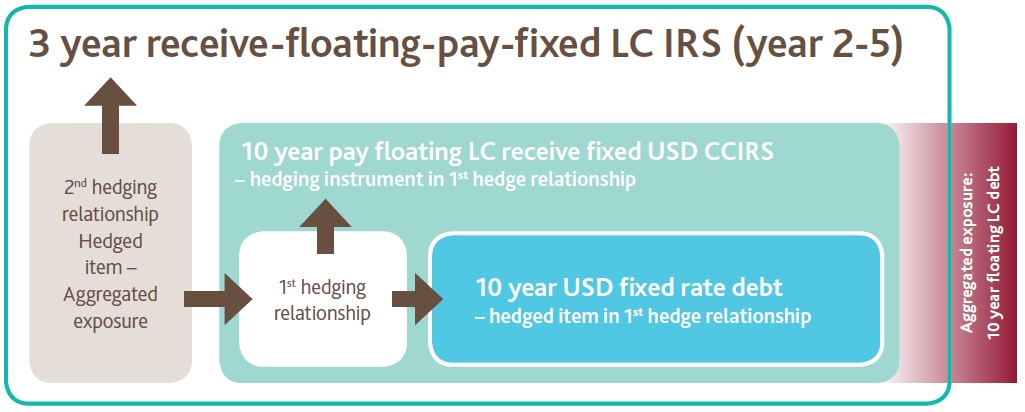
Under IFRS 9, Entity C would be able to designate the following relationships:
- First hedging relationship – to mitigate the exposure to foreign exchange (FX) risk: IFRS 7 Interest rate risk disclosure example
- Hedged item: 10 year fixed rate USD debt IFRS 7 Interest rate risk disclosure example
- Hedging instrument: 10 year cross-currency interest rate swap. IFRS 7 Interest rate risk disclosure example
- Second hedging relationship – to mitigate the exposure to local interest rates risk in years two to five: IFRS 7 Interest rate risk disclosure example
- Hedged item: floating interest rate payments (years two to five) – the aggregated exposure IFRS 7 Interest rate risk disclosure example
- Hedging instrument: pay fixed receive floating interest rates in its local currency.
This means that when Entity C wants to fix its floating rate exposure in its local currency from years two to five by entering into a three-year receive-floating-pay-fixed interest rate swap (IRS), under IFRS 9 Entity C treats the combined exposure of the debt and cross-currency interest rate swap (termed the ‘aggregated exposure’) as a hedged item and establishes a second hedging relationship for years two to five.
Case: Investment entity ABC Ltd invests in a debt portfolio primarily concentrated in the region of Eurasia. Many of the countries in Eurasia have similar economic environments. However, one country, Utopia, has a more developed economic environment, which is dissimilar to the other countries within the region.
When providing a sensitivity analysis for interest rate risk, should ABC Ltd provide disaggregated information showing the sensitivity of ABC Ltd to reasonably possible movements in interest rates in all the countries it invests?
It depends. The management of ABC Ltd decides how it aggregates information to display the overall picture without combining information with different characteristics about exposures to risks from significantly different economic environments [IFRS 7 B3, IFRS 7 B17].
Because many of the countries in Eurasia have similar economic environments, it could be possible to aggregate the information providing it is not unreasonable to assume a reasonably possible change in interest rates would be the same in these countries – for example, a 50 basis point move. However, it would never be appropriate to aggregate these countries with Utopia due to differences in the economic environments.
Example disclosure – Interest rate risk
The Group adopts a policy of ensuring that between 80 and 90% of its interest rate risk exposure is at a fixed rate. This is achieved partly by entering into fixed-rate instruments and partly by borrowing at a floating rate and using interest rate swaps as hedges of the variability in cash flows attributable to movements in interest rates. The Group applies a hedge ratio of 1:1. (IFRS 7 21C, IFRS 7 22A(b)–(c), IFRS 7 22B–22C)
The Group determines the existence of an economic relationship between the hedging instrument and hedged item based on the reference interest rates, tenors, repricing dates and maturities and the notional or par amounts. (IFRS 7 22B(b))
The Group assesses whether the derivative designated in each hedging relationship is expected to be effective in offsetting changes in cash flows of the hedged item using the hypothetical derivative method.
In these hedge relationships, the main sources of ineffectiveness are:
- the effect of the counterparty’s and the Group’s own credit risk on the fair value of the swaps, which is not reflected in the change in the fair value of the hedged cash flows attributable to the change in interest rates; and
- differences in repricing dates between the swaps and the borrowings. (IFRS 7 34(a), IFRS 7 23D)
Profile: Exposure to interest rate risk
The interest rate profile of the Group’s interest-bearing financial instruments as reported to the management of the Group is as follows. (IFRS 7 40)
|
(Amounts in EUR ‘000) |
Nominal amount |
|
|
Fixed-rate instruments |
2019 |
2018 |
|
Financial assets |
2,554 |
2,629 |
|
Financial liabilities IFRS 7 interest rate risk disclosure example |
-15,793 |
-10,522 |
| IFRS 7 interest rate risk disclosure example IFRS 7 interest rate risk disclosure example |
-13,239 |
-7,893 |
|
Effect of interest rate swaps IFRS 7 interest rate risk disclosure example |
-7,000 |
-7,500 |
| IFRS 7 interest rate risk disclosure example IFRS 7 interest rate risk disclosure example |
-21,239 |
-15,393 |
|
Variable-rate instruments IFRS 7 interest rate risk disclosure example |
||
|
Financial liabilities IFRS 7 interest rate risk disclosure example |
-10,086 |
-14,055 |
|
Effect of interest rate swaps IFRS 7 interest rate risk disclosure example |
8,000 |
7,500 |
| IFRS 7 interest rate risk disclosure example IFRS 7 interest rate risk disclosure example |
-2,086 |
-6,555 |
Fair value sensitivity analysis for fixed-rate instruments
The Group does not account for any fixed-rate financial assets or financial liabilities, at FVTPL, and the Group does not designate derivatives (interest rate swaps) as hedging instruments under a fair value hedge accounting model. Therefore, a change in interest rates at the reporting date would not affect profit or loss.
A change of 100 basis points in interest rates would have increased or decreased equity by €65 thousand after tax (2018: €66 thousand). This analysis assumes that all other variables, in particular foreign currency exchange rates, remain constant.
Cash flow sensitivity analysis for variable-rate instruments
A reasonably possible change of 100 basis points in interest rates at the reporting date would have increased (decreased) equity and profit or loss by the amounts shown below. This analysis assumes that all other variables, in particular foreign currency exchange rates, remain constant. (IFRS 7 40)
| IFRS 7 interest rate risk disclosure example
IFRS 7 interest rate risk disclosure example IFRS 7 interest rate risk disclosure example IFRS 7 interest rate risk disclosure example |
Equity, net of tax |
|||
|
100 bp increase |
100 bp decrease |
100 bp increase |
100 bp decrease |
|
|
31/12/19 IFRS 7 interest rate risk disclosure example |
||||
|
Variable-rate instruments IFRS 7 interest rate risk disclosure example |
-66 |
66 |
0 |
0 |
|
Interest rate swaps IFRS 7 interest rate risk disclosure example |
61 |
-61 |
310 |
-302 |
|
Cash flow sensitivity (net) IFRS 7 interest rate risk disclosure example |
-5 |
5 |
310 |
-302 |
| IFRS 7 interest rate risk disclosure example |  |
|||
|
31/12/19 IFRS 7 interest rate risk disclosure example |
||||
|
Variable-rate instruments IFRS 7 interest rate risk disclosure example |
-142 |
142 |
0 |
0 |
|
Interest rate swaps IFRS 7 interest rate risk disclosure example |
61 |
-61 |
280 |
-275 |
|
Cash flow sensitivity (net) IFRS 7 interest rate risk disclosure example |
-81 |
81 |
280 |
-275 |
See also: The IFRS Foundation