Last Updated on 15/10/2025 by 75385885
IFRS 13 Significant Judgments and Estimates – Fair value is one of the most discussed measurements in modern financial reporting. IFRS 13 establishes a single framework for fair-value measurement across all IFRS standards and defines both the principle and the disclosure of the judgments and estimates that make it work. In theory, fair value is an objective market price. In practice, it is a carefully constructed number, anchored in assumptions about markets, participants, timing, and data quality. Understanding the standard therefore means understanding where judgment enters the model.
Where it bites
IFRS 13 bites wherever observable market data fade and professional estimation begins. This occurs in valuation of unlisted equity, derivatives with complex optionality, structured debt, investment property, biological assets, and financial instruments during stressed markets. Even within Level 2 hierarchies, management must decide which prices are orderly, which inputs remain observable, and whether adjustments are required for liquidity or credit risk. The further the model moves from traded prices, the higher the need for transparent disclosure of the reasoning behind it. IFRS 13 does not remove judgment; it standardises it.
Why it matters
Fair-value decisions shape profit, equity, and key ratios. A small change in discount rate can move impairment charges by millions. Because fair value is used across multiple standards—IFRS 9 for financial instruments, IFRS 16 for leases, IFRS 3 for business combinations, IAS 40 for investment property—the integrity of IFRS 13 judgments underpins consistency throughout financial reporting. Investors and regulators rely on the note disclosures in IFRS 13.93–99 to assess whether reported values are reliable or merely convenient. The standard’s discipline forces preparers to show how they reached their conclusions and how sensitive those conclusions are to change.
Read the standard IFRS 13 Fair value measurement at ifrs.org
Judgment areas under IFRS 13 Significant Judgments and Estimates
- Unit of account: Whether the asset or liability is measured individually or as part of a group affects valuation technique and market assumption (IFRS 13.14–16).
- Principal or most advantageous market: The market with the highest volume and activity normally defines fair value, but entities must prove access to that market (13.19–20).
- Valuation technique: Market, income, or cost approach (13.61–66) depending on data availability and nature of the asset.
- Input hierarchy: Observable (Level 1–2) versus unobservable (Level 3) inputs (13.72–90).
- Non-performance risk: Credit standing of both counterparty and the entity itself (13.42).
- Orderly transaction assessment: Especially under volatile conditions (13.B37–B43).
- Highest and best use: For non-financial assets, whether current use is the highest and best use from a market-participant perspective (13.27–33).
Each area contains embedded judgments about markets, assumptions, and models that require explanation under IAS 1 §122–125 or IFRS 18 §115–119.
Practical examples
Technology and Level 3 inputs. When Apple or Siemens values equity stakes in private suppliers, there are no market quotes. Valuation uses income approaches—discounted cash-flow or option models—calibrated to observable transactions. The selection of discount rate, growth rate, and volatility is judgment-heavy. IFRS 13.93(h)–(i) require disclosure of quantitative information about significant unobservable inputs and sensitivity to reasonably possible changes.
Industrial projects and bespoke equipment. Airbus, Rolls-Royce, or Philips often deal with assets so specific that only internal cash-flow forecasts exist. They must justify that the valuation reflects market-participant assumptions, not entity-specific expectations (13.22). Sensitivity analysis becomes the language of credibility.
Financial institutions. Banks continuously assess whether market spreads reflect orderly transactions. During crises, trading may occur at distressed prices. IFRS 13 allows management to disregard those quotes if evidence shows they are not orderly, but such a judgment must be documented and disclosed (13.B43).
What’s the judgment or estimate
Judgment enters first in model selection. A preparer decides whether to apply a market approach (comparable prices), an income approach (present value of future cash flows), or a cost approach (replacement cost). This decision shapes every subsequent input.
Next come estimates: the numerical assumptions—growth rates, discount rates, credit spreads, yield curves, volatilities. Each must reflect market-participant assumptions at the measurement date. IFRS 13 distinguishes between the choice of model (a judgment) and the measurement within the model (an estimate). IAS 1 §122–125 require disclosure of both when they have a significant effect on the statements.
Another recurring judgment is identifying the principal market. For global groups quoted on several exchanges, determining which market has the greatest volume and activity can shift values and FX effects. Entities must justify that choice with data, not convenience.
When prices are stale or missing, management estimates the orderliness of transactions. IFRS 13 B37–B43 require consideration of volume, spreads, and information about forced sales. The line between active and inactive markets is never bright; the judgment must be transparent.
Read a presentation made for the World Bank Group – Fair Value measurement IFRS 13.
IFRS 13 Significant Judgments and Estimates IFRS 13 Significant Judgments and Estimates IFRS 13 Significant Judgments and Estimates IFRS 13 Significant Judgments and Estimates IFRS 13 Significant Judgments and Estimates IFRS 13 Significant Judgments and Estimates IFRS 13 Significant Judgments and Estimates IFRS 13 Significant Judgments and Estimates IFRS 13 Significant Judgments and Estimates IFRS 13 Significant Judgments and Estimates IFRS 13 Significant Judgments and Estimates IFRS 13 Significant Judgments and Estimates IFRS 13 Significant Judgments and Estimates IFRS 13 Significant Judgments and Estimates IFRS 13 Significant Judgments and Estimates IFRS 13 Significant Judgments and Estimates IFRS 13 Significant Judgments and Estimates
Disclosure requirements
IFRS 13.91–99 set out a robust disclosure regime intended to make judgments visible. Key requirements include:
- Valuation techniques and inputs used (13.93 d–e);
- Level in the hierarchy for each class of asset or liability (13.93 b);
- Transfers between levels and the reasons (13.93 c);
- Quantitative information about significant unobservable inputs for Level 3 (13.93 h);
- Reconciliation of opening and closing Level 3 balances (13.93 f);
- Sensitivity analysis for reasonably possible changes in unobservable inputs (13.93 i).
IAS 1 and IFRS 18 build on this by requiring explanation of significant judgments and estimation uncertainty that could materially affect future periods. The two standards operate together: IFRS 13 provides the numbers; IAS 1 / IFRS 18 provide the narrative.
Example 1: Shell plc (Oil & Gas / Energy) — 2024
While IAS 36 doesn’t use IFRS 13 for Value in Use, it does rely on IFRS 13 for the other component of the Recoverable Amount.
- Value in Use (VIU): Defined in IAS 36 as the present value of the future cash flows expected to be derived from an asset or Cash-Generating Unit (CGU). VIU is an entity-specific measurement because it’s based on the cash flows expected from the asset’s current condition and the company’s specific use plan.
- Fair Value (FV): Defined in IFRS 13 as the price that would be received to sell an asset or paid to transfer a liability in an orderly transaction between market participants at the measurement date (an exit price). FV is a market-based measurement.
Recoverable Amount in IAS 36 is the higher of 1) Fair Value Less Costs of Disposal (FVLCOD) and 2) Value in Use (VIU).
IAS 36 explicitly states that the determination of the Fair Value component of FVLCOD must be done in accordance with the guidance in IFRS 13 Fair Value Measurement.
In short, IFRS 13 provides the comprehensive guidance for how to measure Fair Value whenever it is required by another IFRS, and this includes the Fair Value Less Costs of Disposal measurement used in IAS 36. However, IFRS 13 does not apply to or influence the calculation of Value in Use, which remains an entity-specific measurement governed by the specific rules in IAS 36.
Significant estimates – – Proved oil and gas reserves
In assessing the value in use, the estimated risk-adjusted future post-tax cash flows are discounted to their present value using a post-tax discount rate that reflects Shell’s post-tax WACC. (See Note 13). The level of risking reflected in the cash flow assumptions is a consideration in management’s assessment of the discount rate to be applied in order to avoid duplication of systemic and asset-specific risking in calculating value in use, and to ensure the discount rate applied is commensurate with risks included in forecast cash flows.
Assumptions about future commodity prices and refining and chemical margins used in the impairment testing in, respectively, Integrated Gas and Upstream, and Chemicals and Products (see Note 13) are regularly assessed by management, noting that management does not necessarily consider short-term increases or decreases in prices as being indicative of long-term levels.
The price methodology applied is based on Shell management’s understanding and interpretation of demand and supply fundamentals in the near term, taking into account various other factors such as industry rationalisation and energy transition in the long term.
The discount rate, future commodity prices and refining margins used in impairment testing provide a source of estimation uncertainty as referred to in paragraph 125 of IAS 1 Presentation of Financial Statements (IAS 1.125).
Information about the carrying amounts of assets and impairments and their sensitivity to changes in significant estimates is presented in Note 13.
The discount rates applied in determining value in use reflect a current market assessment of the time value of money, adjusted for risks not included in forecast cash flows. The discount rate applied is based on a nominal post-tax weighted average cost of capital (WACC), derived from the following key assumptions:
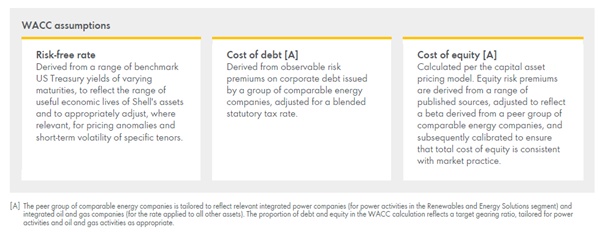
This rate is reassessed throughout the reporting period, with adjustments made when changes in assumptions applied would lead to a change in an investor’s expected rate of return on a portfolio of similar assets. This assessment considers a range of factors, including macroeconomic forecasts, the historical volatility of key assumptions and the level of risking reflected in cash flow forecasts, including the extent to which systemic risks have been reflected in Shell’s Operating Plan, which forms the basis of forecast cash flows in determining value in use.
Cash flow projections used in the determination of value in use were made using management’s forecasts of commodity prices, market supply and demand, forecast expenditures, potential costs associated with operational GHG emissions, product margins including forecast refining margins, chemical margins and expected production volumes (see Note 2). The level of risking reflected in these assumptions is a consideration in management’s assessment of the discount rate to be applied in order to avoid duplication of systemic and asset-specific risking in calculating value in use, and to ensure the discount rate applied is commensurate with risks included in forecast cash flows.
The discount rate applied was a nominal post-tax WACC of 6% (2023: 6%) for the power activities in the Renewables and Energy Solutions segment and a nominal post-tax WACC of 7.5% (2023: 7.5%) for all other businesses. Management assessed the appropriateness of these discount rates as a result of rising bond yields towards the end of 2024. Management concluded that the discount rates remain appropriate and materially commensurate with other significant cash flow assumptions.
Recoverable value was predominantly assessed by reference to value in use in segments other than the Renewables and Energy Solutions segment. The pre-tax discount rates applied for value in use impairment testing vary according to the characteristics of the asset, including its useful life and cash flow profiles. The weighted average pre-tax discount rate applied in the recognition of impairment charges during the year was 9.0% for segments other than the Renewables and Energy Solutions segment.
The near-term commodity price assumptions applied in impairment testing were as follows:
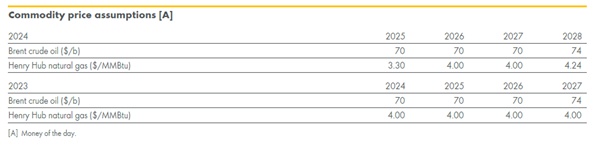
For periods after 2028, the real-term price assumptions applied were: $70 per barrel (/b) (2023: $70/b) for Brent crude oil, and a linear increase from $4.05 per million British thermal units (/MMBtu) to $5.00/MMBtu in 2048 (2023: $4.00/MMBtu) for Henry Hub natural gas.
Oil and gas price assumptions applied for impairment testing are reviewed and, where necessary, adjusted on a periodic basis. Reviews include comparison with available market data and forecasts that reflect developments in demand such as global economic growth, technology efficiency, policy measures and, in supply, consideration of investment and resource potential, cost of development of new supply, and behaviour of major resource holders.
For certain assets in the Chemicals and Products and Renewables and Energy Solutions segments, the recoverable value was determined by reference to fair value less costs of disposal. In determining fair value, adjustments are made to forecast cash flows to reflect assumptions used by market participants. These adjustments predominantly relate to the discount rate applied and commodity price assumptions. For certain assets in the Renewables and Energy Solutions segment, the valuation methodology incorporates other adjustments to reflect comparable transactions.
The total carrying value of property, plant and equipment, goodwill and other intangible assets at December 31, 2024, for which recoverable value was tested in 2024 by reference to fair value less costs of disposal was $0.9 billion related to assets in Renewables and Energy Solutions and $1 billion in Marketing. The majority of the assets for which the recoverable value was determined by reference to fair value less costs of disposal are related to assets classified as held for sale (see Note 19).
The total carrying value of property, plant and equipment, goodwill and other intangible assets at December 31, 2023, for which recoverable value was tested in 2023 by reference to fair value less costs of disposal was $2.6 billion related to assets in Renewables and Energy Solutions and $2.5 billion in Chemicals and Products. The weighted average post-tax discount rate applied to impairments recognised during 2023 is 12% for Renewables and Energy Solutions and 10% for Chemicals and Products.
Sensitivities [Sensitivity analysis (13.93 i))
The main sensitivities in relation to value in use impairment assessment are the commodity price assumptions in Integrated Gas and Upstream, refining and chemical margins in Chemicals and Products, and discount rates in all segments.
Commodity price assumptions
A change of -10% or +10% in the commodity price assumptions over the entire cash flow projection period would ceteris paribus result in $5-9 billion in impairments or $2-5 billion in impairment reversal, respectively, in Integrated Gas and Upstream.
Refining margins
Refining margins applied for impairment testing by reference to value in use are at an average of $10/bbl. A change of -$1/bbl or +$1/bbl in long-term refining margins over the entire cash flow projection period would ceteris paribus result in no impairments or up to $0.5 billion in impairment reversal, respectively, in Chemicals and Products.
Chemical margins
Chemical margins applied for impairment testing by reference to value in use are at an average of $197.5/tonne. A change of -$30/tonne or +$30/tonne in long-term chemical margins over the entire cash flow projection period would ceteris paribus result in up to $0.5 billion in impairments or no impairment reversal, respectively, in Chemicals and Products.
Discount rates
A change of +1% in the discount rate would ceteris paribus result in $1-3 billion in impairments in Integrated Gas and Upstream, and would have no significant impact in other segments.
Where applicable, the above sensitivities include impairment charges that would arise in respect of associates and joint ventures. Where carrying values have been supported by reference to fair value less costs of disposal, recoverable amounts are less sensitive to Shell’s planning assumptions. This is on the basis that key assumptions (including discount rates and commodity prices) have been adjusted to reflect those used by market participants.
In calculating recoverable value, key assumptions are not determined in isolation, to ensure relevant interdependencies are appropriately reflected. In particular, management considers the relationship between discount rates, forecast commodity prices and cash flow risking to ensure impairment testing assumptions result in an implicit expected return which is balanced and appropriate for the asset under review. Each of the sensitivities described above has been tested under a ceteris paribus assumption where all other factors remain unchanged, and as such does not reflect the potential offsetting effects of corresponding changes in other assumptions.
Fair value measurements
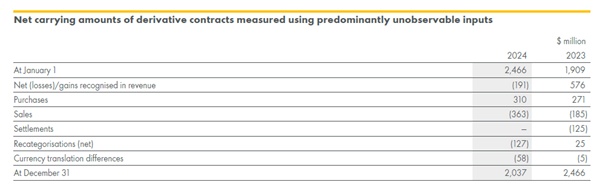
The net carrying amounts of derivative contracts held at December 31 categorised according to the predominant source and nature of inputs used in determining the fair value of each contract were as follows:

Predominantly unobservable inputs – Table
Fair value measurement – Estimate
Where available, fair value measurements are derived from prices quoted in active markets for identical assets or liabilities. In the absence of such information, other observable inputs are used to estimate fair value. Inputs derived from external sources are corroborated or otherwise verified, as appropriate.
In the absence of publicly available information, fair value is determined using estimation techniques that take into account market perspectives relevant to the asset or liability, in as far as they can reasonably be ascertained, based on predominantly unobservable inputs.
For derivative contracts where publicly available information is not available, fair value estimations are generally determined using models and other valuation methods, the key inputs for which include future prices, volatility, price correlation, counterparty credit risk and market liquidity, as appropriate; for other assets and liabilities, fair value estimations are generally based on the net present value of expected future cash flows.
Mondi Group – Integrated report and financial statements 2024
The preparation of the Group’s consolidated financial statements requires the use of accounting estimates which, by definition, may differ from actual results. The estimates are based on management’s best information available about current circumstances and future events. The critical accounting judgements and significant accounting estimates with a significant risk of a material change to the carrying value of assets and liabilities within the next year in terms of IAS 1, ‘Presentation of Financial Statements’, are:
Critical accounting judgements and significant accounting estimates
The preparation of the Group’s consolidated financial statements requires the use of accounting estimates which, by definition, may differ from actual results. The estimates are based on management’s best information available about current circumstances and future events. The critical accounting judgements and significant accounting estimates with a significant risk of a material change to the carrying value of assets and liabilities within the next year in terms of IAS 1, ‘Presentation of Financial Statements’, are:
Significant accounting estimates
- Fair value of forestry assets – refer to note 15
- Actuarial valuations of retirement benefit obligations – refer to note 25
Other areas of judgement and accounting estimates
The consolidated financial statements include other areas of judgement and accounting estimates. While these areas do not meet the definition under IAS 1 of significant accounting estimates or critical accounting judgements, the recognition and measurement of certain material assets and liabilities are based on assumptions and/or are subject to longer-term uncertainties. The other areas of judgement and accounting estimates include:
- Hyperinflation accounting – refer to notes 7 and 35
- Taxation – refer to notes 8 and 35
- Estimates of future cash flows used in the impairment assessment of goodwill and property, plant and equipment – refer to notes 11, 13 and 35
- Residual values and useful economic lives of property, plant and equipment – refer to notes 11 and 35
- Fair value of assets acquired and liabilities assumed in business combinations – refer to notes 26 and 35
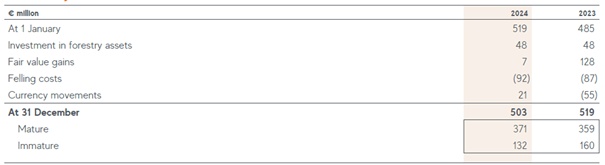
The Group has 255,023 hectares (2023: 254,858 hectares) of owned and leased land available for forestry activities, all of which is in South Africa. 80,667 hectares (2023: 80,614 hectares) are set aside for conservation activities and infrastructure needs. 1,044 hectares (2023: 1,044 hectares) relate to non-core activities. The balance of 173,312 hectares (2023: 173,200 hectares) are under afforestation, which forms the basis of the valuation set out above.
Mature forestry assets are those plantations that are harvestable, while immature forestry assets have not yet reached that stage of growth. Timber is harvested according to a rotation plan, once trees reach maturity. The maturity period ranges from 6.5 to 14.5 years (2023: 6.5 to 14.5 years) depending on species, climate and location. The fair value of forestry assets is a level 3 measure in terms of the fair value measurement hierarchy, consistent with prior years.
The following assumptions have a significant impact on the valuation of the Group’s forestry assets:
- The net selling price is defined as the selling price less the costs of transport, harvesting, extraction and loading, and all selling prices and costs are denominated in South African rand. The net selling price is based on third-party transactions and is influenced by the species, maturity profile and location of timber. In 2024, the net selling price used ranged from the South African rand equivalent of €15 per tonne to €58 per tonne (2023: €15 per tonne to €53 per tonne), with a weighted average of €32 per tonne (2023: €34 per tonne).
- The conversion factor, which is used to convert hectares of land under afforestation to tonnes of standing timber, is dependent on the species, the maturity profile of the timber, the geographic location and a variety of other environmental factors, such as the anticipated impact of climate change on water scarcity and fire risks. In 2024, the conversion factors ranged from 7.7 to 25.3 (2023: 7.6 to 25.0).
- The risk premium on immature timber of 12.6% (2023: 12.4%) is based on an assessment of the risks associated with forestry assets in South Africa and is applied for the years the immature timber has left to reach maturity. A risk premium on mature timber of 4.0% (2023: 4.0%) was applied. The risk premium applied to immature and mature timber includes factors for the anticipated impact of climate change on water scarcity and fire risks. An increase in the severity and frequency of extreme weather events, such as higher temperatures, changes in rainfall patterns and drought conditions, may result in higher timber losses in future years caused by stronger winds, erosion, fires, pests and diseases.
The valuation of the Group’s forestry assets is determined in South African rand and converted to euro at the closing exchange rate on 31 December of each year.
Management has performed sensitivity analyses of reasonably possible changes in the significant assumptions and the EUR/ZAR exchange rate. The sensitivity table is based on historical experience; however, the estimates may vary by greater amounts. Therefore, the Board considers the forestry assets valuation to be a significant accounting estimate. The reported value of owned forestry assets would change as follows should there be a change in these underlying assumptions on the basis that all other factors remain unchanged:

IFRS 3 Business Combinations requires the fair value measurement principles and disclosure requirements of IFRS 13 Fair Value Measurement for several key disclosures, particularly concerning the assumptions and inputs used in determining fair values at the acquisition date.
IFRS 13 provides the framework for measuring fair value, but IFRS 3 determines what needs to be measured at fair value in a business combination.
The IFRS 13-related fair value disclosures are primarily triggered by the requirement in IFRS 3 to disclose information that enables users to evaluate the nature and financial effects of the business combination.1
The most significant area where IFRS 13 disclosures are necessary for IFRS 3 compliance relates to the Fair Value Hierarchy and the Valuation Techniques used for assets and liabilities measured at fair value, specifically those where fair value inputs are not observable (Level 3).
To 31 December 2024
On 5 February 2024, the Group announced the completion of the acquisition of Hinton Pulp mill in Alberta (Canada) from West Fraser Timber Co. Ltd (West Fraser) for an agreed consideration of USD 5 million, before working capital adjustments. The mill has the capacity to produce around 250,000 tonnes of pulp per annum and will provide the Group with access to local, high-quality fibre from a well-established wood basket as part of a long-term partnership with West Fraser.
The Group intends to invest in the mill to improve productivity and sustainability performance and, subject to pre-engineering and permitting, expand the facility primarily with a new kraft paper machine which will integrate its paper bag operations in the Americas and support future growth.
Hinton’s revenue for the year ended 31 December 2024 was €115 million with a loss after tax of €21 million. Since the date of acquisition, Hinton’s revenue of €102 million and a loss after tax of €17 million have been included in the consolidated income statement. Details of the net assets acquired, as adjusted from book to fair value, are as follows:
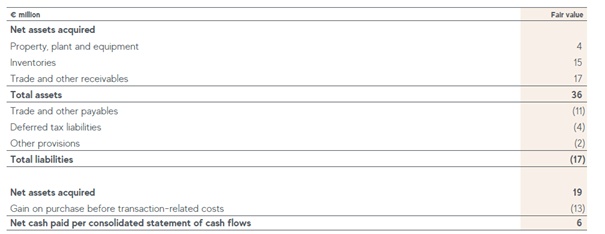
Transaction costs of €4 million were charged to other net operating expenses in the consolidated income statement.
The acquisition is a purchase of assets that constitutes a business accounted for under IFRS 3, ‘Business Combinations’. The purchase price allocation resulted in a net gain on purchase of €9 million, net of transaction-related costs, as the fair value of net assets acquired was in excess of the consideration paid. The gain on purchase is attributable to the mill’s loss-making operations at the time of the transaction and the need for investment to improve productivity and sustainability performance. The gain was recognised in other net operating expenses in the consolidated income statement.
The fair values of assets acquired and liabilities assumed in business combinations are level 3 measures in terms of the fair value measurement hierarchy. Property, plant and equipment has been measured at fair value using relevant valuation methods accepted under IFRS 13, ‘Fair Value Measurement’, with related deferred tax adjustments. Management has considered the impact of environmental and climate risks on the estimated fair values of Hinton’s property, plant and equipment. These considerations did not have a material impact.
Assets and liabilities that are measured at fair value, or where the fair value of financial instruments has been disclosed in notes to the consolidated financial statements, are based on the following fair value measurement hierarchy:
- Level 1 – quoted prices (unadjusted) in active markets for identical assets or liabilities
- Level 2 – inputs other than quoted prices included within level 1 that are observable for the asset or liability, either directly (that is, as prices) or indirectly (that is, derived from prices)
- Level 3 – inputs for the asset or liability that are not based on observable market data (that is, unobservable inputs) and certain assets acquired and liabilities assumed in a business combination (see note 26).
The fair values of financial instruments that are not traded in an active market (for example, over-the-counter derivatives) require a degree of estimation and judgement and are determined using generally accepted valuation techniques. These valuation techniques maximise the use of observable market data and rely as little as possible on Group-specific estimates.
Specific valuation methodologies used to value financial instruments include the following:
- The fair values of foreign exchange contracts are calculated as the present value of expected future cash flows based on observable yield curves and exchange rates.
- The fair values of the Group’s commodity price derivatives are calculated as the present value of expected future cash flows based on observable market data.
- Other techniques, including discounted cash flow analysis, are used to determine the fair values of other financial instruments.
The Group’s trading and financing activities expose it to various financial risks that, if left unmanaged, could adversely impact current or future earnings. Although not necessarily mutually exclusive, these financial risks are categorised separately according to their different generic risk characteristics and include market risk (foreign exchange risk and interest rate risk), credit risk and liquidity risk. The Group manages all of these financial risks in order to minimise their potential adverse impact on the Group’s financial performance.
The principles, practices and procedures governing the Group-wide financial risk management process have been approved by the Board and are overseen by the Executive Committee. In turn, the Executive Committee delegates authority to a central Treasury function (Group Treasury) for the practical implementation of the financial risk management process across the Group and for ensuring that the Group’s entities adhere to specified financial risk management policies. Group Treasury continually reassesses and reports on the financial risk environment, identifying, evaluating and hedging financial risks by entering into derivative contracts with counterparties where appropriate. The Group does not take speculative positions on derivative contracts.
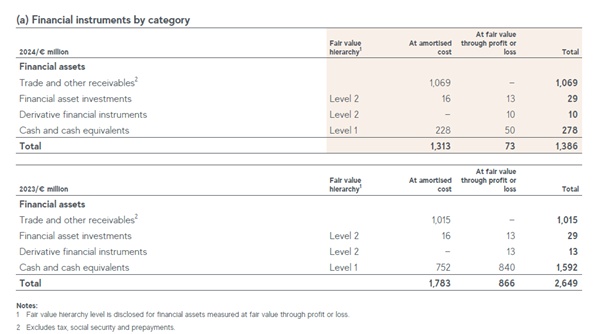
The fair values of financial assets investments represent the published prices of the securities concerned.
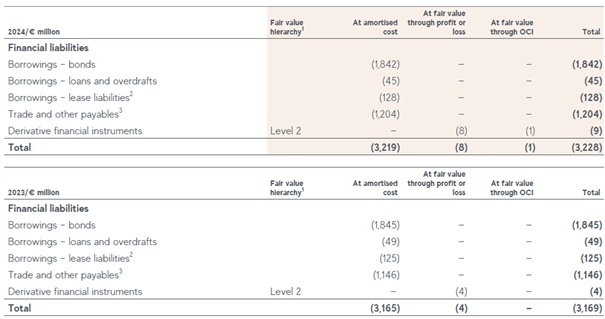
Notes:
1 Fair value hierarchy level is disclosed for financial liabilities measured at fair value through profit or loss.
2 Lease liabilities are financial instruments outside of scope of IFRS 9, ‘Financial Instruments’, and are accounted for under IFRS 16, ‘Leases’ (see note 35).
3 Excludes tax, social security and deferred income.
(b) Fair value measurement
There have been no transfers of assets or liabilities between levels of the fair value hierarchy during the year.
Except as detailed below, the carrying values of financial instruments at amortised cost as presented in the consolidated financial statements approximate their fair values.

Material accounting policies
Critical accounting judgements and significant accounting estimates
The preparation of the financial statements of Mondi plc includes the use of estimates and assumptions. Although the estimates used are based on management’s best information about current circumstances and future events and action
Governance and internal control
Behind every fair-value number stands a governance process. IFRS 13 implicitly assumes robust internal control over financial reporting. Entities typically maintain valuation policies approved by the board or audit committee. Common control activities include:
IFRS 13 Significant Judgments and Estimates IFRS 13 Significant Judgments and Estimates IFRS 13 Significant Judgments and Estimates IFRS 13 Significant Judgments and Estimates IFRS 13 Significant Judgments and Estimates IFRS 13 Significant Judgments and Estimates IFRS 13 Significant Judgments and Estimates IFRS 13 Significant Judgments and Estimates IFRS 13 Significant Judgments and Estimates IFRS 13 Significant Judgments and Estimates IFRS 13 Significant Judgments and Estimates IFRS 13 Significant Judgments and Estimates IFRS 13 Significant Judgments and Estimates IFRS 13 Significant Judgments and Estimates IFRS 13 Significant Judgments and Estimates IFRS 13 Significant Judgments and Estimates IFRS 13 Significant Judgments and Estimates
- Model validation by independent risk or finance teams;
- Periodic back-testing against market outcomes;
- Documented approval of key assumptions;
- Segregation between trading desks and valuation units;
- Independent price verification for Level 2 instruments.
Link with IAS 1 and IFRS 18
IAS 1 §122–133 (and IFRS 18 §115–119 once effective) form the backbone of disclosure on judgments and estimates. For IFRS 13 measurements this means:
- Explaining how management determined that market data were observable;
- Describing why certain inputs or markets were chosen;
- Quantifying how sensitive the valuation is to those assumptions;
- Identifying which judgments could change materially within the next reporting year.
IFRS 18 encourages integrated disclosure—linking valuation inputs with related performance measures or risk factors instead of isolating them in a technical note. Cross-referencing also prevents duplication. Many entities provide a table of Level 3 sensitivities in the IFRS 13 note and cross-refer to “Key sources of estimation uncertainty” under IAS 1 §125, ensuring consistent language.
IFRS 13 Significant Judgments and Estimates IFRS 13 Significant Judgments and Estimates IFRS 13 Significant Judgments and Estimates IFRS 13 Significant Judgments and Estimates IFRS 13 Significant Judgments and Estimates IFRS 13 Significant Judgments and Estimates IFRS 13 Significant Judgments and Estimates IFRS 13 Significant Judgments and Estimates IFRS 13 Significant Judgments and Estimates IFRS 13 Significant Judgments and Estimates IFRS 13 Significant Judgments and Estimates IFRS 13 Significant Judgments and Estimates IFRS 13 Significant Judgments and Estimates IFRS 13 Significant Judgments and Estimates IFRS 13 Significant Judgments and Estimates IFRS 13 Significant Judgments and Estimates IFRS 13 Significant Judgments and Estimates
Where governance meets communication
The audit committee’s oversight role bridges the technical and the communicative sides of IFRS 13. Committees ensure that fair-value assumptions reflect market evidence and that disclosure reflects reality, not optimism. Transparent discussion of valuation sensitivities—especially in private-equity or infrastructure funds—strengthens stakeholder confidence. Inconsistent or opaque language erodes it quickly.
Emerging issues
Fair value is evolving with markets. Three developments are shaping future IFRS 13 practice:
- Data automation and AI. Machine-learning tools now gather and calibrate Level 2 data in real time. While efficiency increases, IFRS 13 still requires human oversight—management remains responsible for ensuring inputs are observable, relevant, and unbiased.
- ESG and carbon pricing. The rise of emissions-trading schemes introduces new fair-value classes. Valuation of carbon credits or environmental liabilities applies IFRS 13 principles but relies on immature markets, increasing judgment intensity. Entities must disclose how they assess market depth and volatility.
- Sustainability-related fair value. Integration with CSRD and ESRS frameworks may extend the fair-value concept to non-financial capitals—natural, social, or human. IFRS 13’s hierarchy and disclosure logic provide a ready template for those emerging valuations.
- Market stress and disorderly trades. Episodes of illiquidity—pandemic, war, rapid rate hikes—test the boundary between fair value and forced sale. The lesson: document, disclose, and avoid mechanical mark-to-market when markets cease to function.
In all these trends, the constant principle remains that management must measure what a knowledgeable, willing market participant would pay or receive. Judgment is inevitable; transparency is optional—but required by IFRS 13.
FAQs – Significant Judgments and Estimates
Q1. What constitutes a “significant unobservable input” under IFRS 13, and when is a valuation considered Level 3?
A significant unobservable input is an input to a valuation technique for which observable market data is not available and must be developed by the entity (e.g. projected cash flow growth rate, discount rates for niche assets). When such inputs have a material effect on the fair value measurement, the valuation is classified as Level 3 per IFRS 13.72–90.
Q2. How should transfers into or out of Level 3 be treated in disclosures?
Transfers between levels must be disclosed (IFRS 13.97). The entity should explain the reasons for transfers (e.g. increased market activity, new data becoming available), and the amounts transferred.
E.g., “During the year, fair value measurements of Investment X were transferred from Level 3 to Level 2 due to emergence of observable market quotes.”
Q3. What sensitivity disclosures are required for Level 3 measurements?
For recurring Level 3 fair values, the entity must provide a narrative sensitivity description and a quantitative sensitivity analysis showing how fair value would change if the unobservable inputs were modified in a reasonably possible way.
Q4. When is it reasonable to use proxy or comparable market data in valuation?
When identical market data is unavailable, entities may use analogous or proxy data (e.g. comparable transactions) and adjust them to reflect the subject asset’s characteristics.
The adjustments must be justifiable, documented, and reflect what market participants would do. The use of proxies is more defensible when supplemented by cross-checks and sensitivity analysis.
Q5. Does IFRS 13 require sensitivity disclosures for Level 1 and Level 2 measurements?
No. The sensitivity disclosure requirement (narrative + quantitative) specifically applies to Level 3 measurements using significant unobservable inputs.
For Level 1/2 measurements, the assumption is that observable inputs dominate, so such sensitivity disclosures are not required under IFRS 13.
Q6. How do we ensure comparability and consistency of fair value judgments over time?
Preparers should:
– Use consistent valuation techniques and input selection across periods unless changes are justified
– Disclose reasons for changes in assumptions or methods
– Benchmark assumptions to observable data or external evidence
– Document governance, reviews, and validation activities
– Provide clear sensitivity disclosures so users can see how changes in assumptions would affect value