1. Why Höfner Matters as a Corporate Governance Case
Höfner corporate governance – At first glance, the bankruptcy of Höfner appears to be a cultural tragedy rather than a governance case. A historic German instrument maker, founded in the nineteenth century, globally admired, emotionally intertwined with the story of The Beatles—and suddenly insolvent. The reflex explanation is tempting: geopolitics, trade wars, bad luck. Yet that explanation is insufficient. What failed at Höfner was not craftsmanship, reputation, or relevance. What failed was governance.
Höfner is not an isolated story. It represents a broader and recurring governance pattern: organisations that accumulate symbolic capital faster than institutional resilience. Boards and owners often assume that strong brands, loyal customers, and cultural affection provide implicit protection against structural risk. In reality, those very qualities can mask fragility. Heritage becomes a comfort blanket. Reputation becomes a substitute for strategy.
From a corporate governance perspective, Höfner is therefore not a story about guitars. It is a case about how historical success, emotional value, and global fame can delay the professionalisation of governance structures—until an external shock exposes the absence of strategic depth. The bankruptcy did not begin with tariffs. The tariffs merely revealed what governance had not prepared for.
This article deliberately reframes Höfner’s collapse away from celebrity nostalgia and towards boardroom accountability. The key question is not why did Höfner fail? but why was a company with such extraordinary intangible assets structurally unprepared for foreseeable risk?
2. Origins and Organisational DNA (1887–1960): Craft Before Control
Höfner was founded in 1887 by Karl Höfner as a violin maker. The company emerged from a Central European tradition in which craftsmanship was not merely a production method but an identity. Knowledge was tacit, transferred through apprenticeship rather than documentation. Authority was personal, not institutional. Quality control was embedded in pride, not policy.
From a governance standpoint, this early structure was entirely logical. The organisation was small, local, owner-managed, and vertically integrated. Strategy and execution were indistinguishable. Oversight was direct. Risk was experiential. There was no separation between ownership, management, and control because none was needed.
This governance model works exceptionally well—within a stable environment. It produces excellence, consistency, and deep product integrity. But it also creates a blind spot: the belief that what has worked historically will continue to work indefinitely. Formal governance structures are often perceived as bureaucratic intrusions rather than protective mechanisms.
Crucially, Höfner’s early DNA was never designed for scalability. It was designed for perfection. The organisation did not grow up expecting global volatility, currency exposure, geopolitical interference, or regulatory fragmentation. Governance remained implicit, personal, and trust-based. That choice, rational at inception, would later become a constraint.
3. The McCartney Moment: Accidental Globalisation Without Governance
Höfner’s transformation from respected German instrument maker to global icon did not result from strategic expansion. It resulted from coincidence. In the early 1960s, a young Paul McCartney purchased a Höfner 500/1 violin bass in Hamburg. As The Beatles rose from obscurity to global phenomenon, the instrument followed. The “Beatle Bass” became one of the most recognisable instruments in popular music history.
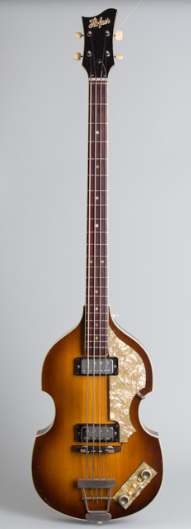
From a governance perspective, this moment is pivotal. Höfner experienced instant globalisation without institutional preparation. There was no brand governance framework, no intellectual property strategy aligned with global exposure, no risk assessment of dependency on a single cultural narrative. The brand scaled, but the organisation did not.
This created a structural asymmetry. Höfner’s external perception evolved faster than its internal governance capabilities. The company became emotionally indispensable to popular culture while remaining operationally modest. The brand accrued value that was not captured in governance mechanisms, contractual structures, or strategic reserves.
In boardroom terms, Höfner acquired a dominant intangible asset without building the governance architecture to protect it. Dependency risk emerged silently: one product, one story, one association. The McCartney connection elevated the brand—but it also concentrated risk. Cultural capital replaced strategic diversification.
Read more on Paul McCartney.com: Paul on Höfner.
4. From Icon to Institution (1970–2000): The Professionalisation That Never Fully Happened
After the peak of Beatlemania, Höfner did not disappear. On the contrary, it retained an exceptional reputation among musicians. The product portfolio expanded to include electric guitars, violins, cellos, and double basses. The company survived decades of market change—an achievement in itself.
Yet survival should not be confused with governance maturity. While competitors professionalised—introducing supervisory boards, external capital, risk management frameworks, and international licensing strategies—Höfner largely remained an institution defined by heritage rather than governance evolution.
This period represents the most critical missed opportunity. The organisation had time, brand recognition, and credibility. What it lacked was a deliberate transition from craft organisation to governed enterprise. There is little evidence of a formalised supervisory structure with independent oversight. Strategic renewal appears incremental rather than systemic. Risk management remained operational, not strategic.
In governance terms, Höfner stayed emotionally large but institutionally small. The company behaved as if reputation itself constituted a buffer. Yet reputation, unlike capital, cannot absorb shocks. It amplifies disappointment when expectations are not met.
This is a familiar pattern in heritage organisations. Boards—where they exist—often see their role as custodians of tradition rather than architects of resilience. Governance becomes preservation-focused instead of future-oriented. The organisation becomes excellent at remembering, but poor at anticipating.
By the turn of the millennium, Höfner was globally admired, internationally exposed, and structurally under-governed. The company had crossed the threshold into global dependency without installing global governance. What followed was not an abrupt collapse, but a slow accumulation of unaddressed risk—until external forces applied pressure.
5. Global Reach Without Global Governance (2000–2020)
By the early twenty-first century, Höfner had become what many heritage companies aspire to be: a small organisation with a global footprint. Roughly two-thirds of its revenue was generated outside Germany, while the company itself remained modest in scale, with an annual turnover of approximately €6.5 million and a workforce of around 45 employees
. On paper, this looks like successful internationalisation. From a governance perspective, it is a high-risk configuration.
Global exposure magnifies complexity. It introduces currency risk, trade policy risk, logistics dependency, regulatory fragmentation, and demand volatility. Large multinationals mitigate these risks through layered governance systems: risk committees, scenario planning, diversified sourcing, hedging strategies, and board-level geopolitical awareness. Höfner, by contrast, carried global exposure on a governance structure that still resembled a regional craft business.
This mismatch is critical. Governance should scale with exposure, not with headcount. Yet many heritage companies implicitly scale governance with organisational size rather than risk profile. Höfner’s international sales success created a false sense of security: strong demand abroad was interpreted as validation of the existing model, rather than as a signal that governance needed to mature.
From an enterprise risk management perspective, the warning signs were visible. Revenue concentration in foreign markets without corresponding buffers makes an organisation structurally vulnerable. A single regulatory shift, tariff increase, or logistical disruption can have disproportionate effects. Without formalised risk appetite statements, escalation mechanisms, or contingency planning, such risks remain unmanaged until they materialise.
In essence, Höfner operated globally while thinking locally. The organisation crossed borders, but its governance framework did not.
6. The Tariff Shock: Trigger, Not Root Cause
When international trade tensions intensified and tariffs increased—particularly under the Trump administration—Höfner’s sales were hit hard. The public narrative quickly settled on geopolitics as the culprit. Tariffs were framed as the decisive cause of bankruptcy. This explanation is emotionally satisfying, politically resonant, and strategically misleading.
From a governance standpoint, tariffs are not a root cause. They are a stress test.
Well-governed organisations assume that external shocks will occur. They may not predict their exact form or timing, but they recognise volatility as a constant. Trade policy is inherently political and cyclical. A company with two-thirds of its revenue abroad should, at board level, have discussed adverse trade scenarios long before they materialised.
The real governance failure lies in the absence of shock absorbers. There appears to have been no meaningful diversification of revenue streams, no structural flexibility to reallocate markets, and no financial buffer to withstand temporary downturns. The organisation was optimised for continuity, not resilience.
A useful metaphor here is that of a high tide. When the tide rises, it does not create naked swimmers—it reveals them. The tariffs did not weaken Höfner’s governance; they exposed that it had never been reinforced.
Blaming geopolitics after the fact is a common governance reflex. It shifts responsibility outward and reframes structural fragility as external injustice. Yet boards are not judged by how well they predict crises, but by how well they prepare for uncertainty. In that sense, the tariff shock merely accelerated an outcome that governance had left inevitable.
7. Stakeholders Without Structural Protection
One of the most sobering aspects of the Höfner bankruptcy is its human dimension. Approximately 45 employees faced the prospect of losing their jobs, with short-term wage protection temporarily provided by German public institutions.
This intervention softened the immediate impact, but it also raises a deeper governance question: where was stakeholder contingency planning?
Heritage companies often cultivate strong internal loyalty. Long tenure, craftsmanship pride, and emotional attachment are common. Yet loyalty is not a substitute for structural safeguards. Employees become stakeholders not only through culture, but through governance choices that recognise their exposure to organisational risk.
In well-developed governance systems, stakeholder impact is not an afterthought. Workforce continuity plans, social risk assessments, and transition governance are increasingly seen as board-level responsibilities. The absence of such mechanisms suggests that stakeholder risk was either underestimated or assumed to be externally absorbable.
This is a subtle but important point. When organisations rely implicitly on the state, society, or goodwill to absorb downside consequences, governance discipline weakens. The presence of public wage guarantees does not absolve boards from anticipating organisational distress. On the contrary, it underscores the social cost of governance failure.
Höfner’s collapse illustrates a recurring governance paradox: organisations that see themselves as cultural institutions often neglect the institutional mechanisms that protect the very people who sustain that culture. Emotional value without structural responsibility ultimately shifts risk to those least able to bear it.
By the time Höfner entered insolvency proceedings, the outcome felt sudden to the public but predictable from a governance perspective. Global exposure, concentrated dependencies, and insufficient institutionalisation had converged. The remaining questions now move beyond diagnosis.
8. The Paul McCartney Question: Celebrity, Ownership, and Governance Illusions
As news of Höfner’s bankruptcy spread, a predictable public question emerged: why does Paul McCartney not step in and save the company? With a personal fortune vastly exceeding Höfner’s annual revenue, the suggestion appears almost self-evident. Yet from a governance perspective, this question reveals a profound misunderstanding of what corporate sustainability requires.
Celebrity patronage is not governance. Emotional attachment, however genuine, does not replace institutional discipline. In fact, it can undermine it. Ownership by a cultural icon risks reinforcing precisely the dependency that weakened the organisation in the first place. The brand would become even more closely tied to a single narrative, further concentrating risk rather than diversifying it.
Governance demands distance. Effective boards are designed to introduce constructive friction, independent judgement, and long-term accountability. A celebrity saviour model tends to bypass these mechanisms. Decisions become symbolic rather than strategic. Oversight becomes personal rather than procedural.
There is also a moral hazard dimension. If organisations expect to be rescued because of their cultural importance, governance incentives weaken. Difficult decisions are postponed, structural reforms delayed, and responsibility externalised. From a governance standpoint, the question is therefore not who could save Höfner, but what governance model would prevent the need for saving in the first place.
Read more on Rolling Stone UK: Commiserations to everyone at Höfner, and thank you for all your help over the years.
9. What Governance Could Have Looked Like: A Counterfactual Analysis
Looking back, Höfner’s trajectory was not inevitable. Alternative governance choices were available at multiple points in time. A counterfactual analysis helps clarify what was missing.
A professional supervisory board with independent members could have reframed strategic discussions away from preservation alone and toward resilience. Explicit risk appetite statements would have made trade dependency visible and discussable. Scenario planning could have stress-tested the business model against adverse geopolitical developments long before tariffs became reality.
Brand governance, in particular, stands out as an underdeveloped capability. Höfner possessed a globally recognised intangible asset without a formal strategy to monetise, protect, or decouple it from operational fragility. Licensing, limited editions, or structured partnerships might have transformed cultural capital into financial buffers.
Crucially, none of these measures would have undermined craftsmanship. Governance does not erode identity; it shields it. The absence of governance did not preserve Höfner’s soul—it exposed it to forces it could not withstand.
10. Future Scenarios: What Is Still Possible?
Despite insolvency, Höfner’s story is not necessarily over. Several future-oriented governance scenarios remain plausible, each with distinct implications.

One scenario involves a strategic restart. New capital, combined with a professionalised governance structure, could refocus the company on a high-end niche, deliberately limiting scale while strengthening margins and resilience. In this model, governance maturity compensates for organisational smallness.
Another possibility is a foundation or trust-based structure, positioning Höfner as a protected cultural asset rather than a growth-oriented enterprise. Governance would emphasise stewardship, continuity, and social value, with financial sustainability subordinated to preservation within defined boundaries.
A third scenario separates brand from manufacturing. Intellectual property and brand stewardship could be governed independently from production, reducing operational risk while safeguarding cultural value. This model requires sophisticated governance to manage interfaces and incentives.
Finally, there is the scenario of an orderly exit. Even decline can be governed responsibly. Preserving value, protecting employees where possible, and managing legacy with integrity are themselves governance choices. Failure without governance is chaos; failure with governance is closure.
11. Lessons for Boards and Supervisory Bodies
Höfner’s collapse offers lessons that extend far beyond the music industry. Boards overseeing family businesses, founder-led organisations, cultural institutions, and SMEs with international exposure should take note.
First, heritage is not a buffer—it is a risk factor if left unmanaged. The stronger the emotional attachment to the past, the greater the need for forward-looking governance.
Second, governance must scale with exposure, not size. A small organisation with global reach faces risks comparable to much larger entities and requires governance sophistication accordingly.
Third, external shocks are not excuses. They are tests. Organisations that fail such tests rarely do so because the shock was unforeseeable, but because preparation was insufficient.
Finally, governance is not about control alone. It is about stewardship—of people, culture, reputation, and future viability. When governance fails, the costs are not abstract. They are borne by employees, communities, and society.
Read more in our blogs on: Good Corporate Governance – Foundations of Trust and Accountability and the COSO Internal Control Framework: Lessons from Global Corporate Failures.
Höfner corporate governance heritage brand governance cultural capital corporate governance governance failure SMEs brand risk and board oversight
Höfner corporate governance Höfner corporate governance Höfner corporate governance Höfner corporate governance Höfner corporate governance Höfner corporate governance Höfner corporate governance Höfner corporate governance Höfner corporate governance Höfner corporate governance Höfner corporate governance Höfner corporate governance Höfner corporate governance Höfner corporate governance Höfner corporate governance Höfner corporate governance
12. Closing Reflection: Governance as the Silent Instrument
Höfner mastered the art of sound. Its instruments shaped the soundtrack of a generation. Yet sound alone does not sustain an organisation. Governance is the silent instrument—rarely noticed when it works, painfully audible when it fails.
Without tuning, even the finest violin drifts out of pitch. Without governance, even the most iconic brand loses coherence. Höfner’s story reminds us that excellence in craft must be matched by excellence in oversight.
Corporate governance does not create music. But without it, eventually, the music stops.
FAQ’s – Höfner, how a Heritage Brand Lost Its Resilience
Höfner corporate governance Höfner corporate governance Höfner corporate governance Höfner corporate governance Höfner corporate governance Höfner corporate governance Höfner corporate governance Höfner corporate governance Höfner corporate governance Höfner corporate governance Höfner corporate governance Höfner corporate governance Höfner corporate governance Höfner corporate governance Höfner corporate governance Höfner corporate governance
FAQ 1 — Why is Höfner a corporate governance case rather than a cultural story?

Höfner is often framed as a cultural tragedy because of its association with Paul McCartney and The Beatles. However, from a governance perspective, its bankruptcy is best understood as a structural failure rather than an emotional one. The company retained exceptional craftsmanship, brand recognition, and cultural relevance, yet lacked the institutional governance mechanisms required to manage global exposure and strategic risk.
Corporate governance exists precisely to protect organisations when tradition, reputation, or informal control are no longer sufficient. Höfner’s case illustrates what happens when symbolic capital grows faster than governance maturity. The collapse was not caused by declining relevance but by insufficient preparation for volatility. That makes Höfner a governance case with broad relevance for boards overseeing heritage brands, SMEs, and founder-led organisations.
FAQ 2 — Were the Trump-era tariffs really the cause of Höfner’s bankruptcy?

No. The tariffs were a trigger, not the root cause. Trade policy volatility is a foreseeable risk for any company generating a substantial share of revenue abroad. Well-governed organisations anticipate such uncertainty through diversification, buffers, and scenario planning.
In Höfner’s case, tariffs exposed an absence of shock absorbers. There was no evidence of sufficient financial resilience, market diversification, or strategic flexibility. Governance did not fail because it failed to predict tariffs; it failed because it did not prepare for uncertainty. This distinction is essential for boards seeking to avoid repeating the same mistake.
FAQ 3 — What role does brand dependency play in governance failure?

Brand dependency becomes a governance risk when it is unmanaged. Höfner’s identity became heavily concentrated around one iconic product and one cultural narrative. While this strengthened recognition, it increased vulnerability. When demand or access to markets faltered, there were limited alternative revenue streams.
Governance should make dependency visible and discussable at board level. Without explicit oversight, emotional attachment to a brand can crowd out strategic realism. Strong brands require stronger governance, not weaker.
FAQ 4 — Why is celebrity ownership not a governance solution?

Celebrity ownership introduces emotional capital but rarely institutional discipline. While public perception may improve temporarily, governance risks increase when decisions become symbolic or personal. Oversight weakens, accountability blurs, and dependency intensifies.
Corporate governance relies on independence, distance, and structured challenge. A celebrity saviour model risks undermining these principles. Sustainable recovery requires governance reform, not patronage.
FAQ 5 — Could Höfner have professionalised governance without losing its soul?

Yes. Governance and craftsmanship are not opposites. In fact, governance exists to protect what makes an organisation distinctive. Professional supervisory boards, risk frameworks, and brand strategies do not dilute identity—they ensure it survives external shocks.
The false dilemma between authenticity and governance is one of the most persistent myths in heritage organisations. Höfner’s case shows that the absence of governance is far more threatening to cultural identity than its presence.
FAQ 6 — What should boards of SMEs and family businesses learn from Höfner?

Boards should understand that governance complexity follows risk exposure, not organisational size. Small companies operating internationally face risks comparable to much larger firms. Informal governance works only within stable environments.
The key lesson is proactive institutionalisation. Governance must evolve before crises occur, not after. Höfner demonstrates the cost of waiting too long.