Good Corporate Governance: Governance as the Nervous System of Business
hide
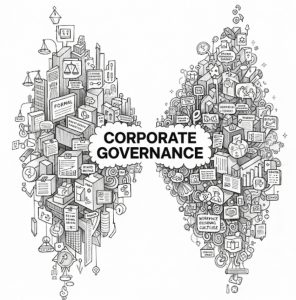
In every advanced economy, trust is the lifeblood of business. Without it, financial markets falter, employees disengage, and society questions the license to operate of entire industries. Good corporate governance is the nervous system of the corporation: transmitting signals of accountability, transparency, and ethical behavior throughout the organizational body.
Although the language of governance is universal, its application varies by jurisdiction. In the United States, the governance model is rules-based, heavily shaped by law, litigation, and regulatory enforcement. In the United Kingdom, governance is principle-based, relying on the flexible but demanding doctrine of “comply or explain.” On the European continent, stakeholder governance has long coexisted with shareholder primacy, while Asia and emerging markets bring their own cultural dimensions.
The purpose of this cornerstone is to explore the foundations of good corporate governance across the Anglo-American world and beyond, highlighting pillars, practices, and pitfalls. By weaving together lessons from landmark reforms and infamous scandals – from Enron to Wirecard, from Carillion to Toshiba – we can draw insights into what makes governance truly effective in the 21st century.
Also read Corporate Failures as Governance Lessons: From Enron to Carillion.
The Four Pillars of Good Governance
Though national codes differ, most converge on four universal pillars:
-
Accountability – management must be held accountable to the board, and the board to shareholders and society.
-
Transparency – financial and non-financial information must be reliable, consistent, and accessible.
-
Responsibility – companies must comply with laws and act ethically towards stakeholders.
-
Fairness – decision-making should balance the interests of shareholders, employees, creditors, and the broader community.
When these principles erode, cracks appear – often visible only after disaster strikes.
Also read Shareholder Activism and the Role of Institutional Investors.
United States: Rule-Based Governance and the Power of Law
The U.S. is the world’s most rule-driven governance system. Its foundations lie in:
-
Delaware corporate law, which emphasizes fiduciary duties of care and loyalty, often interpreted through shareholder primacy.
-
Securities regulation enforced by the SEC, ensuring disclosure and investor protection.
-
The Sarbanes-Oxley Act (SOX) of 2002, born from the ashes of Enron and WorldCom.
-
NYSE and Nasdaq listing rules, mandating audit committees, independence standards, and whistleblower procedures.
SOX reshaped corporate America. Section 302 made CEOs and CFOs personally certify financial statements. Section 404 introduced the rigorous assessment of internal control over financial reporting. For many companies, this was a shock: compliance costs soared, but investor trust was gradually restored.
Yet the rule-based approach has limits. The 2008 collapse of Lehman Brothers revealed that legal compliance is no substitute for prudent risk management. Similarly, Wells Fargo’s fake-accounts scandal (2016) showed how toxic incentives can thrive despite formal controls. In the U.S., governance can become a game of box-ticking – effective only when coupled with board courage and cultural vigilance.
Read more on the website of the Sarabnes-Oxley Compliance Professionals Associations (SOXCPA), and our blog Sarbanes-Oxley and the U.S. Approach to Internal Control.
United Kingdom: Principle-Based Governance and “Comply or Explain”
Across the Atlantic, the UK model reflects a principle-based ethos. Since the Cadbury Report (1992), Britain has favored flexibility over rigidity. The UK Corporate Governance Code (2024) requires:
-
A clear separation of CEO and chair.
-
At least half of the board composed of independent non-executive directors.
-
Robust audit, remuneration, and nomination committees.
-
Meaningful dialogue with shareholders.
Crucially, companies may depart from these provisions, but must explain why. This system respects diversity of practice but places heavy responsibility on shareholders to scrutinize explanations.
The model has been widely admired, yet not without failures. Carillion’s collapse in 2018 exposed weaknesses in non-executive oversight and shareholder passivity. Despite red flags in debt levels and contract accounting, the board failed to challenge management effectively. The “comply or explain” model works only when both boards and investors embrace their roles seriously.
Read more in the UK Corporate Governance Code the Financial Reporting Council and our blog The UK Corporate Governance Code – Comply or Explain in Practice.
Continental Europe: Stakeholders and Supervisory Boards
On the European continent, governance often reflects a stakeholder orientation. German companies operate under a two-tier board system: a management board (Vorstand) and a supervisory board (Aufsichtsrat), which includes employee representatives. This model emphasizes long-term stability and social partnership.
Yet scandals reveal vulnerabilities. Wirecard’s collapse in 2020, despite being a DAX-listed tech darling, showed that supervisory boards can fail just as spectacularly as unitary boards. Weak audit quality and regulatory blind spots allowed a €1.9 billion fraud to persist for years. The lesson: structure alone cannot guarantee substance.
Italy’s Parmalat scandal (2003) and South Africa’s Steinhoff collapse (2017) further illustrate that without strong enforcement and a culture of challenge, governance codes remain paper tigers.
Read more on Cambridge University Press – Shareholder engagement at European general meetings and Board Dynamics: Non-Executive vs. Independent Directors.
Asia: Tradition Meets Modern Governance
In Asia, governance reforms have accelerated. Japan’s Corporate Governance Code (2015) promoted independent directors and cross-shareholding transparency. Yet cases like Toshiba’s accounting scandal (2015) demonstrate cultural resistance to whistleblowing and challenge.
In emerging markets, governance is complicated by family ownership, state influence, and weaker enforcement. Progress is visible – for instance, in Singapore’s proactive regulation – but consistency remains uneven.
Read more: Japan’s Corporate Governance Code.
The Role of Audit Committees and Internal Audit
Across jurisdictions, the audit committee has become the linchpin of board oversight. Its responsibilities – overseeing financial reporting, engaging external auditors, monitoring internal controls – are central to investor confidence.
But structure alone is insufficient. Enron had an audit committee. So did Wirecard. The difference lies in tone at the top, independence, and willingness to challenge. Similarly, internal audit functions can serve as early warning systems – but only if properly resourced and empowered.
Both in the U.S. and UK, shareholder activism has grown as a governance tool. Hedge funds like Elliott Management or Pershing Square push for board changes and strategic overhauls. Institutional investors such as BlackRock, Vanguard, and State Street increasingly focus on ESG commitments. Proxy advisors (ISS, Glass Lewis) shape voting outcomes.
While activism can improve accountability, it also risks short-termism. The challenge for boards is to balance legitimate shareholder pressure with sustainable strategy.
Culture, Ethics, and ESG – The Expanding Frontier
Governance today is inseparable from corporate culture. The Wells Fargo case showed how incentive systems can undermine ethics. Volkswagen’s “Dieselgate” scandal revealed the costs of a culture prioritizing performance at any price.
At the same time, ESG has become mainstream. Boards must oversee climate risks, human rights, and diversity. In Europe, the CSRD/ESRS framework pushes for standardized ESG disclosure. Globally, the ISSB standards (IFRS S1 and S2) are emerging as a baseline.
For governance professionals, the frontier is clear: sustainability is no longer optional – it is governance.
Also read further in Culture, Ethics and ESG: Expanding the Scope of Governance.
Digital Governance and Cybersecurity
A new dimension of governance is digital oversight. Boards face rising responsibilities for cybersecurity, AI ethics, and data privacy. The U.S. SEC’s 2023 cybersecurity disclosure rules and the EU’s NIS2 directive exemplify how regulators expect boards to integrate cyber risk into governance frameworks.
Boards that treat technology as “operational” rather than “strategic” expose themselves to existential risks. Cybersecurity is the new financial reporting – invisible until it fails, devastating when it does.
Global Convergence and Divergence
The world is moving toward convergence of standards, but differences remain:
-
The U.S. emphasizes rules, liability, and litigation.
-
The UK emphasizes principles, flexibility, and dialogue.
-
Europe emphasizes stakeholders and co-determination.
-
Asia is in transition, blending tradition with reform.
The emergence of global frameworks – ISSB, OECD Principles of Corporate Governance, G20 initiatives – suggests gradual harmonization. Yet culture, politics, and law ensure diversity will persist.
Read more – Introduction to the ISSB and IFRS Sustainability Disclosure Standards, G20/OECD – Principles of Corporate Governance 2023.
Conclusion: Governance as Global Infrastructure
Good corporate governance is not an abstract concept; it is the infrastructure of capitalism. Like electricity or clean water, it is invisible until it fails. When it works, capital flows, innovation flourishes, and trust endures. When it fails, as with Enron, Carillion, Wirecard, or Steinhoff, the costs are systemic and profound.
For boards, executives, and investors, the lesson is clear: governance is not the cost of doing business – it is the foundation of sustainable success. The nervous system must remain alert, responsive, and ethical, or the corporate body will collapse.
Governance is the invisible infrastructure of global business. Yet strong governance cannot exist without effective risk management and internal control. To understand how companies can truly embed accountability and resilience, we need to examine the mother of all risk management models: the COSO Internal Control – Integrated Framework.
Read more: COSO Internal Control Framework: Lessons from Global Corporate Failures.
Good Corporate Governance
Good Corporate Governance
Good Corporate Governance Good Corporate Governance Good Corporate Governance Good Corporate Governance Good Corporate Governance Good Corporate Governance Good Corporate Governance Good Corporate Governance