Last update 25/11/2019
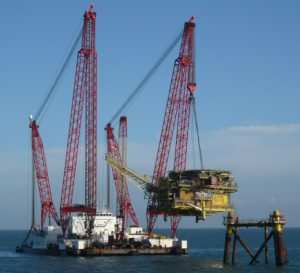
Fair Value of Decommissioning Obligation is about a nice example of decommissioning a large oil platform.
On 1 January 20X1 Entity A assumes a decommissioning (i.e., asset retirement) liability in a business combination. The entity is legally required to dismantle and remove an offshore oil platform at the end of its useful life, which is estimated to be 10 years. On the basis of IFRS 13, Entity A uses the expected present value technique to measure the fair value of the decommissioning liability. Entity A was contractually allowed to transfer its decommissioning liability to a market participant, and in this regard Entity A concludes that a market participant would use all the following inputs, probability-weighted as appropriate, when estimating the price it would expect to receive:
- Labor costs;
- Allocation of overhead costs;
- The compensation that a market participant would require for undertaking the activity and for assuming the risk associated with the obligation to dismantle and remove the asset. Such compensation includes both of the following:
- Profit on labor and overhead costs; and
- The risk that the actual cash outflows might differ from those expected, excluding inflation;
- The effect of inflation on estimated costs and profits;
- The time value of money, represented by the risk-free rate; and
- The non-performance risk relating to the risk that Entity A will not fulfill the obligation, including Entity A’s own credit risk.
The significant assumptions used by Entity A to measure fair value are as follows:
(a) Labor costs are developed on the basis of current marketplace wages, adjusted for expectations of future wage increases, required to hire contractors to dismantle and remove offshore oil platforms.
Entity A assigns probability assessments to a range of cash flow estimates as follows:
|
Cash flow estimate (€) |
Probability assessment |
Expected cash flow (€) |
|
100,000 |
25% |
25,000 |
|
125,000 |
50% |
62,500 |
|
175,000 |
25% |
43,750 |
|
131,250 |
||
The probability assessments are developed on the basis of Entity A’s experience with fulfilling obligations of this type and its knowledge of the market.
(b) Entity A estimates allocated overhead and equipment operating costs using the rate it applies to labor costs (80% of expected labor costs). This is consistent with the cost structure of market participants.
(c) Entity A estimates the compensation that a market participant would require for undertaking the activity and for assuming the risk associated with the obligation to dismantle and remove the asset as follows:
- A third-party contractor typically adds a mark-up on labor and allocated internal costs to provide a profit margin on the job. The profit margin used (20%) represents Entity A’s understanding of the operating profit that contractors in the industry generally earn to dismantle and remove offshore oil platforms. Entity A concludes that this rate is consistent with the rate that a market participant would require as compensation for undertaking the activity.
- A contractor would typically require compensation for the risk that the actual cash outflows might differ from those expected because of the uncertainty inherent in locking in today’s price for a project that will not occur for 10 years. Entity A estimates the amount of that premium to be 5 per cent of the expected cash flows, including the effect of inflation.
(d) Entity A assumes a rate of inflation of 4% over the 10-year period on the basis of available market data.
(e) The risk-free rate of interest for a 10-year maturity on 1 January 20X1 is 5%. Entity A adjusts that rate by 3.5% to reflect its risk of non-performance (i.e., the risk that it will not fulfill the obligation), including its credit risk. Therefore, the discount rate used to compute the present value of the cash flows is 8.5%. Entity A concludes that its assumptions would be used by market participants.
Fair Value of Decommissioning Obligation
In addition, Entity A does not adjust its fair value measurement for the existence of a restriction preventing it from transferring the liability. As illustrated in the following table, Entity A measures the fair value of its decommissioning liability as €194,879.
|
Expected cash flows |
(€) 1 January 20X1 |
|
Expected labor costs Fair Value of Decommissioning Obligation |
131,250 |
|
Allocated overhead and operating equipment costs (0.80 x €131,250 =) |
105,000 |
|
Contractor’s profit mark-up [0.20 x (€131,250 + €105,000) =] Fair Value of Decommissioning Obligation |
47,250 |
|
Expected cash flows before inflation adjustment |
283,500 |
|
Inflation factor (4% for 10 years) Fair Value of Decommissioning Obligation |
X 1.4802 |
|
Expected cash flows adjusted for inflation |
419,638 |
|
Market risk premium (0.05 x €419,637 =) Fair Value of Decommissioning Obligation |
20,982 |
|
Expected cash flows adjusted for market risk |
440,619 |
|
Expected present value using discount rate of 8.5% for 10 years |
194,879 |
See also: The IFRS Foundation