Last update 11/12/2019
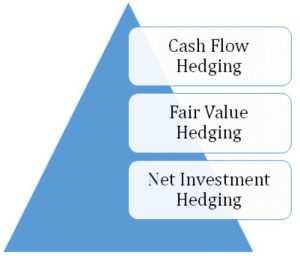
 The fair value hedge is one of three hedges defined in IFRS 9, the others are the cash flow hedge and the hedge of a net investment.
Hedge accounting can bring a number of advantages over traditional accounting methods. The core benefit is that by addressing the timings mismatch associated with standard derivative accounting, hedge accounting removes temporary volatility from the P&L. As a result, the financial statements will better reflect the company’s true economic performance.
Reducing the volatility in earnings results in a number of additional benefits: Fair Value Hedge
- Enterprise value. Earnings volatility is negatively perceived by investors. Fair Value Hedge
- Creditworthiness. Predictability in future earnings is a positive factor in creditworthiness.
- Risk management. Statements reflect better and more accurately how FX-risk is managed.
- Executive compensation. Compensation tied to performance, for example measured based on quarterly earnings, can incur unintended impacts from earnings volatility.
But it can also go very wrong, see this article from Reuters: Dutch housing coop Vestia seeks damages from Deutsche Bank for derivatives
Definition – Fair Value Hedge
The fair value hedge is the hedge of exposure to fair value variability in an asset, liability, or unrecognised firm commitment (or part thereof i.e. a component), attributable to a risk that could affect profit or loss. The risks involve interest rate or exchange rate changes. For example, if your company owns a large stock portfolio, you could buy put options on the stocks in the portfolio. And, the value of these options would increase if the stock’s price were to fall, reducing or even eliminating your potential losses. Fair Value Hedge
Recognition Fair Value Hedge Fair Value Hedge Fair Value Hedge Fair Value Hedge Fair Value Hedge
- Gain or loss on hedging instrument: recognised in profit or loss (unless the hedging instrument is an equity instrument measured at fair value through OCI, then recognised in OCI).
- Gain or loss on hedged item: recognised in profit or loss (unless the hedged item is an equity instrument measured at fair value through OCI, then recognised in OCI
Example and journal entries
Tepeco, Inc. is a company engaged in commodities trading. The company recently obtained $5 million short-term borrowing which is secured by the company’s inventory of 1,000 tons of copper which it purchased at a cost of $5.2 million. The bank has obligated Tepeco, Inc. to provide additional collateral in event the value of copper inventories fall below $5 million. On 1 January 2015, Tepeco, Inc. sold the inventories forward by entering into a 12-month futures contract at price of $5,200 per ton.
On 30 June 2015, i.e. the financial year end of Tepeco, Inc., price of copper fell to $4,900 per ton.
Identify the hedged instrument and the hedging instrument and journalize the transactions.
The accounting
Hedged instrument is the instrument whose fair value is shielded using the hedging strategy. In this case, it is the copper inventory held by Tepeco, Inc. Hedging instrument on the other hand is the derivative instrument which mitigates the fair value changes of hedged instrument by reversely mimicking its fair value movement. Fair Value Hedge
On 30 June 2015, the fair value of copper inventories held for trading shall be adjusted as follows:
|
Dr Profit or loss – fair value hedge loss |
$300,000 |
|
|
Cr Inventories ($5,200,000 – $4,900 x 1,000) |
#300,000 |
The loss on inventories shall be offset by corresponding gain on the forward transaction. Since the forward transaction entitles Tepeco, Inc. to sell copper at $5,200 per ton even though the market price is $4,900 per ton, it represents a $300 gain per ton, which translates into $300,000 gain on 1,000 tons. The fair value change of the hedging instrument is recognized as follows:
|
Dr Derivative (asset) |
$300,000 |
|
|
Cr Profit or loss – fair value hedge profit |
#300,000 |
There shall be zero effect on the net value of inventories on Tepeco, Inc. balance sheet even though copper price fell over the period by $300 per ton. The hedging strategy saves Tepeco, Inc. from furnishing additional security to the bank in wake of the fall in fair value.
See also: The IFRS Foundation

