EPS Calculation
Here is full example of an EPS Calculation. This narrative builds on the basic principles introduced in the narrative EPS, and sets out the specific basic and diluted EPS calculation rules as per IAS 33 Earnings per share.
Case
Company P earns a consolidated net profit of 4,600,000 during the year ended 31 December Year 1 and 5,600,000 during the year ended 31 December Year 2. The total number of ordinary shares outstanding on 1 January Year 1 is 3,000,000.
Various POSs are issued before 1 January Year 1 and during the years ended 31 December Year 1 and Year 2. During this period, the outstanding number of ordinary shares also changes.
The statement of changes in equity below summarises only the actual movements in the outstanding number of ordinary shares, followed by detailed information about such movements and POSs outstanding during the periods.

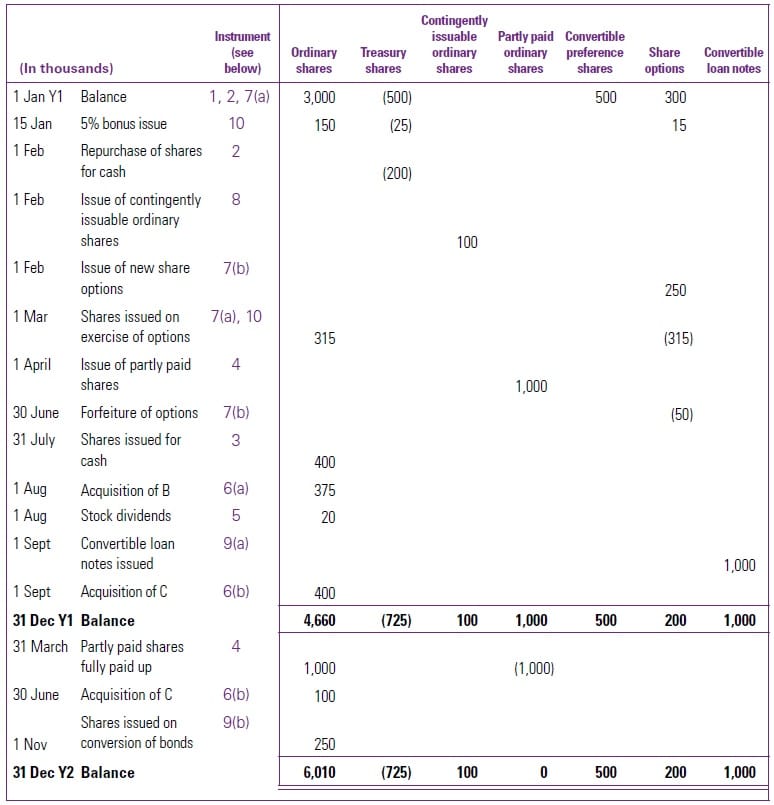
At 1 January Year 1, P has 500,000 outstanding convertible preference shares. Dividends on these shares are discretionary and non-cumulative. Each preference share is convertible into two ordinary shares at the holder’s option.
The preference shares are classified as equity in P’s financial statements.
On 15 October Year 1, a dividend of 1.20 per preference share is declared. The dividend is paid in cash on 15 December Year 1. Preference dividends are not tax-deductible.
No dividend is declared on these shares during the year ended 31 December Year 2.
Before 1 January Year 1, P reacquired and held in treasury 500,000 ordinary shares.
On 1 February Year 1, Subsidiary S acquires 200,000 shares in P.
On 31 July Year 1, P issues 400,000 ordinary shares for cash.
On 1 April Year 1, under a share subscription plan, P issues 1,000,000 new ordinary shares to an investor at a subscription price of 25 each.
The subscription price is paid up in accordance with the following schedule:
- 30 June Year 1: 50%
- 31 March Year 2: 50%.
Each partly paid ordinary share is entitled to dividends in proportion to the percentage of the subscription price paid up on the share.
5. Stock dividends
On 1 July Year 1, P declares an interim dividend. Shareholders can choose whether to receive cash, or ordinary shares to the value of the cash alternative. Some shareholders choose the share alternative.
On 1 August Year 1, the dividends are reinvested; and 20,000 ordinary shares are issued in connection with the share alternative.
a. Acquisition of Company B
On 1 May Year 1, P makes an offer to acquire all of the shares in Company B. In accordance with the relevant laws and regulations, each of the shareholders of B can decide whether to accept the offer, and P obtains the voting rights and all other rights associated with each share as each individual shareholder accepts the offer. Part of the consideration would be satisfied by new ordinary shares to be issued by P.
On 1 June Year 1, more than half of the shares in B are tendered for acceptance. Consequently, P acquires control over B and starts to consolidate B’s results from that date. The acquisition constitutes a business combination under IFRS 3 Business Combinations. In connection with these acceptances, 375,000 ordinary shares are issued by P on 1 August Year 1.
b. Acquisition of Company C
On 1 August Year 1, P acquires the entire equity interests of Company C. Consequently, P obtains control over C and starts to consolidate C’s results from that date. The acquisition constitutes a business combination under IFRS 3.
The consideration transferred in exchange for control over C includes the following ordinary shares issued/to be issued by P:
- 400,000 ordinary shares are issued on 1 September Year 1; and
- another 100,000 ordinary shares are to be issued on 30 June Year 2, but only if the net profit of C for the eight months ending 31 March Year 2 exceeds 700,000.
P accounts for the 100,000 ordinary shares that may be issued on the satisfaction of the net profit target as contingent consideration in connection with the acquisition of C. Because the contingent consideration would be settled in a fixed number of ordinary shares of P, it is accounted for as equity and is therefore not subsequently remeasured.
C’s net profits for the relevant periods are as follows:
- five months ended 31 December Year 1: 710,000
- eight months ended 31 March Year 2: 850,000.
a. Share options issued outside a share-based payment arrangement
Before Year 1, P writes certain call options over its ordinary shares to third party investors.
At 1 January Year 1, 300,000 of these options are outstanding. Each option entitles its holder to one of P’s ordinary shares with an exercise price of 15.
All of these options are exercised on 1 March Year 1.
b. Share options issued under a share-based payment arrangement
On 1 February Year 1, under an equity-settled share-based payment arrangement, P grants 25,000 share options to each of its 10 employees – i.e. 250,000 in total. Each grant is conditional on the employee working for P over the next three years.
The forfeiture details are as follows.
- At the grant date, P estimates that three of the employees will leave during the three-year period and will therefore forfeit their rights to the share options.
- On 30 June Year 1, two employees leave.
- At 31 December Year 1, P maintains its original estimate of forfeiture.
- No additional employees leave during Year 2 and P continues to estimate at 31 December Year 2 that 70% of the options will vest.
Additional information relating to the share option is as follows.
- Exercise price of each option: 18.
- Grant-date fair value of each option in accordance with IFRS 2 Share-based Payment: 3.7.
On 1 February Year 1, under another equity-settled share-based payment arrangement, P grants 100,000 shares to its CEO, conditional on the CEO remaining in P’s employment during the vesting period.
These shares will vest in Year 3 if:
- P’s basic EPS for Year 2 exceeds 1.4 per share; and
- P’s basic EPS for Year 3 exceeds the basic EPS for Year 2 by 10%.
9. Convertible instruments
a. Voluntarily convertible loan notes
On 1 September Year 1, P issues 1,000,000 convertible loan notes at their face value of 15,000,000. Interest is payable annually in arrears. In addition, they are convertible into a total of 500,000 ordinary shares at the discretion of the holder at any time before 31 August Year 3; if the holder’s conversion right is not exercised by 31 August Year 3, then the loan notes are to be repaid fully in cash on that date. The holder does not convert the notes during Year 1 and Year 2.
The total annual interest expense relating to the liability component of the convertible loan is 500,000 for Year 1 and 1,500,000 for Year 2. Interest is tax deductible.
b. Mandatory convertible bonds
On 1 October Year 1, P issues convertible bonds at their face value of 7,500,000.
These bonds are mandatory convertible into 250,000 ordinary shares on 1 November Year 2. The notes are classified as equity.
10. Bonus issues in Year 1 and Year 3
Bonus issue in Year 1: On 15 January Year 1, P makes a bonus issue of one ordinary share for every 20 shares held – i.e. 5%. As a result of the bonus issue, the terms of the following instruments that are outstanding at 15 January Year 1 are adjusted in accordance with the ‘anti-dilution’ provisions:
- convertible preference shares: The conversion ratio increases from 2 to 2.1; and
- share options: The number of options issued outside a share-based payment arrangement (instrument 7(a)) increases by 5% and the cash exercise price per share decreases by approximately 5% (being 100 / 105).
Bonus issue in Year 3: On 15 May Year 3, P makes a bonus issue of one ordinary share for every one share held – i.e. 100%. As a result of this additional bonus issue, the conversion terms of the following instruments that are outstanding at 15 May Year 3 are adjusted in accordance with the anti-dilution provisions in their terms:
- convertible preference shares: The conversion ratio increases from 2.1 to 4.2; and
- share options: The number of shares to be issued for each option under the share-based payment arrangement (instrument 7(b)) increases by 100% and the exercise price reduced by 50%.
The financial statements for the year ended 31 December Year 2 are authorised for issue on 1 May Year 3, before the bonus issue takes place.
11. Additional information
- P’s tax rate is 30%.
- The average market price of P’s shares during the following periods is:
- 1 January to 1 March Year 1: 25
- 1 April to 30 June Year 1: 27
- 1 February to 31 December Year 1: 33
- 1 April to 31 December Year 1: 35
- 1 January to 31 March Year 2: 35
- 1 January to 31 December Year 2: 38.
These average market prices for P’s shares already include an adjustment as a result of the bonus issue on 15 January Year 1.
Calculating basic EPS
Year 1
The basic EPS computations for Year 1 are as follows.
Step 1: Determine the numerator
In this example, there is no profit or loss from discontinued operations. Therefore, there is no need to split the basic EPS calculation into total operations and continuing operations.
The numerator is adjusted by the dividend paid on the preference shares that are classified in equity but that are not ordinary shares.

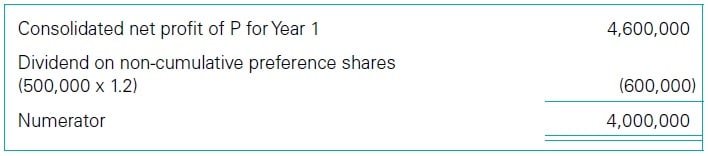
Accordingly, the numerator is 4,000,000.
Step 2: Determine the denominator
P calculates the denominator as follows.

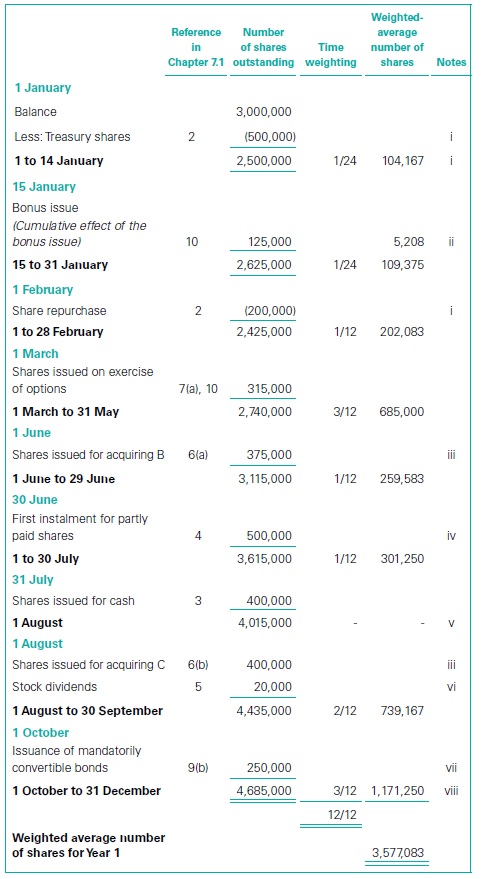
Notes
|
i |
Treasury shares: Treasury shares are not treated as outstanding ordinary shares and are deducted from the denominator. These include P’s shares held by P’s subsidiaries that are presented as treasury shares in P’s consolidated financial statements (see Treasury shares). |
|
ii |
Bonus issue: The bonus issue represents an increase in the number of shares outstanding without a corresponding change in resources and is retrospectively adjusted as if the bonus issue had occurred at the beginning of the earliest period presented. The adjustment is determined as follows: – weighted-average number of shares for the period before the bonus issue x adjustment factor = 104,167 x 5% = 5,208 |
|
iii |
Shares issued to acquire a business: When an entity issues ordinary shares as part of the consideration transferred in a business combination, these shares are included in the denominator from the date of acquisition, unless they are contingently issuable ordinary shares. Therefore, although the 375,000 shares are issued on 1 August, they are treated as outstanding from 1 June, being the date on which P acquires control and starts to consolidate B’s results. Similarly, the 400,000 shares issued on 1 September as consideration for the acquisition of C are treated as outstanding from 1 August. |
|
iv |
Partly paid ordinary shares: To the extent that partly paid shares are entitled to participate in dividends during the period relative to a fully paid ordinary shares, they are treated as a fraction of an ordinary share. Therefore, these shares are included as fractions of ordinary shares in the denominator as they are paid up. Because the first installment (50%) of the subscription price is receivable on 30 June, they are treated as 50% of an ordinary share in the denominator from this date – i.e. 1,000,000 x 50% = 500,000 shares. |
|
v |
The time weighting for a single day is assumed to be immaterial in this example. |
|
vi |
Stock dividends: Because the interim stock dividends contain no bonus element, the shares issued as stock dividends are added to the denominator on a prospective basis (see Stock dividends). The 20,000 shares issued are treated as outstanding from 1 August Year 1, being the date on which the cash dividends are reinvested. |
|
vii |
Mandatory convertible bonds: Ordinary shares that are to be issued on a mandatory conversion of a convertible instrument are included in the denominator from the date on which the contract is entered into. Accordingly, the 250,000 shares are treated as outstanding from 1 October. |
|
viii |
Note that the denominator for basic EPS need not be the same as the actual number of ordinary shares outstanding as shown in the table earlier. |
Actual number of ordinary shares outstanding at 31 December Year 1:
|
– Ordinary shares |
4,660,000 |
|
-725,000 |
|
|
– Partly paid shares |
1,000,000 |
|
4,935,000 |
|
|
Partly paid shares that are included as fractions of shares |
-500,000 |
|
Shares issuable under Mandatory convertible instruments |
250,000 |
|
Number of shares outstanding in EPS calculation at 31 December Year 1 |
4,685,000 |
The denominator is therefore 3,577,083.
Step 3 Determine basic EPS
Basic EPS = 4,000,000 / 3,577,083 = 1.12
Year 2
The basic EPS computations for Year 2 are as follows:
Step 1: Determine the numerator
In this example, there is no profit or loss from discontinued operations. Therefore, there is no need to split the basic EPS calculation into total operations and continuing operations.
No dividends are paid out on the preferred shares for Year 2. Therefore, the numerator is 5,600,000.
Step 2: Determine the denominator
P calculates the denominator as follows.
|
Number of shares outstanding |
Time weighting |
Weighted-average number of shares |
Notes |
|
|
1 January to 30 March |
4,685,000 |
03 / 12 |
1,171,250 |
i |
|
31 March |
||||
|
500,000 |
ii |
|||
|
100,000 |
ii |
|||
|
1 April to 31 December |
5,285,000 |
9 / 12 |
3,963,750 |
|
|
12 / 12 |
||||
|
Weighted-average number of shares for Year 2 |
5,135,000 |
|||
Notes
|
i |
The number of ordinary shares outstanding for the purposes of basic EPS is brought forward from the previous calculation. As noted in the Year 1 basic EPS calculation above, this number is not necessarily equal to the actual number of ordinary shares outstanding at that date. |
|
ii |
Partly paid ordinary shares: The second installment (50%) of the subscription price for the partly paid shares was receivable on 31 March. From this date, these shares become fully paid and are fully entitled to dividends. Therefore, the remaining fraction – i.e. 1,000,000 x 50% = 500,000 shares – is included in the weighted-average number of shares from 31 March. |
|
iii |
Shares issued to acquire a business (contingent consideration): The ordinary shares that are issuable under the contingent consideration arrangement in connection with the acquisition of C are contingently issuable ordinary shares. Contingently issuable ordinary shares are treated as outstanding and included in the denominator from the date on which all of the conditions are met. The earnings target in respect of C’s net profit for the eight months ended 31 March Year 2 is met. Therefore, the 100,000 additional shares are treated as outstanding from the date on which the conditions are satisfied – i.e. 31 March. |
The denominator is therefore 5,135,000.
Step 3 Determine basic EPS
Basic EPS = 5,600,000 / 5,135,000 = 1.09
|
Consider this! |
||||||||||||
|
Item 10 in the fact pattern above refers to a bonus issue occurring on 15 May Year 3, when P makes a bonus issue of one ordinary share for every one share held – i.e. 100%. The financial statements for the year ended 31 December Year 2 are authorised for issue on 1 May Year 3, before the bonus issue takes place. Therefore, this Year 3 bonus issue is not relevant to the EPS amounts disclosed in P’s financial statements for the years ended 31 December Year 1 or Year 2. However, if the bonus issue were to occur before the financial statements for the year ended 31 December Year 2 are authorised, then the post-year end bonus issue would need to be reflected in the EPS amounts included in the Year 2 financial statements. The summary of the amounts used to calculate the basic EPS for Year 2 and the comparative information for Year 1 would then be as follows.
|
Diluted EPS calculation
Year 1
The diluted EPS computations for Year 1 are as follows.
Step 1: Identify POSs
The POSs are as follows.
|
Instruments |
POSs? |
Analysis |
|
Yes |
If they are converted, then ordinary shares would be issued. |
|
|
Yes |
To the extent that partly paid shares are not entitled to participate in dividends in a period, they are treated as the equivalent of options (and therefore POSs) for that period. |
|
|
Contingent consideration in connection with acquisition of C |
Yes |
If the specified conditions are met, then ordinary shares would be issued. |
|
Yes |
If they are exercised, then ordinary shares would be issued. |
|
|
Yes |
If the specified conditions are met, then the ordinary shares would vest. |
|
|
Yes |
If they are converted, then ordinary shares would be issued. |
|
|
No |
Although ordinary shares will be issued in the future on the mandatory conversion, these shares are treated as if they were issued from the date on which the contract is entered into, and are therefore included in the denominator for basic EPS from that date. |
|
Instruments |
Adjustment to earnings if shares are issued |
Adjustment to weighted-average number of shares if shares are issued |
EPIS |
Notes |
||
|
Number of shares |
Time weighting |
Weighted average |
||||
|
Convertible preference shares |
600,000 |
1,050,000 |
12 / 12 |
1,050,000 |
0.57 |
i |
|
Partly paid ordinary shares |
ii |
|||||
|
– first 50% installment |
– |
37,037 |
3 / 12 |
9,259 |
– |
|
|
– second 50% installment |
– |
142,857 |
9 / 12 |
107,143 |
– |
|
|
Contingent consideration in connection with acquisition of C |
– |
100,000 |
5 / 12 |
41,667 |
– |
iii |
|
Share options |
iv |
|||||
|
– options outside share-based payment |
– |
143,520 |
2 / 12 |
23,920 |
||
|
– options under share-based payment |
– |
see note v |
see note v |
77,231 |
v |
|
|
Contingently issuable ordinary shares |
– |
– |
N/A |
– |
N/A |
vi |
|
Voluntarily convertible loan notes |
350,000 |
500,000 |
4 / 12 |
166,667 |
2.10 |
vii |
Notes
|
i |
Convertible preference shares Potential adjustment to the numerator for EPIS: The convertible preference shares, if they are fully converted, would increase the numerator by the amount of dividends declared on preference shares during the year (600,000). Potential adjustment to the denominator for EPIS: The convertible preference shares, if they are fully converted, would increase the number of outstanding shares by 1,050,000 – i.e. 500,000 x 2.1. The assumed conversion reflects the adjusted conversion ratio as a result of the bonus issue issued on 15 January Year 1. |
|
ii |
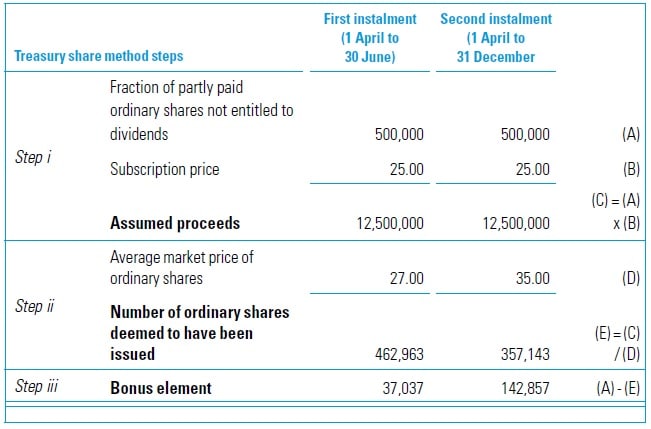
Partly paid ordinary shares Potential adjustment to the numerator for EPIS: No adjustment is required. Potential adjustment to the denominator for EPIS: The adjustment is determined using the treasury share method, as follows.
|
|
iii |
Shares issued to acquire a business (contingent consideration) C’s net profit for the five months ended 31 December Year 1 is 710,000. If 31 December Year 1 were the end of the contingency period, then the specified condition in respect of the issuance of 100,000 additional shares would be met. Potential adjustment to the numerator for EPIS: No adjustment is required. Potential adjustment to the denominator for EPIS: The 100,000 shares are included in the denominator from the date of acquisition – i.e. 1 August. |
|
iv |
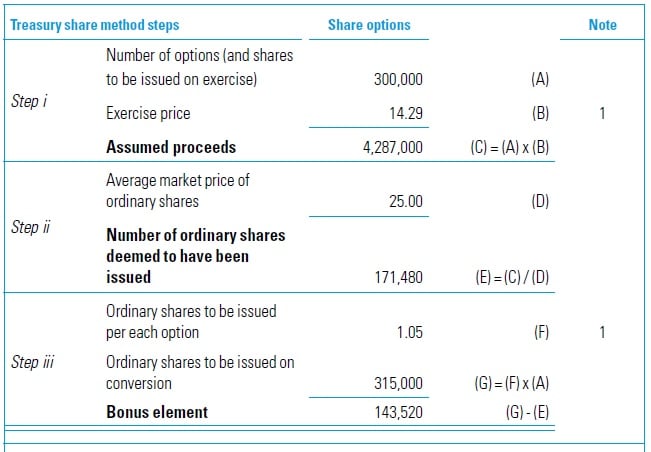
Share options outside share-based payment arrangement Potential adjustment to the numerator for EPIS: No adjustment is required. Potential adjustment to the denominator for EPIS: The potential adjustment is determined using the treasury share method, as follows.
Note 1. This reflects the adjusted conversion ratio as a result of the bonus issue (instrument 10 in Chapter 7.1). |
|
v |
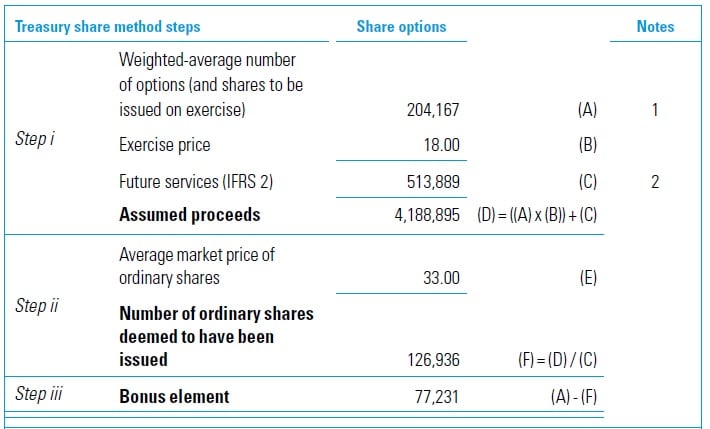
Share options under share-based payment arrangement Potential adjustment to the numerator for EPIS: No adjustment is required.
Notes 1. i.e. (250,000 x 5/12) + (200,000 x 6/12). 2. In this step, proceeds include the fair value of future services to be rendered by the employee for the remaining period not vested. P applies Approach 1 in Example 5.17 and the assumed proceeds are the unearned IFRS 2 charge for the eight employees that remain at 31 December Year 1 – i.e. 3.7 x 25 / 36 x 200,000. |
|
vi |
Contingently issuable ordinary shares If 31 December Year 1 were the end of the contingency period, then the specified conditions regarding the basic EPS amounts for Year 2 and Year 3 would not be met. Accordingly, these shares are ignored when determining the diluted EPS. |
|
vii |
Voluntarily convertible loan notes Potential adjustment to the numerator for EPIS: The convertible loan notes, if they are fully converted on issue, would increase profit or loss for the year by the post-tax amount of the interest expense: (interest expense on the convertible loan notes) x (1 – income tax rate) = (500,000) x (1 – 30%) = 350,000 Potential adjustment to the denominator for EPIS: The convertible bonds, if they are fully converted on issue, would increase the number of outstanding shares by 500,000. |



Step 3: Rank POSs based on EPIS
The POSs are ranked in order from the most dilutive to the least dilutive. POSs that have no effect on the earnings in the EPIS calculation are included first in the ranking. Therefore, the ranking is as follows.
|
Instruments |
EPIS |
|
Partly paid ordinary shares |
|
|
– first 50% installment |
– |
|
– second 50% installment |
– |
|
Contingent consideration in connection with acquisition of C |
– |
|
Share options |
|
|
– options outside share-based payment |
– |
|
– options under share-based payment |
– |
|
Convertible preference shares |
0.57 |
|
Voluntarily convertible loan notes |
2.10 |
Step 4: Determine basic EPS from continuing operations
Basic EPS is 1.12 (see Step 3 of the basic EPS computation in Calculating basic EPS).
Step 5: Identify dilutive POSs and determine diluted EPS
The impact of each class of POSs is calculated one by one, from the most dilutive to the least dilutive, in a sequence and cumulatively. In each sub-step, the ‘before’ and ‘after’ EPS amounts are compared.
|
Earnings |
Weighted-average number of shares |
Per share |
Dilutive? |
|
|
Basic EPS from continuing operations |
4,000,000 |
3,577,083 |
1.12 |
|
|
Partly paid ordinary shares, first installment |
– |
9,529 |
||
|
Subtotal |
4,000,000 |
3,586,612 |
1.12 |
Yes |
|
Partly paid ordinary shares, second installment |
– |
107,142 |
||
|
Subtotal |
4,000,000 |
3,693,755 |
1.08 |
Yes |
|
Contingent consideration |
– |
41,667 |
||
|
Subtotal |
4,000,000 |
3,735,422 |
1.07 |
|
|
Share options outside share-based payment |
– |
23,920 |
||
|
Subtotal |
4,000,000 |
3,759,342 |
1.06 |
Yes |
|
Share options under share-based payment |
– |
77,231 |
||
|
Subtotal |
4,000,000 |
3,836,573 |
1.04 |
Yes |
|
Convertible preference shares |
600,000 |
1,050,000 |
||
|
Subtotal |
4,000,000 |
4,886,573 |
0.94 |
Yes |
|
Voluntarily convertible loan notes |
350,000 |
166,667 |
||
|
Subtotal |
4,950,000 |
5,053,240 |
0.98 |
No |
The diluted EPS is increased by the voluntarily convertible loan notes. Therefore, the convertible loan notes are anti-dilutive.
Diluted EPS = 0.94
Year 2
The diluted EPS computations for Year 2 are as follows.
Step 1: Identify POSs
|
Instruments |
POSs? |
Analysis |
|
Convertible preference shares lliink |
Yes |
If they are converted, then ordinary shares would be issued. |
|
Partly paid ordinary shares |
Yes |
To the extent that partly paid shares are not entitled to participate in dividends in a period, they are treated as the equivalent of options (and therefore POSs) for that period. |
|
Contingent consideration in connection with acquisition of C |
Yes |
If the specified conditions are met, then ordinary shares would be issued. |
|
Share options |
Yes |
If they are exercised, then ordinary shares would be issued. |
|
Contingently issuable ordinary shares |
Yes |
If the specified conditions are met, then the ordinary shares would vest. |
|
Voluntarily convertible loan notes |
Yes |
If they are converted, then ordinary shares would be issued. |
|
Mandatory convertible bonds |
No |
Although ordinary shares will be issued in the future on the mandatory conversion, these shares are treated as if they were issued from the date on which the contract is entered into, and are therefore included in the denominator for basic EPS from that date. |
|
Instruments |
Adjustment to earnings if shares are issued |
Adjustment to weighted-average number of shares if shares are issued |
EPIS |
Notes |
||
|
Number of shares |
Time weighting |
Weighted average |
||||
|
Convertible preference shares |
– |
1,050,000 |
12 / 12 |
1,050,000 |
0.57 |
i |
|
Partly paid ordinary shares |
||||||
|
– first 50% installment |
– |
– |
– |
– |
||
|
– second 50% installment |
– |
142,857 |
3 / 12 |
35,714 |
– |
ii |
|
Contingent consideration in connection with acquisition of C |
– |
100,000 |
3 / 12 |
25,000 |
– |
iii |
|
Share options |
||||||
|
– options under share-based payment |
– |
98231 |
12 / 12 |
98,231 |
– |
iv |
|
Contingently issuable ordinary shares |
– |
– |
N/A |
– |
N/A |
v |
|
Voluntarily convertible loan notes |
1,050,000 |
500,000 |
12 / 12 |
500,000 |
2.10 |
vi |
Notes
|
i |
Convertible preference shares Potential adjustment to the numerator for EPIS: No adjustment is required, because no dividends are declared. Potential adjustment to the denominator for EPIS: The convertible preference shares, if they are fully converted, would increase the number of outstanding shares by 1,050,000 – i.e. 500,000 x 2.1. The assumed conversion reflects the adjusted conversion ratio as a result of the bonus issue issued on 15 January Year 1. |
|
ii |
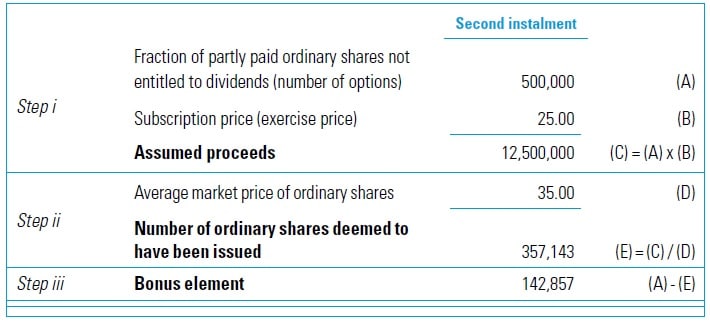
Partly paid ordinary shares Potential adjustment to the numerator for EPIS: No adjustment is required. Potential adjustment to the denominator for EPIS: The adjustment is determined using the treasury share method, as follows.
|
|
iii |
Shares issued to acquire a business (contingent consideration) The end of the contingency period is reached during Year 2. Therefore, the contingently issuable ordinary shares (100,000) are added to the diluted EPS. Potential adjustment to the numerator for EPIS: No adjustment is required. Potential adjustment to the denominator for EPIS: 100,000 shares are included in the denominator from the beginning of the period to the date on which the condition is satisfied (i.e. the date on which the shares are treated as outstanding for basic EPS – 31 March). |
|
iv |
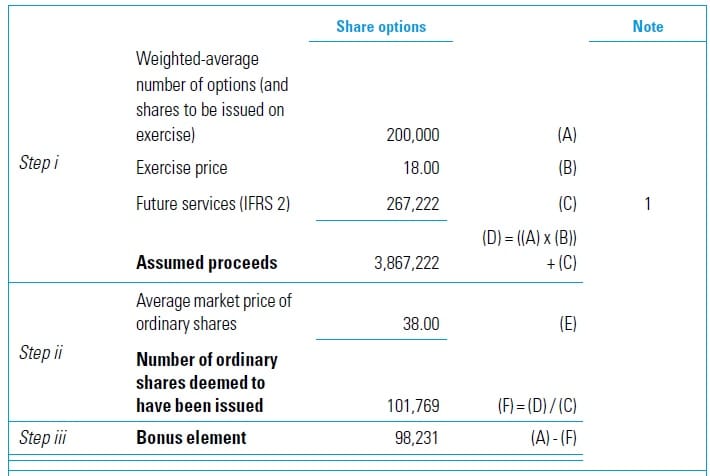
Share options outside share-based payment arrangement Potential adjustment to the numerator for EPIS: No adjustment is required. Potential adjustment to the denominator for EPIS: The potential adjustment is determined using the treasury share method, as follows.
Note 1. In this step, proceeds include the fair value of future services to be rendered by the employee for the remaining period not vested. The assumed proceeds are the unearned IFRS 2 charge for the eight employees that remain at 31 December Year 1 – i.e. 3.7 x 13 / 36 x 200,000. |
|
v |
Contingently issuable ordinary shares If 31 December Year 2 were the end of the contingency period, then the specified conditions regarding the basic EPS amounts for Year 2 and Year 3 would not be met. Accordingly, these shares are ignored when determining the diluted EPS. |
|
vi |
Voluntarily convertible loan notes Potential adjustment to the numerator for EPIS: The convertible loan notes, if they are fully converted on issue, would increase profit or loss for the year by the post-tax amount of the interest expense: (interest expense on the convertible loan notes) x (1 – income tax rate) = (1,500,000) x (1 – 30%) = 1,050,000 Potential adjustment to the denominator for EPIS: The convertible bonds, if they are fully converted on issue, would increase the number of outstanding shares by 500,000. |


Step 3: Rank POSs based on EPIS
The POSs are ranked in order from the most dilutive to the least dilutive. POSs that have no effect on the earnings in the EPIS calculation are included first in the ranking. Therefore, the ranking is as follows.
|
Instruments |
EPIS |
|
Convertible preference shares |
– |
|
Partly paid ordinary shares – second 50% installment |
– |
|
Contingent consideration in connection with acquisition of C |
– |
|
Share options – options under share-based payment |
|
|
Voluntarily convertible loan notes |
2.10 |
Step 4: Determine basic EPS from continuing operations
Basic EPS is 1.09 (see Step 3 of the basic EPS computation in Calculating basic EPS above).
Step 5: Identify dilutive POSs and determine diluted EPS
The impact of each class of POSs is calculated one by one, from the most dilutive to the least dilutive, in a sequence and cumulatively. In each sub-step, the ‘before’ and ‘after’ EPS amounts are compared.
|
Earnings |
Weighted-average number of shares |
Per share |
Dilutive? |
|
|
Basic EPS from continuing operations |
5,600,000 |
5,135,000 |
1.09 |
|
|
Convertible preference shares |
– |
1,050,000 |
||
|
Subtotal |
5,600,000 |
6,185,000 |
0.91 |
Yes |
|
Partly paid ordinary shares, second installment |
– |
35,714 |
||
|
Subtotal |
5,600,000 |
6,220,714 |
0.90 |
Yes |
|
Contingent consideration |
– |
25,000 |
||
|
Subtotal |
5,600,000 |
6,245,714 |
0.90 |
Yes |
|
Share options under share-based payment |
– |
98,231 |
||
|
Subtotal |
5,600,000 |
6,343,945 |
0.88 |
Yes |
|
Voluntarily convertible loan notes |
1,050,000 |
500,000 |
||
|
Subtotal |
6,650,000 |
6,843,945 |
0.97 |
No |
The diluted EPS is increased by the voluntarily convertible loans notes. Therefore, the convertible loan notes are anti-dilutive.
Diluted EPS = 0.88
|
Consider this! |
|
Similarly to calculating basic EPS, if a bonus issue were to occur before the financial statements are authorised for issue, then it would also need to be reflected in diluted EPS. However, the terms and conditions underlying the POSs are considered when determining whether the weighted-average number of POSs needs to be adjusted. |
Annualreporting provides financial reporting narratives using IFRS keywords and terminology for free to students and others interested in financial reporting. The information provided on this website is for general information and educational purposes only and should not be used as a substitute for professional advice. Use at your own risk. Annualreporting is an independent website and it is not affiliated with, endorsed by, or in any other way associated with the IFRS Foundation. For official information concerning IFRS Standards, visit IFRS.org or the local representative in your jurisdiction.
EPS Calculation EPS Calculation EPS Calculation EPS Calculation EPS Calculation EPS Calculation EPS Calculation EPS Calculation EPS Calculation EPS Calculation EPS Calculation EPS Calculation EPS Calculation EPS Calculation EPS Calculation EPS Calculation EPS Calculation EPS Calculation EPS Calculation EPS Calculation EPS Calculation EPS Calculation EPS Calculation EPS Calculation EPS Calculation EPS Calculation EPS Calculation EPS Calculation EPS Calculation EPS Calculation EPS Calculation EPS Calculation EPS Calculation EPS Calculation EPS Calculation EPS Calculation