COSO Internal Control Framework is globally recognized as the leading standard for designing, implementing, and evaluating internal control systems. Since its initial release in 1992, and especially after its 2013 revision, the framework has provided boards, executives, and auditors with a consistent structure to assess and strengthen governance, risk management, and compliance. The framework identifies five interrelated components—Control Environment, Risk Assessment, Control Activities, Information & Communication, and Monitoring Activities—that function together like the nervous system of an organization.
For companies across industries and geographies, from Enron and WorldCom to Wirecard and Parmalat, history has demonstrated that weak internal control environments can trigger catastrophic failures. By contrast, organizations that embed COSO principles create resilience, accountability, and trust with investors and stakeholders. This cornerstone article explains the framework, connects it to enterprise risk management (ERM), and illustrates its relevance with international case studies. It also introduces a series of follow-up blogs, each dedicated to one of the five COSO components.
The COSO Framework: Origins and Purpose
The Committee of Sponsoring Organizations of the Treadway Commission (COSO) issued its Internal Control – Integrated Framework in 1992. Its purpose was clear: to provide a universally applicable standard for evaluating internal control systems. Prior to COSO, internal control practices were fragmented, often defin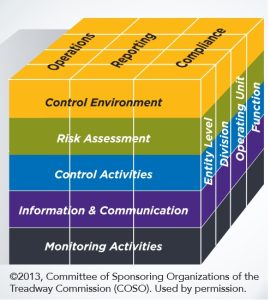 ed differently across jurisdictions, audit firms, and regulators.
The original framework quickly gained traction, particularly in the United States under the Sarbanes-Oxley Act of 2002 (SOX), which explicitly referred to COSO as a suitable framework for evaluating internal controls over financial reporting. Internationally, regulators and stock exchanges also embraced its principles, integrating them into corporate governance codes and assurance practices.
The 2013 revision modernized the framework to reflect changes in technology, globalization, and risk management. Importantly, it emphasized that internal control is not merely about compliance, but about achieving objectives in three categories: operations, reporting, and compliance.
Read more from the Institute of Risk Management – A risk practitioner’s guide to the COSO ERM Frameworks.
The Five Components of Internal Control (Textual Schema)
At its core, COSO identifies five integrated components:
-
Control Environment – The foundation; it sets the tone at the top, defines integrity, ethical values, and governance structures.
-
Risk Assessment – The identification and analysis of risks to achieving objectives, forming the basis for control activities.
-
Control Activities – The specific actions, policies, and procedures that mitigate identified risks.
-
Information & Communication – The nervous system that ensures relevant information flows across the organization and to stakeholders.
-
Monitoring Activities – Ongoing and separate evaluations to ensure controls remain effective over time.
These five components function as an integrated system. Weakness in one undermines the others.
Why COSO Matters: Linking Internal Control and Governance
Internal control is not just a compliance requirement; it is the practical expression of corporate governance. Boards of directors and audit committees rely on robust control systems to ensure accountability, transparency, and ethical conduct.
Failures in governance are almost always failures in internal control. Consider Enron and WorldCom in the early 2000s: both collapsed under the weight of fraudulent financial reporting enabled by weak oversight and poor control environments. Wirecard, once a German fintech star, unraveled in 2020 due to fabricated revenues and missing cash balances—classic symptoms of ineffective monitoring and compromised information flows. Parmalat, the Italian dairy giant, hid billions in debt until 2003, demonstrating the consequences of deficient risk assessment and oversight.
These cases reveal a common thread: when boards and executives neglect COSO principles, the organization’s nervous system fails, often with systemic consequences for markets and society.
COSO and Enterprise Risk Management (ERM)
While the Internal Control – Integrated Framework focuses on achieving objectives and safeguarding reporting, COSO also developed an Enterprise Risk Management (ERM) framework, first published in 2004 and updated in 2017. ERM expands the perspective: instead of viewing risk solely as something to mitigate, it considers risk as inherent to value creation.
The connection between the two frameworks is crucial. Internal control, as defined in the 2013 COSO framework, provides the discipline and structure, while ERM aligns risk appetite and strategy. Together, they create a comprehensive governance system in which internal control supports, but does not replace, strategic risk management.
Integration Across the Five Components
One of the framework’s strengths lies in its emphasis on integration. Internal control should not be a checklist of isolated procedures. Instead, it is a system in which tone at the top influences risk assessment, risk assessment drives control activities, information enables effective monitoring, and monitoring reinforces the control environment.
For example, a strong control environment—where integrity and ethical values are promoted—loses effectiveness if risk assessment fails to capture emerging threats such as cybersecurity or ESG compliance. Likewise, sophisticated risk models mean little if monitoring mechanisms are weak or information flows are distorted.
The five components are not sequential but interdependent, resembling the circulatory system of an organism: failure in one artery can jeopardize the entire body.
One way IFRS has shown its willingness to work on integration and improvement of governance is the introduction of IFRS 18 Presentation and Disclosure in Financial Statements (read a comprehensive post on IFRS 18 here), also regarding Management-Defined Performance Measures.
Application in a Global Context
Multinational companies face particular challenges in applying COSO. Cultural differences affect the perception of control, regulatory regimes vary, and operations span jurisdictions with diverse risks. Yet the universality of COSO lies in its principles: integrity, accountability, transparency, and continuous monitoring apply everywhere.
Case example – Wirecard: The German payments company’s downfall illustrates what happens when oversight bodies rely too heavily on trust without enforcing robust control activities and independent monitoring. Despite being listed on a major European exchange, billions in fictitious cash went undetected for years. A strong application of COSO would have required systematic verification of bank balances and independent risk assessment.
Case example – Parmalat: By dispersing subsidiaries across multiple jurisdictions, Parmalat exploited weak information flows and ineffective monitoring. Its fraud remained hidden until liquidity collapsed. Under COSO, reliable reporting and transparent communication across entities would have been paramount.
These cases highlight the need for global consistency: internal control must transcend national borders and adapt to complexity without losing discipline.
Challenges and Criticism
While widely respected, the COSO framework is not immune to criticism.
-
Some argue it is too conceptual, lacking practical guidance for smaller organizations.
-
Others claim it overemphasizes documentation and checklists, leading to bureaucratic compliance rather than true governance.
-
Implementation can be costly, especially in heavily regulated sectors where external auditors expect extensive evidence of control effectiveness.
Nevertheless, the framework’s adaptability is also its strength. Organizations are encouraged to apply it proportionally, tailoring the level of formality to their size, industry, and risk profile.
Lessons Learned from Failures
The corporate scandals of the past four decades converge on a few lessons that COSO directly addresses:
-
Tone at the top is decisive. Enron and WorldCom demonstrate how leadership arrogance and unethical culture destroy the control environment.
-
Independent monitoring is vital. Wirecard shows that without rigorous oversight, even regulators and auditors can be deceived.
-
Risk assessment must evolve. Parmalat failed to recognize liquidity risk and excessive leverage, both of which could have been mitigated by systematic evaluation.
-
Information integrity sustains trust. Without accurate, timely, and transparent reporting, investors cannot make informed decisions.
Conclusion and Way Forward
The COSO Internal Control – Integrated Framework remains the global benchmark for evaluating internal control systems. Its five components form an interdependent structure that supports governance, accountability, and resilience. From Enron to Wirecard, the evidence is overwhelming: organizations that ignore COSO principles expose themselves to catastrophic risk, while those that embrace them strengthen not only compliance but also long-term value creation.
This cornerstone article has introduced the framework, explained its relevance, and illustrated its lessons through international case studies. In the next article series, we will explore each of the five COSO components in detail, starting with:
Step 1 – Establishing a Robust Internal Control Framework (The Control Environment)
COSO Internal Control Framework
COSO Internal Control Framework
COSO Internal Control Framework COSO Internal Control Framework COSO Internal Control Framework COSO Internal Control Framework COSO Internal Control Framework COSO Internal Control Framework COSO Internal Control Framework COSO Internal Control Framework COSO Internal Control Framework COSO Internal Control Framework