Category 4 Upstream Transportation and Distribution
Category description – Category 4 Upstream Transportation and Distribution includes emissions from:
- Transportation and distribution of products purchased in the reporting year, between a company’s tier 1 suppliers1 and its own operations in vehicles not owned or operated by the reporting company (including multi-modal shipping where multiple carriers are involved in the delivery of a product, but excluding fuel and energy products) – link to figure 7.3 in the Scope 3 Standard
- Third-party transportation and distribution services purchased by the reporting company in the reporting year (either directly or through an intermediary), including inbound logistics, outbound logistics (e.g., of sold products), and third-party transportation and distribution between a company’s own facilities.
Emissions may arise from the following transportation and distribution activities throughout the value chain:
- Air transport
- Rail transport
- Road transport
- Marine transport
- Storage of purchased products in warehouses, distribution centers, and retail facilities.
Outbound logistics services purchased by the reporting company are categorized as upstream because they are a purchased service. Emissions from transportation and distribution of purchased products upstream of the reporting company’s tier 1 suppliers (e.g., transportation between a company’s tier 2 and tier 1 suppliers) are accounted for in scope 3, category 1 (Purchased goods and services). Table 4.1 shows the scope and category of emissions where each type of transportation and distribution activity should be accounted for.
A reporting company’s scope 3 emissions from upstream transportation and distribution include the scope 1 and scope 2 emissions of third-party transportation companies (allocated to the reporting company).
|
Table [4.1] Accounting for emissions from transportation and distribution activities in the value chain |
|
|
Transportation and distribution activity in the value chain |
|
|
Transportation and distribution in vehicles and facilities owned or controlled by the reporting company |
Scope 1 (for fuel use) or Scope 2 (for electricity use) |
|
Transportation and distribution in vehicles and facilities leased by and operated by the reporting company (and not already included in scope 1 or scope 2) |
Scope 3, category 8 (Upstream leased assets) |
|
Transportation and distribution of purchased products, upstream of the reporting company’s tier 1 suppliers (e.g., transportation between a company’s tier 2 and tier 1 suppliers) |
Scope 3, category 1 (Purchased goods and services), since emissions from transportation are already included in the cradle-to-gate emissions of purchased products. These emissions are not required to be reported separately from category 1. |
|
Production of vehicles (e.g., ships, trucks, planes) purchased or acquired by the reporting company |
Account for the upstream (i.e., cradle-to-gate) emissions associated with manufacturing vehicles in Scope 3, category 2 (Capital goods) |
|
Transportation of fuels and energy consumed by the reporting company |
Scope 3, category 3 (Fuel- and energy-related emissions not included in scope 1 or scope 2) |
|
Transportation and distribution of products purchased by the reporting company, between a company’s tier 1 suppliers and its own operations (in vehicles and facilities not owned or controlled by the reporting company) |
Scope 3, category 4 (Upstream transportation and distribution) |
|
Transportation and distribution services purchased by the reporting company in the reporting year (either directly or through an intermediary), including inbound logistics, outbound logistics (e.g., of sold products), and transportation and distribution between a company’s own facilities (in vehicles and facilities not owned or controlled by the reporting company) |
Scope 3, category 4 (Upstream transportation and distribution) |
|
Transportation and distribution of products sold by the reporting company between the reporting company’s operations and the end consumer (if not paid for by the reporting company), including retail and storage (in vehicles and facilities not owned or controlled by the reporting company) |
Scope 3, category 9 (Downstream transportation and distribution) |
|
Source: Table 5.7 from the Scope 3 Standard. |
|
This section provides calculation guidance first from transportation and then from distribution (e.g., warehouses, distribution centers).
Category 4 Upstream Transportation and Distribution – Calculating emissions from transportation
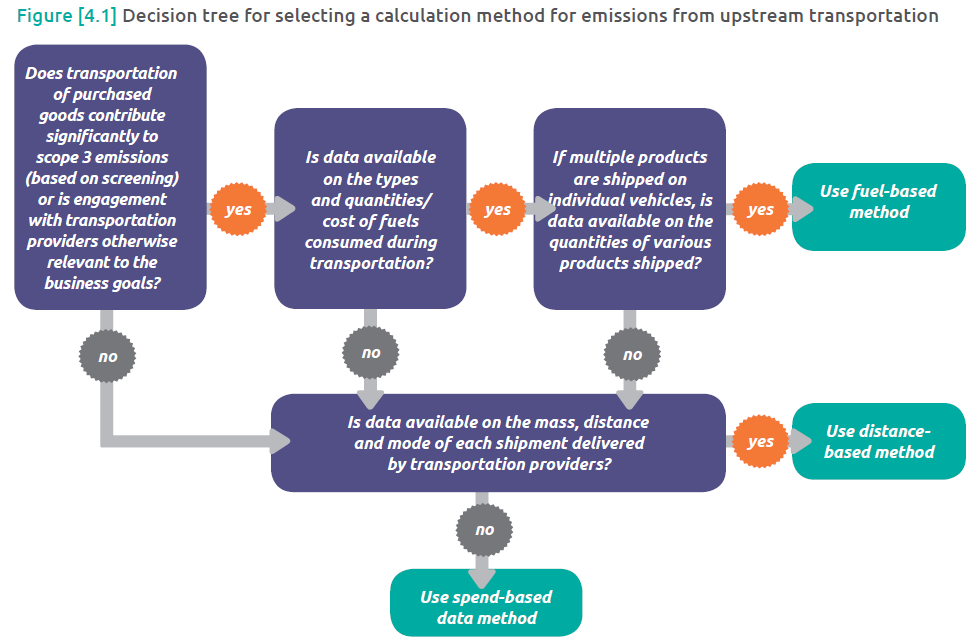
Companies may use the following methods to calculate scope 3 emissions from transportation:
- Fuel-based method, which involves determining the amount of fuel consumed (i.e., scope 1 and scope 2 emissions of transport providers) and applying the appropriate emission factor for that fuel
- Distance-based method, which involves determining the mass, distance, and mode of each shipment, then applying the appropriate mass-distance emission factor for the vehicle used
- Spend-based method, which involves determining the amount of money spent on each mode of business travel transport and applying secondary (EEIO) emission factors.
The GHG Protocol has a calculation tool for transportation that uses a combination of the fuel-based and distance-based methods. This combination is used because CO2 is better estimated from fuel use, and CH4 and N2O are better estimated from distance travelled. The tool uses fuel-efficiency ratios to convert either type of activity data (fuel or distance) supplied by the user into either fuel or distance depending on the GHG being calculated. The calculation tool (“GHG emissions from transport or mobile sources”) is available at the GHG Protocol website: http://www.ghgprotocol.org/calculation-tools/all-tools).
It is important to note that the calculation tool was originally developed to calculate an organization’s scope 1 emissions (i.e., emissions from vehicles that the organization owns and operates). Therefore, the emission factors that pre-populate the calculation tool are combustion emission factors. When calculating emissions from transportation in scope 3, companies should use life cycle emission factors (see “Energy emission factors in scope 3 accounting” in the Introduction for more information on which emission factors to use). If using the GHG Protocol transport calculation tool to calculate scope 3 emissions, companies should customize the tool by entering life cycle emission factors.
Category 4 Upstream Transportation and Distribution – Fuel-based method (transportation)
The fuel-based method should be used when companies can obtain data for fuel use from transport providers (and, if applicable, refrigerant leakage due to refrigeration of products) from vehicle fleets (e.g., trucks, trains, planes, vessels).
Companies should also take into account any additional energy used and account for fugitive emissions (e.g., refrigerant loss or air-conditioning). Companies may optionally calculate any emissions from unladen backhaul (i.e., the return journey of the empty vehicle).
Where fuel use data is unavailable, the company may derive fuel use by using the:
- Amount spent on fuels and the average price of fuels
- Distance travelled and the vehicle’s fuel efficiency
- Amount spent on transportation services, fuel cost share (as percent of total cost of transportation services) and the average price of fuels.
For calculating CO2, the fuel-based method is more accurate than the distance-based method because fuel consumption is directly related to emissions.
The fuel-based method is best applied if the vehicle exclusively ships the reporting company’s purchased goods (i.e., exclusive use or truckload shipping, rather than less-than-truckload (LTL) shipping). Otherwise, emissions should be allocated between goods shipped for the reporting company and goods shipped for other companies. See chapter 8 of the Scope 3 Standard for further guidance on allocating emissions.
Companies should allocate emissions based on the following default limiting factors for each transportation mode, unless more accurate data is available to show that another factor is the limiting factor:
- Road transport: Truck capacity is typically limited by mass, so mass-based allocation should be used
- Marine transport: Vessel capacity is typically limited by volume, so volume-based allocation should be used
- Air transport: Aircraft capacity is typically limited by mass, so mass-based allocation should be used
- Rail transport: Rail capacity is typically limited by mass, so mass-based allocation should be used.
If there are multiple shipments on a transport leg, distance should also be used as a means for allocation. (For more information, see the Deutsche Post DHL example in this section.)
If data required for allocation is not available or reliable due to the variety of goods transported in one vehicle at the same time, the distance-based method should be used to calculate scope 3 emissions.
Activity data needed
Companies should collect data on:
- Quantities of fuel (e.g., diesel, gasoline, jet fuel, biofuels) consumed
- Amount spent on fuels
- Quantities of fugitive emissions (e.g., from air conditioning and refrigeration).
If applicable:
- Distance travelled
- Average fuel efficiency of the vehicle, expressed in units of liters of fuel consumed per tonne per kilometer transported
- Cost of fuels
- Volume and/or mass of purchased goods in the vehicle
- Information on whether the products are refrigerated in transport.
Emission factors needed
Companies should collect:
- Fuel emission factors, expressed in units of emissions per unit of energy consumed (e.g., kg CO2e/liters, CO2e/Btu)
- For electric vehicles (if applicable), electricity emission factors, expressed in units of emissions per unit of electricity consumed (e.g., kg CO2e/kWh)
- Fugitive emission factors, expressed in units of emissions per unit (e.g., kg CO2e/kg refrigerant leakage)
Emission factors should at a minimum include emissions from fuel combustion, and should, where possible, include cradle-to-gate emissions of the fuel (i.e., from extraction, processing, and transportation to the point of use).
Note: For air travel emission factors, multipliers or other corrections to account for radiative forcing may be applied to the GWP of emissions arising from aircraft transport. If applied, companies should disclose the specific factor used.
Data collection guidance
Data sources for activity data include:
- Aggregated fuel receipts
- Purchase records (provided by transportation providers)
- Internal transport management systems.
Data sources for emission factors include:
- Transportation carriers
- Government agencies (e.g., Defra provides emission factors for the United Kingdom)
- The GHG Protocol website (http://www.ghgprotocol.org/calculation-tools/all-tools and http://www.ghgprotocol.org/standards/scope-3-standard)
- Industry associations
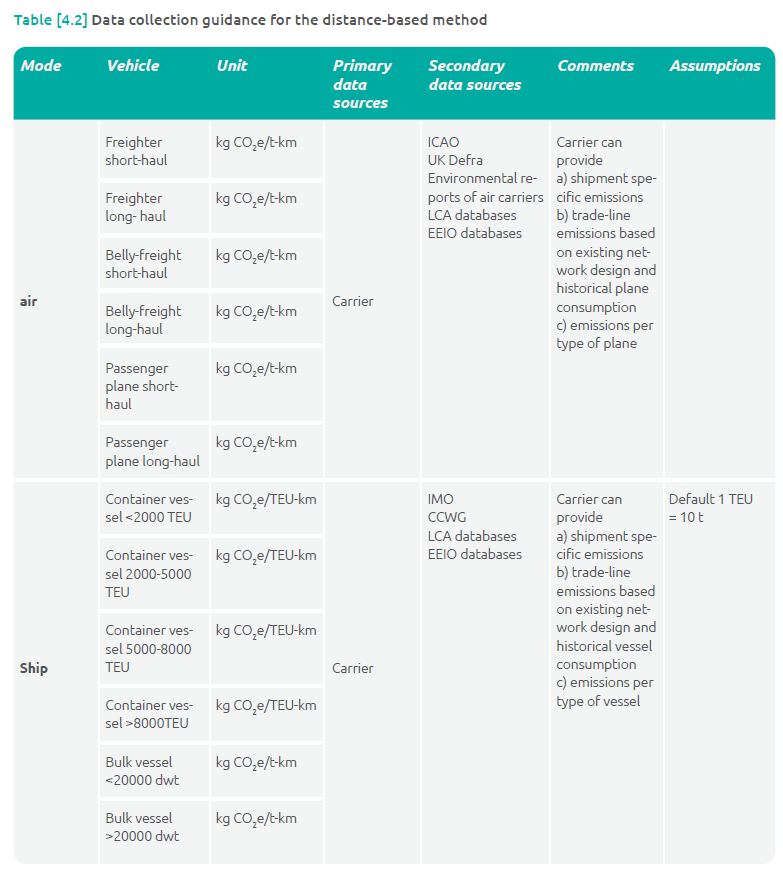
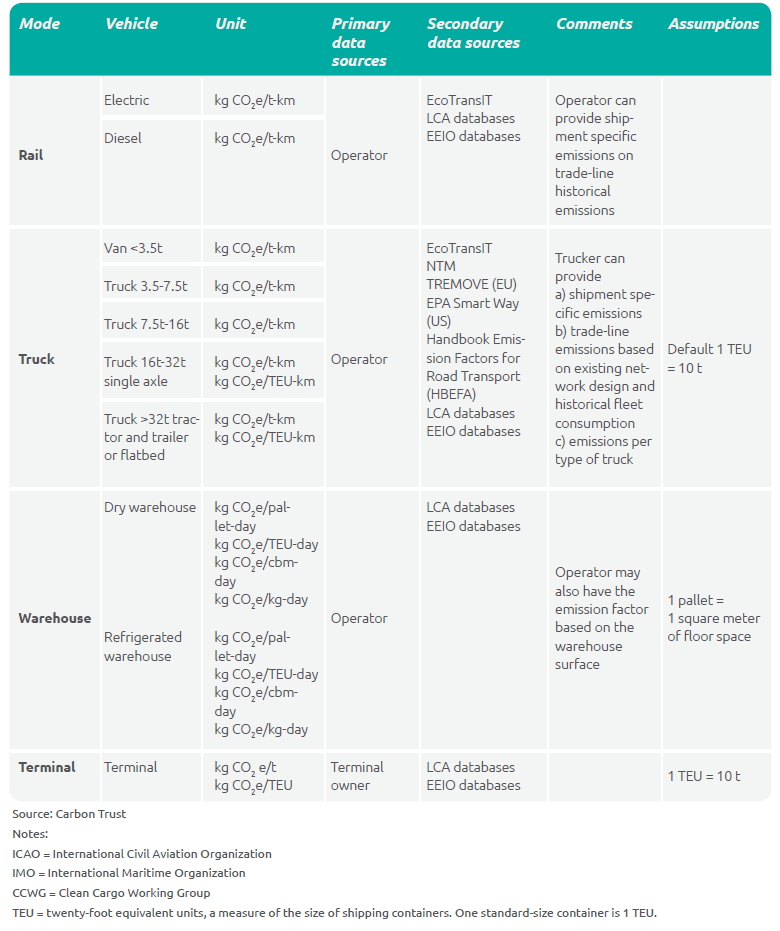
- Additional sources in table 4.2 Data collection guidance for the distance-based method.
Transportation emissions are calculated by multiplying each fuel/refrigerant type used by a corresponding emission factor and summing the results as shown in the formula below:
|
Calculation formula [4.1] Fuel-based method (transportation) |
|
CO2e emissions from transportation = |
|
sum across fuel types: Σ (quantity of fuel consumed (liters) × emission factor for the fuel (e.g., kg CO2e/liter)) + sum across grid regions: Σ (quantity of electricity consumed (kWh) × emission factor for electricity grid (e.g., kg CO2e/kWh)) + sum across refrigerant and air-conditioning types: Σ (quantity of refrigerant leakage × global warming potential for the refrigerant (e.g., kg CO2e)) |
If fuel consumption data is unavailable, companies may use formula 4.2 and/or formula 4.3 to calculate quantities of fuel consumed.
|
Calculation formula [4.2] Calculating fuel use from fuel spend |
|
Quantities of fuel consumed (liters) = |
|
sum across fuel types:
|
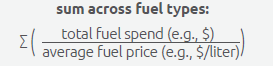
Companies should first apportion annual amount spent on fuel to each relevant fuel type. Where the mix of fuels is unknown, companies may refer to average fuel mix statistics from industry bodies and/or government statistical publications.
|
Calculation formula [4.3] Calculating fuel use from distance travelled |
|
Quantities of fuel consumed (liters) = |
|
sum across transport steps: Σ (total distance travelled (e.g., km) × fuel efficiency of vehicle (e.g., liters/km)) |
If allocation is needed, companies should calculate the allocated fuel use (for the goods shipped by the reporting company) using the formula below, then apply formula 4.1 above.
|
Calculation formula [4.4] Allocating fuel use |
|
Allocated fuel use = |
|
Companies may optionally substitute mass of goods by volume with dimensional mass or chargeable mass where data is available to prove that the alternative method is more suitable. Dimensional mass is a calculated mass that takes into account packaging volume as well as the actual mass of the goods. Chargeable mass is the higher value of either the actual or the dimensional mass of the goods. |

Companies may optionally calculate emissions from unladen backhaul (i.e., the return journey of the empty vehicle) using the following formula:
|
Calculation formula [4.5] Calculating emissions from unladen backhaul |
|
CO2e emissions from unladen backhaul = |
|
for each fuel type: Σ (quantity of fuel consumed from backhaul × emission factor for the fuel (e.g., kg CO2e/liter)) where: quantity of fuel consumed from backhaul = average efficiency of vehicles unladed (l/km) × total distance travelled unladen. |
…
|
Example [4.1] Calculating emissions from upstream transportation using the fuel-based method |
|
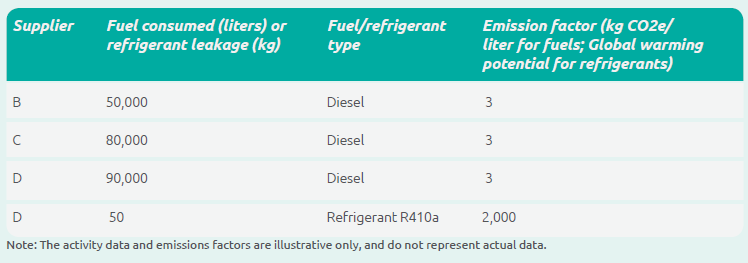
Company A makes bread in Italy. Suppliers B, C, and D supply refrigerated raw materials for Company A’s operations. Company A collects activity data from its suppliers on the amount of fuel used and refrigerant leakage incurred by the transport of raw materials to Company A’s facility. All trucks transport goods exclusively for Company A. Company A collects emission factors for the fuel type used by suppliers and for refrigerant leakage. The situation is summarized in the table below:
|
|
emissions from diesel is calculated as: Σ (quantity of fuel consumed (liters) × emission factor for the fuel (kg CO2e/liter)) = (50,000 × 3) + (80,000 × 3) + (90,000 × 3) = 660,000 kg CO2e emissions from refrigerant leakage is calculated as: Σ (quantity of refrigerant leakage (kg) × emission factor for refrigerant (kg CO2e/kg)) = 50 × 2,000 = 100,000 kg CO2e total emissions is calculated as follows: emissions from fuels + emissions from refrigerant leakage = 660,000 + 100,000 = 760,000 kg CO2e |
Category 4 Upstream Transportation and Distribution – Distance-based method (transportation)
In this method, distance is multiplied by mass or volume of goods transported and relevant emission factors that incorporate average fuel consumption, average utilization, average size and mass or volume of the goods and the vehicles, and their associated GHG emissions.
Emission factors for this method are typically represented in grams or kilograms of carbon dioxide equivalent per tonne-kilometer or TEU-kilometer. Tonne-kilometer is a unit of measure representing one tonne of goods transported over 1 kilometer. TEU-kilometer is a unit of measure representing one twenty-foot container equivalent of goods transported over 1 kilometer.
The distance-based method is especially useful for an organization that does not have access to fuel or mileage records from the transport vehicles, or has shipments smaller than those that would consume an entire vehicle or vessel.
If sub-contractor fuel data cannot be easily obtained in order to use the fuel-based method, then the distance-based method should be used. Distance can be tracked using internal management systems or, if these are unavailable, online maps. However, accuracy is generally lower than the fuel-based method as assumptions are made about the average fuel consumption, mass or volume of goods, and loading of vehicles.
Activity data needed
Companies should collect data on the distance travelled by transportation suppliers. This data may be obtained by:
- Mass or volume of the products sold
- Actual distances provided by transportation supplier (if actual distance is unavailable, companies may use the shortest theoretical distance)
- Online maps or calculators
- Published port-to-port travel distances.
The actual distances should be used when available, and each leg of the transportation supply chain should be collected separately.
Emission factors needed
Companies should collect:
-
Emission factor by mode of transport (e.g., rail, air, road) or vehicle types (e.g., articulated lorry, container vessel), expressed in units of greenhouse gas (CO2, CH4, N2O, or CO2e) per unit of mass (e.g., tonne) or volume (e.g., TEU) travelled (e.g., kilometer).
Common forms of emission factors are kg CO2e/tonne/km for road transport or kg CO2e/TEU/km for sea transport.
Note: For air travel emission factors, multipliers or other corrections to account for radiative forcing may be applied to the GWP of emissions arising from aircraft transport. If applied, companies should disclose the specific factor used.
Data collection guidance
Companies may obtain activity data from:
- Purchase orders
- Specific carrier or mode operator
- Internal management systems
- Industry associations
- Online maps and calculators.
Companies may obtain emission factors from:
- Transportation carriers
- Government agencies (e.g., Defra provides emission factors for the United Kingdom)
- The GHG Protocol website (http://www.ghgprotocol.org/calculation-tools/all-tools and http://www.ghgprotocol.org/standards/scope-3-standard)
- Industry associations
- Additional sources in table 4.2 Data collection guidance for the distance-based method.
When collecting emission factors, it is important to note that they may be vehicle, regional, or country specific.
Calculation resources include:
- GHG Protocol Calculation Tool, “Mobile Combustion GHG Emissions Calculation Tool. Version 2.0. June 2009,” developed by World Resources Institute, available at http://www.ghgprotocol.org/calculation-tools/all-tools.
- U.S. EPA Climate Leaders GHG Inventory Protocol, “Optional Emissions from Commuting, Business Travel and Product Transport,” available at: http://www.epa.gov/stateply/documents/resources/commute_travel_product.pdf
- UK Defra, “Guidance on Measuring and Reporting GHG Emissions from Freight Transport Operations,” available at http://www.defra.gov.uk/environment/economy/business-efficiency/reporting/
- UK Defra GHG Conversion Factors, developed by the United Kingdom Department of Environment, Food and Rural Affairs (Defra), available at http://www.defra.gov.uk/environment/economy/business-efficiency/reporting/
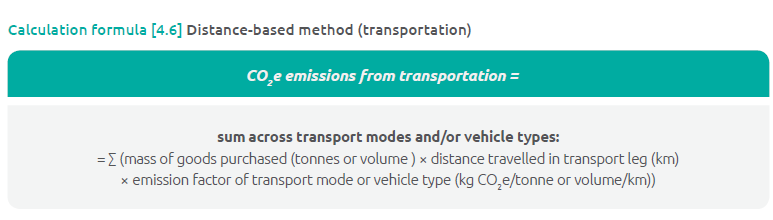
To calculate emissions, companies should multiply the quantity of goods purchased in mass (including packaging and pallets) or volume by the distance travelled in the transport leg and then multiply that by an emission factor specific to the transport leg (usually a transport mode- or vehicle type-specific emission factor).
Because each transport mode or vehicle type has a different emission factor, the transport legs should be calculated separately and total emissions aggregated.
The following formula can be applied to all modes of transport and/or vehicle types to calculate emissions from transportation:
Category 4 Upstream Transportation and Distribution Category 4 Upstream Transportation and Distribution Category 4 Upstream Transportation and Distribution Category 4 Upstream Transportation and Distribution Category 4 Upstream Transportation and Distribution Category 4 Upstream Transportation and Distribution Category 4 Upstream Transportation and Distribution Category 4 Upstream Transportation and Distribution Category 4 Upstream Transportation and Distribution
Category 4 Upstream Transportation and Distribution Category 4 Upstream Transportation and Distribution Category 4 Upstream Transportation and Distribution Category 4 Upstream Transportation and Distribution Category 4 Upstream Transportation and Distribution Category 4 Upstream Transportation and Distribution Category 4 Upstream Transportation and Distribution Category 4 Upstream Transportation and Distribution Category 4 Upstream Transportation and Distribution Category 4 Upstream Transportation and Distribution Category 4 Upstream Transportation and Distribution Category 4 Upstream Transportation and Distribution