Introduction — When Technology Becomes Geopolitics
ASML geopolitical governance – In the 19th century, nations fought for coal.
In the 20th century, they competed for oil.
But in the 21st century, the most contested resource is something you cannot dig from the ground: the ability to manufacture advanced semiconductors.
And at the center of this new global contest sits ASML, a Dutch company whose machines determine who can and who cannot build the world’s most advanced chips. As Trouw reported with striking clarity, ASML has unintentionally become the nerve center of global technological power. It is no longer simply a business; it is an instrument of geopolitical balance.
Understanding ASML means understanding a new kind of governance — one where a single company’s decisions shape not only markets, but strategic capabilities of entire nations.
ASML’s Unique Position in the Semiconductor Ecosystem
A Monopoly Measured in Nanometres
Semiconductors are the “brains” of modern technology. Every AI system, missile guidance platform, smartphone, electric vehicle, or cloud data center depends on chips measured in billionths of a meter. But the machines required to produce those chips — lithography machines — are even more complex.
This is where ASML becomes unique.
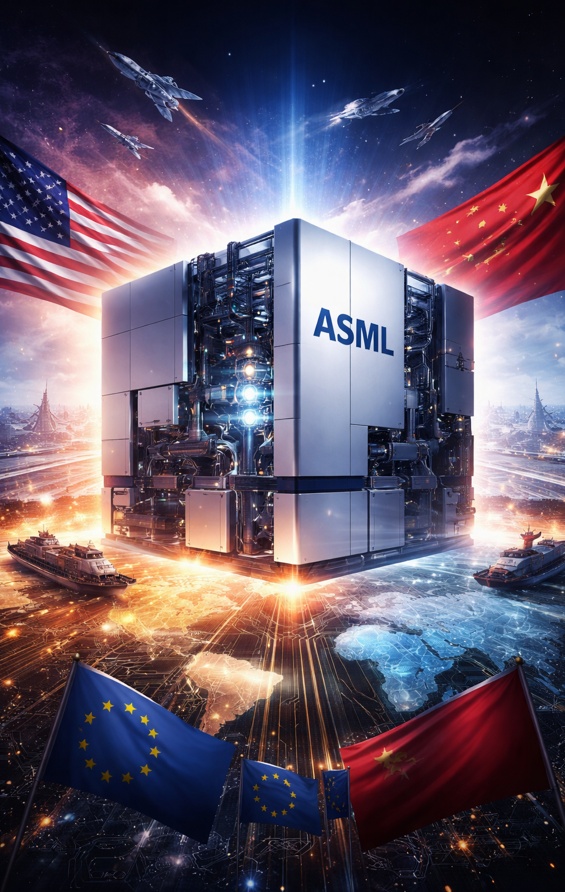
• ASML is the only company on Earth that can build EUV machines.
EUV (Extreme Ultraviolet) lithography uses light with a wavelength of just 13.5 nanometres. This allows chipmakers like TSMC, Samsung, and Intel to carve unimaginably fine patterns onto silicon wafers. ASML’s EUV system is so complex that no other company — and no other nation — has replicated it.
Why is this important?
Because EUV is essential for the most advanced chips used in AI, high-end computing, and military applications. Without EUV, a country simply cannot compete in next-generation semiconductors.
• ASML’s machines contain more than 100,000 precision components — each critical to the whole.
These machines are not assembled; they are orchestrated. From German optics to American plasma sources to Japanese precision parts, each subsystem performs at levels approaching physical limits. If even one supplier falters, the entire machine fails.
Governance implication:
ASML’s success depends on an extremely fragile and global supply-chain ecosystem — which means ASML’s risk environment is global, political, and systemic.
• ASML’s research footprint spans decades of innovation and billions in investment.
Rivals cannot simply “catch up.” EUV is the result of over 20 years of coordinated engineering among ASML and its strategic partners. This creates a technological moat so deep that even state-driven industrial giants like China cannot replicate it quickly.
Governance implication:
ASML is not just a market leader. It is a strategic choke point, controlling a technology every major power wants but only the Netherlands can provide.
Read more on the unique position of ASML in the New York Times: How the Maker of the ‘Most Complex Machine Humans Ever Created’ Is Navigating Trade Fights.
Geopolitics: The New Operating System of ASML
When Markets Are Overruled by Power
For most of its history, ASML operated within the world of globalisation — a world in which supply chains expanded, markets opened, and technology flowed freely across borders. But today’s world is no longer shaped primarily by trade. It is shaped by geopolitical friction — especially between the United States and China.
Trouw revealed how this tension redefines the environment in which ASML must operate. Export laws now change quarterly. Diplomatic pressure shapes product strategy. International intelligence agencies track ASML’s technological developments. Every machine sold to a foundry in Asia becomes a matter of national interest.
Read more from Reuters: ASML says geopolitics, new export restrictions remain risks.
This geopolitical shift transforms ASML’s ordinary business categories:
• Customers become strategic allies — or security threats.
Selling equipment to Taiwan strengthens a democratic partner in the Indo-Pacific.
Selling to China strengthens a rival power.
ASML must navigate these perceptions, even when it wishes to remain commercially neutral.
• Suppliers become geopolitical risk nodes.
If a critical supplier sits in a country subject to sanctions or export restrictions, the entire EUV supply chain becomes vulnerable.
• Export controls become more important than sales contracts.
A signed order from a Chinese foundry means nothing if Washington exercises veto power over the underlying components.
• “Neutrality” becomes impossible.
ASML cannot pretend geopolitics does not affect it. If it tries, external forces will impose reality upon it — via export bans, component restrictions, diplomatic pressure, or cybersecurity threats.
What emerges is a new truth:
ASML does not merely operate in a geopolitical environment — ASML is a geopolitical environment.
Export Controls and the U.S. Strategic Doctrine
Washington’s Invisible Hand on Dutch Soil
One of the most striking themes in the Trouw article is the degree of control the United States exercises over ASML’s business, despite ASML being a Dutch company operating under Dutch and European law.
This influence is not political theatre; it is structural.
• ASML’s technology contains critical U.S. components — giving Washington legal leverage.
The EUV light source, developed by Cymer (a U.S. company acquired by ASML), contains IP classified under American export law. This means Washington can—and does—block any shipment that contains U.S. technology.
Explanation:
Under U.S. export regulations (specifically the Foreign Direct Product Rule), any product that embeds sensitive U.S. IP is subject to American approval. ASML’s highest-end tools fall squarely within this category.
• Washington calls, and The Hague must respond.
The Dutch government does not independently design its China export strategy. It aligns it with U.S. national security requests, because the Netherlands cannot afford to weaken the transatlantic alliance.
Example:
In 2019, the U.S. pressured the Netherlands to block ASML from exporting EUV machines to SMIC (China’s leading foundry). After months of diplomatic engagement, the Dutch cabinet agreed — effectively subordinating its commercial decision to U.S. strategic interest.
• Export controls change unpredictably — destabilising ASML’s long-term planning.
When the U.S. tightens rules (as it did in October 2022 and October 2023), ASML must instantly adjust:
-
revenue forecasts
-
service agreements
-
supply-chain workflows
-
software updates
-
training programs in Asia
Each new restriction reconfigures ASML’s operational reality.
• Export controls are increasingly used as industrial tools, not just security tools.
Although framed as protecting national security, U.S. export controls also serve to protect America’s technological leadership. This is not unusual — nations have always used industrial policy as strategic leverage — but it places ASML in the crossfire of U.S. ambition.
Metaphor:
ASML sits in a diplomatic vise.
Washington tightens from one side.
Beijing pushes back from the other.
The Netherlands is the metal caught in between.
Read from the counter-party: European Union Institute for Security Issues: Tech war 2.0: The dangers of Trump’s ‘G2’ bargaining with an emboldened China.
China’s Technological Sovereignty Strategy
The Nation That Cannot Access the Machine It Needs Most
If Washington treats ASML as a tool of containment, Beijing sees ASML as a gatekeeper — one that stands between China and parity with the West.
China has invested hundreds of billions into its semiconductor ecosystem, yet EUV technology remains out of reach. And because ASML cannot ship EUV equipment to China, the technological gap widens with each process node.
• China views ASML’s restrictions as a national obstacle — not a corporate choice.
In the Chinese strategic outlook, the inability to access EUV machines is a structural disadvantage. It affects:
-
military development
-
AI capability
-
aerospace design
-
advanced manufacturing
-
economic competitiveness
Therefore, China does not “accept” ASML’s export limitations; it resents them.
• China has attempted to accelerate domestic development — but EUV is nearly impossible to replicate quickly.
EUV lithography is not a single invention. It is an ecosystem of hard physics problems, fine optics, plasma generation, vacuum dynamics, and ultra-fast metrology.
Illustrative example:
To achieve EUV, ASML uses molten tin droplets laser-struck 50,000 times per second, producing plasma at millions of degrees Celsius, generating EUV light. Even small deviations make the system collapse.
Replicating this requires decades of learning and a tight integration of thousands of suppliers. China, despite massive investment, remains behind.
• Beijing responds asymmetrically when markets close.
When access to EUV is denied, China shifts to:
-
cyber intrusions
-
pressure on European politicians
-
recruitment of foreign engineers
-
reverse engineering of older DUV tools
-
subsidies for domestic alternatives
-
retaliatory trade measures
ASML becomes a pawn on China’s strategic chessboard — even though ASML would prefer to remain a neutral supplier.
Raed more in our blog: The Governance of Export Controls – How China Mirrors the U.S. Foreign Direct Product Rule (FDPR).
• ASML’s board must manage China as both a customer and a systemic risk.
This duality is the hardest governance challenge:
-
China buys ASML’s machines.
-
China also tries to bypass ASML’s technological choke point.
This tension will shape ASML’s risk landscape for decades.
Europe’s Strategic Ambition and Structural Weakness
The Continent That Owns the Toolmaker but Not the Factories
Europe is proud of ASML — and rightly so. It is Europe’s most important technology company and perhaps the most strategically valuable company Europe has ever produced.
But Europe faces an uncomfortable truth:
It does not have the semiconductor manufacturing base that ASML enables.
In the 1990s, Europe held around 20–25% of global chip production. Today, it is below 10%.
Explanation:
Europe focused on automotive and industrial engineering while chip fabrication became concentrated in Taiwan, South Korea, and the United States. Europe built machines, not fabs.
• ASML is a world leader inside a continent that is not.
Europe’s position is paradoxical:
-
It owns the toolmaker everyone needs
-
But it cannot produce the highest-end chips itself
-
And it relies on Taiwan for technologies essential to its digital economy
This creates strategic vulnerability.
If Taiwan falters, Europe falters.
Even though ASML remains strong.
• The EU Chips Act aims to change this — but the gap is enormous.
Building a competitive European semiconductor ecosystem requires:
-
tens of thousands of engineers
-
years of fabrication experience
-
regional cluster formation
-
massive subsidies
-
regulatory harmonisation across member states
The EU’s ambition is real.
The scale of the challenge is greater.
• ASML must support Europe while remaining a global company.
This balancing act includes:
-
expanding Dutch and European manufacturing capacity
-
supporting new fabs from Intel, TSMC, and others in Europe
-
advocating for smoother intra-EU talent migration
-
helping universities modernise engineering programs
Behind each of these tasks lies a governance question:
How does ASML remain European without becoming insular?
And how does it remain global without being politically exposed?
Supply Chain Fragility and Systemic Exposure
The Orchestra of 3,000 Instruments — Where One Broken Violin Silences the Symphony
An EUV machine is, in effect, the most complex machine ever sold. It requires thousands of suppliers spread across many nations, each performing perfectly at microscopic tolerances.
• ASML’s suppliers are often single-source — meaning no backups exist.
Zeiss, for example, produces optics so precise that no competitor can match them. If Zeiss faces disruption — from floods, political unrest, trade disputes — EUV production halts.
Other suppliers produce highly specialised components in small workshops that do not have second factories. Many are small German or Japanese precision firms whose entire business depends on ASML.
• This supply chain is uniquely vulnerable to geopolitics.
If export restrictions affect a small supplier, ASML’s entire production line can break.
If a supplier is acquired by a politically sensitive buyer, regulators may intervene.
If a natural disaster disrupts a supplier region, ASML’s delivery deadlines fail.
This makes supply-chain governance a strategic necessity, not a procurement function.
• Supply-chain resilience is now a board-level topic.
Boards of traditional manufacturing companies typically oversee supply-chain risk indirectly.
ASML’s board must oversee it directly — because supply chain = national security.
As Trouw highlighted, what makes ASML extraordinary is the mismatch between its size (a single company in a small European country) and its strategic weight (a global lever of technological capability).
This mismatch defines its governance challenge.
And it defines the era we are entering.
The Dutch State and the EU Chips Act
A Small Country Protecting a Giant
The Netherlands is a small nation with an outsized company.
At no point in Dutch economic history has a single private enterprise been so strategically central to global technological capability as ASML is today. This creates a governance challenge not only for the company, but for the Dutch state itself. As Trouw noted, The Hague now finds itself balancing three competing obligations:
-
to protect a national champion,
-
to maintain its vital alliance with the United States, and
-
to preserve trade relations with China, its second-largest non-EU export market.
This balancing act is a diplomatic tightrope.
• The Dutch government must align with U.S. security priorities — even when it harms Dutch commercial interests.
When the U.S. requests tighter export controls, The Hague must consider more than ASML’s quarterly results. It must consider NATO commitments, transatlantic intelligence relationships, and European defence realities.
This is not a normal business consideration.
It is statecraft.
For example, when Washington pressured the Netherlands to block EUV shipments to China in 2019, the Dutch cabinet agreed — despite the fact that ASML had a lawful contract with SMIC and saw substantial commercial opportunity in China. The decision underscored a truth that governs ASML more than any commercial logic: in matters of strategic technology, alliance politics override market dynamics.
• At the same time, the Dutch state must shield ASML from foreign influence and acquisition attempts.
A company as strategically valuable as ASML naturally attracts the attention of foreign investors — some benign, some state-directed. The Netherlands has introduced stricter investment screening rules, reflecting a recognition that ASML is not merely an asset but a strategic infrastructure.
Governance implication:
ASML’s fate cannot be determined by capital markets alone. The state must act as a guardian of technological sovereignty.
• The Netherlands also bears responsibility for ensuring ASML’s operational future.
This includes supporting:
-
housing and infrastructure for ASML’s rapidly expanding workforce
-
regional mobility upgrades (roads, rail, airports)
-
talent migration pathways within the EU
-
education partnerships with Dutch and European universities
When a company grows into a global cornerstone, its home country must evolve into a host capable of supporting its weight. Eindhoven is no longer just a high-tech region; it is a geopolitical industrial hub.
• Yet the Netherlands cannot act alone — ASML’s significance exceeds national capacity.
This is where the EU Chips Act becomes essential.
The Chips Act represents Europe’s belated recognition that semiconductor capability is not a luxury but a necessity. Europe cannot rely indefinitely on foreign fabs. A single geopolitical shock — for example, a crisis in Taiwan — would plunge the continent into technological paralysis.
The Chips Act aims to:
-
attract TSMC, Intel, and Samsung to build fabs in Europe
-
fund research and pilot lines
-
support supply-chain diversification
-
strengthen local ecosystem capability
-
increase Europe’s share of global chip production to 20%
But the Act also implicitly acknowledges something deeper:
Europe’s future strategic autonomy is tied to ASML.
Without ASML’s leadership, Europe would have almost no foothold in the semiconductor value chain. Europe owns the most important upstream toolmaker, yet lacks downstream fabs. The Chips Act attempts to correct this imbalance — but doing so requires ASML as both anchor and partner.
• For ASML, the Chips Act is both opportunity and obligation.
It offers a stronger European customer base.
It promises deeper supply-chain resilience.
It strengthens Europe’s political interest in ASML’s success.
But it also creates expectations:
-
ASML must support European industrialisation
-
ASML must integrate into EU-funded projects
-
ASML must contribute expertise to emerging EU fabs
-
ASML must help build Europe’s talent pool
This is where corporate governance becomes political governance.
ASML must coordinate its strategies with European ambitions — without becoming captured by them.
Board Oversight Under Geopolitical Pressure
The Supervisory Board as a Strategic Nerve Center
ASML’s Supervisory Board now oversees an organisation embedded in global power dynamics. It must operate as much in the language of geopolitics as in the language of financial stewardship. Few corporate boards anywhere face comparable complexity.
• The board must integrate geopolitical intelligence into decision-making.
This includes:
-
tracking U.S. export-control trends
-
understanding China’s industrial policy
-
monitoring EU regulatory developments
-
assessing supply-chain vulnerabilities to global shocks
-
interpreting Taiwan security signals
-
evaluating national-security expectations from host governments
These are not side considerations. They are the primary governance reality.
If ASML’s board were blind to geopolitics, it would be steering a ship without understanding the currents, reefs, or storms shaping its course.
• The board must safeguard ASML’s technological leadership under increasing espionage risk.
ASML’s intellectual property is among the most sought-after in the world. State actors — especially those whose semiconductor ambitions are constrained by ASML’s monopoly — will inevitably attempt to obtain sensitive designs, software, or manufacturing techniques.
This requires board-level oversight of:
-
cybersecurity posture
-
insider threat mitigation
-
third-party risk
-
supplier network security
-
legal enforcement strategy
-
cooperation with Dutch and European security agencies
Governance implication:
For ASML, protecting IP is not a legal function. It is a core pillar of geopolitical resilience.
This is a delicate task.
ASML must comply with U.S. export controls, but it must not appear to be an American geopolitical instrument. It must serve Asian customers, but it must protect European strategic interests. It must support the EU Chips Act, but remain a global supplier unfettered by regional protectionism.
Think of ASML as a tightrope walker suspended between skyscrapers.
One skyscraper is Washington.
The other is Beijing.
Below is the European Union, watching anxiously.
Every step must be precise.
• The board must prepare ASML for the long-term: a world where the semiconductor map may fracture.
A global semiconductor “decoupling” could create separate technological spheres:
-
a U.S.-dominated ecosystem in the West
-
a Chinese ecosystem behind its own Great Semiconductor Firewall
-
a contested middle space where Europe struggles to remain aligned but autonomous
ASML must have strategies for all scenarios:
-
maintaining market leadership in bifurcated markets
-
protecting revenue diversity
-
supporting both Western fabs and emerging regional fabs
-
preparing for supply-chain realignment
-
assessing potential bans on servicing Chinese machines
-
navigating export controls that evolve toward “full decoupling”
The board must anticipate not just quarterly earnings, but tectonic shifts in global industry structure.
• The board must ensure ethical governance as ASML’s power grows.
Lithography machines enable both beneficial and harmful technologies.
Advanced chips power AI breakthroughs — but they also power advanced weaponry, surveillance systems, and cyberwarfare.
ASML is not responsible for how customers use their chips, yet it cannot entirely avoid the ethical implications of enabling technological asymmetry. The board must walk a fine line: upholding legal parameters while maintaining a responsible stance toward dual-use concerns.
In short, ASML’s Supervisory Board must operate with the foresight of a state security council and the independence of a corporate steward. Very few boards have ever been asked to do the same.
Long-Term Risk Scenarios
When Strategic Projection Replaces Normal Forecasting
Semiconductor companies typically model risk using familiar variables: market demand, competitor innovation, capital expenditure cycles. But ASML must model risks that are geopolitical, systemic, and occasionally existential.
Below we examine the major risk scenarios shaping ASML’s governance horizon — each explained, contextualised, and linked to strategic implications.
Scenario 1 — A Taiwan Crisis Disrupts the Global Semiconductor Backbone
The Taiwan Strait is the most important geopolitical fault line in the technological world.
• Why Taiwan matters to ASML
TSMC, located in Taiwan, is ASML’s largest customer and the world’s leading manufacturer of advanced chips. Without TSMC’s demand, ASML’s EUV roadmap would collapse. Taiwan is ASML’s anchor customer, innovation partner, and strategic enabler.
• What a crisis would mean
A blockade, military conflict, or even a prolonged diplomatic standoff would bring global chip production to a standstill. ASML engineers stationed in Taiwan might be unable to service machinery. Supply chains would collapse. Every major tech sector would be disrupted, from automotive to cloud infrastructure.
• Governance implication
ASML’s board must prepare contingency plans for:
-
regional instability
-
service disruptions
-
relocation or duplication of engineering talent
-
alternative customer concentration strategies
-
collaboration with emergency-response plans of Western governments
The board cannot treat Taiwan risk as remote.
It is central.
Scenario 2 — Full U.S.–China Technological Decoupling
What if U.S. export controls expand until no advanced semiconductor equipment can be exported to China at all?
• Explanation
The United States has already restricted EUV and advanced DUV sales to China. A future escalation could extend to:
-
older DUV models
-
service agreements
-
spare parts
-
software updates
-
even refurbished equipment
In short: the entire Chinese market could close.
• Strategic consequence
China represents a large portion of ASML’s revenue for deep-UV tools. Losing this market would be painful, but not fatal. The deeper challenge is that decoupling would cement a fractured semiconductor world where China develops its own supply chain — and will eventually become a competitor.
• Governance implication
ASML must:
-
diversify customer bases
-
strengthen ties with U.S., EU, Taiwanese, and Korean fabs
-
reduce revenue exposure to politically volatile regions
-
maintain a neutral corporate identity despite political constraints
This scenario is not hypothetical.
It is trending.
Read the U.S. Department of State’s thinking: Pax Silica Summit – Securing the Silicon Supply Chain.
Scenario 3 — China Achieves a Breakthrough in Domestic Lithography
China’s semiconductor ecosystem is investing aggressively in domestic lithography. While years behind, China is determined.
• Explanation
Chinese firms are developing their own DUV systems and researching EUV alternatives. Most prototypes are far behind ASML’s capabilities, but sustained state investment can eventually reduce dependency.
• What this means for ASML
China will not outperform ASML soon — but it could start bridging the gap in mid-range lithography over the next decade.
• Governance implication
ASML’s monopoly will not last forever.
The board must:
-
preserve technology lead
-
protect IP aggressively
-
keep R&D cycles ahead of competitors
-
prepare for a world with more players in lithography
This is the long game.
Read more on the latests developments on Reuters: Exclusive: How China built its ‘Manhattan Project’ to rival the West in AI chips.
Scenario 4 — Supply Chain Disruption Undermines EUV Production
ASML’s supply chain is a delicate ecosystem.
One disruption — geopolitical, environmental, or financial — can trigger cascading effects.
• Example
If Zeiss, ASML’s optics partner in Germany, faces a major disruption, EUV production could halt for months. Similarly, if Japanese suppliers face export restrictions, or if a critical U.S. component becomes subject to new regulatory controls, EUV output would fall.
• Governance implication
ASML must:
-
build redundancy where possible
-
deepen partnerships with key suppliers
-
collaborate with governments on supply-chain security
-
diversify sourcing in areas vulnerable to geopolitical shock
This is not about efficiency.
It is about resilience.
Read the IFRS Jargon article on supply chain.
Scenario 5 — Internal Cultural Strain from Hyper-Growth
ASML is growing at extraordinary speed.
Rapid expansion can create cultural fractures:
-
overstretched teams
-
junior managers promoted too quickly
-
inconsistent quality norms across global offices
-
cybersecurity vulnerabilities created by onboarding volume
-
decline in institutional memory
-
miscommunication between engineering hubs
Governance implication:
The board must ensure growth does not undermine the cultural and operational integrity that enabled ASML’s technological breakthroughs.
Case Comparisons: Lessons From Other Strategic Industries
Why ASML Is Unlike Any Company That Came Before It
Corporate governance evolves through crises.
Whenever a company becomes strategically important, its governance challenges become amplified — and the lessons become universal. To understand ASML’s extraordinary position, it is helpful to contrast it with other companies that faced global pressure.
These comparisons reveal what makes ASML similar, but more importantly, what makes ASML utterly different.
• Huawei — when a company becomes a geopolitical symbol
Huawei’s rise in 5G telecom infrastructures triggered intense scrutiny from Western governments. The fear was that Huawei’s network technologies could be leveraged for intelligence purposes by Beijing. This fear led to:
-
blanket bans on Huawei equipment
-
sanctions on Huawei’s semiconductor access
-
blacklisting of affiliates
-
global diplomatic campaigns
Relevance for ASML:
ASML now finds itself in a reverse position: instead of being a Chinese company distrusted by the West, ASML is a Western company blocked from serving China. Its technology is treated as too strategically sensitive to cross into Beijing’s hands.
But unlike Huawei, ASML has no intention to act politically — yet geopolitics envelops it regardless.
• Nokia — the strategic failure of losing technological leadership
Nokia once dominated global mobile markets. But it underestimated ecosystem shifts toward smartphones and lost its strategic edge in the blink of an eye.
Relevance for ASML:
Nokia’s lesson is harsh: technological leadership must never be taken for granted. Even though ASML’s EUV monopoly is strong today, the board must maintain relentless innovation or risk falling behind emerging competitors, especially those backed by state-driven investment strategies like China.
• Boeing — engineering complexity and governance breakdown
Boeing’s 737 MAX crisis exposed how production speed, internal culture, and cost pressures can undermine safety. It demonstrated that even the most advanced engineering companies can fall into governance traps when oversight fails.
Relevance for ASML:
ASML’s machines are more complex than passenger aircraft engines. It cannot allow:
-
engineering shortcuts
-
overexpansion without cultural integration
-
quality control dilution
-
managerial overconfidence
If Boeing teaches one lesson, it is this:
When the product is too important to fail, governance must be too robust to crack.
• TSMC — ASML’s mirror in vulnerability
Taiwan Semiconductor Manufacturing Company (TSMC) is the most important chip manufacturer in the world — and ASML’s largest customer. Yet it sits at the front line of geopolitical tension.
Relevance for ASML:
TSMC demonstrates that technological indispensability does not equal safety.
ASML and TSMC are like Siamese twins: different organs, same circulatory system.
If Taiwan stumbles, ASML stumbles.
If ASML falters, TSMC falters.
Both companies must be governed with the assumption that their destinies are co-dependent.
ASML as the Case Study of 21st-Century Governance
A Company That Must Think Like a State
The traditional model of corporate governance assumes that companies operate within markets and states regulate them from the outside.
ASML breaks that model.
ASML is a private corporation whose technology is treated as sovereign infrastructure. Its decisions influence national economies, defence capabilities, AI development arcs, and diplomatic relationships. This raises a question central to modern governance:
How does a company remain a company when nations treat it as a strategic nerve center?
• ASML must think several moves ahead — like a geopolitical strategist.
The board must assess scenarios normally reserved for governments:
-
Will the U.S.–China rivalry intensify?
-
How will Taiwan’s future shape semiconductor supply?
-
What happens if China achieves technological parity?
-
What if the EU fails to build a strong semiconductor ecosystem?
-
How will AI reshape national technological priorities?
This is not ordinary risk management.
It is grand strategy.
• ASML must build governance frameworks that anticipate state intervention.
Governments will impose export controls, cybersecurity regulations, supply-chain audits, and industrial obligations. ASML’s governance cannot be reactive. It must anticipate these moves and shape long-term structures accordingly.
Read more in our blog: ASML and the Power of Governance: From Underdog to Global Chip Machine Leader.
• ASML must protect a technology that the world wants — and some actors want to steal.
This requires:
-
intelligence-level cybersecurity
-
supplier risk mapping
-
internal security protocols as strict as defence contractors
-
awareness of foreign recruitment campaigns targeting ASML engineers
-
cross-border cooperation with intelligence agencies
What ASML protects is not inventory; it is national advantage.
• ASML must maintain legitimacy in the eyes of multiple blocs.
The U.S. wants ASML as an ally.
China wants ASML as a partner.
Europe wants ASML as its crown jewel.
Navigating this triangle requires extraordinary governance diplomacy.
ASML geopolitical governance ASML geopolitical governance ASML geopolitical governance ASML geopolitical governance ASML geopolitical governance ASML geopolitical governance ASML geopolitical governance ASML geopolitical governance ASML geopolitical governance ASML geopolitical governance ASML geopolitical governance ASML geopolitical governance ASML geopolitical governance ASML geopolitical governance ASML geopolitical governance ASML geopolitical governance ASML geopolitical governance ASML geopolitical governance ASML geopolitical governance ASML geopolitical governance ASML geopolitical governance ASML geopolitical governance ASML geopolitical governance ASML geopolitical governance ASML geopolitical governance ASML geopolitical governance
Why ASML Redefines the Concept of “Strategic Autonomy”
Europe’s Last Leverage in the Tech Age
For years, Europe has debated the idea of “strategic autonomy” — the ability to operate independently in critical areas such as:

-
defence
-
digital sovereignty
-
energy security
-
strategic industries
Yet Europe’s technological dependence has been severe:
-
No global cloud giant
-
No smartphone ecosystem
-
No GPU champion like Nvidia
-
Limited semiconductor manufacturing capacity
ASML stands alone as Europe’s irreplaceable technological pillar.
• ASML gives Europe leverage in global diplomacy.
When the EU negotiates with the U.S. or China on technology, ASML is the unspoken asset behind the curtain. It is the reason both powers must treat Europe as a relevant player in tech policy.
• ASML’s presence pressures Europe to build real semiconductor capacity.
The EU Chips Act is not an industrial development plan.
It is a response to the existential realization that Europe cannot remain technologically dependent on Asian fabs forever.
• ASML shows the limits of European sovereignty.
Europe owns the toolmaker.
But the U.S. controls export rules.
And Asia hosts the factories.
This creates a triangular dependency where Europe is strategically important yet strategically constrained.
• ASML demonstrates what a future “European strategic company” must look like.
Deep tech.
Long-term R&D cycles.
Fragile supply chains.
State-infused governance.
Global influence.
Global responsibility.
ASML is not merely Europe’s strongest technology firm.
It is Europe’s prototype for global-scale strategic relevance.
ASML geopolitical governance ASML geopolitical governance ASML geopolitical governance ASML geopolitical governance ASML geopolitical governance ASML geopolitical governance ASML geopolitical governance ASML geopolitical governance ASML geopolitical governance ASML geopolitical governance ASML geopolitical governance ASML geopolitical governance ASML geopolitical governance ASML geopolitical governance ASML geopolitical governance ASML geopolitical governance ASML geopolitical governance ASML geopolitical governance ASML geopolitical governance ASML geopolitical governance ASML geopolitical governance ASML geopolitical governance ASML geopolitical governance ASML geopolitical governance ASML geopolitical governance ASML geopolitical governance
Conclusion — ASML and the Architecture of Tomorrow’s Power
ASML began as a modest Philips spin-off assembling lithography tools in Brabant. Today it is the hinge on which the technological future pivots.
Trouw exposed a reality the world is only beginning to understand:
ASML does not simply manufacture machines. It manufactures geopolitical capability.
Its EUV systems determine:
-
who can produce cutting-edge chips
-
who can lead in AI
-
who can maintain advanced militaries
-
who can dominate digital infrastructure
-
who can innovate at scale
-
who can compete in the global knowledge economy
ASML has become the heart of a global technological circulatory system.
If the heart stops beating, the entire system breaks.
This is why Washington controls what ASML can export.
This is why Beijing invests billions to replicate what ASML creates.
This is why Europe rewrites industrial policy around ASML’s presence.
This is why the Netherlands modernises its security, housing, and industrial frameworks to support ASML’s growth.
ASML shows that in the 21st century:
-
Corporations can become geopolitical actors.
-
Technology can become national leverage.
-
Innovation can become diplomacy.
-
Supply chains can become fault lines.
-
Corporate boards must govern with the mindset of national security councils.
ASML is not simply a business case.
It is a governance case that defines the era.
The company’s machines etch nanometre-scale circuits,
but the company itself is etched into the strategic architecture of the world.
Future historians may well say:
“If the 20th century belonged to oil, the 21st century belonged to lithography — and ASML was the refinery of global power.”
ASML geopolitical governance ASML strategic governance ASML global power dynamics ASML US–China technology tensions ASML export control policy ASML US–China technology tensions
ASML geopolitical governance ASML geopolitical governance ASML geopolitical governance ASML geopolitical governance ASML geopolitical governance ASML geopolitical governance ASML geopolitical governance ASML geopolitical governance ASML geopolitical governance ASML geopolitical governance ASML geopolitical governance ASML geopolitical governance ASML geopolitical governance ASML geopolitical governance ASML geopolitical governance ASML geopolitical governance ASML geopolitical governance ASML geopolitical governance ASML geopolitical governance ASML geopolitical governance ASML geopolitical governance ASML geopolitical governance ASML geopolitical governance ASML geopolitical governance ASML geopolitical governance ASML geopolitical governance
FAQ’s – ASML
FAQ 1 – Why is ASML considered the most strategically important technology company in the world?

ASML has become the global bottleneck for cutting-edge semiconductor production — the quiet but indispensable heartbeat of the digital economy. Unlike other strategic companies (Boeing, Huawei, Nvidia, Meta), ASML operates in a market where there is no alternative supplier. Its EUV lithography machines are essential for producing the world’s most advanced chips, enabling applications in AI, quantum computing, aerospace, medical imaging, satellites, autonomous vehicles, and virtually every modern defence system.
What makes ASML uniquely strategic is that its technology determines national capability. Countries can possess capital, engineers, patents, and fabrication plants — but without ASML’s machines, they cannot produce chips below critical nanometer thresholds. This gives ASML geopolitical weight unmatched by any other European company.
Moreover, the supply chain that feeds ASML involves more than 3,000 specialised suppliers across Germany, Japan, the U.S., and Europe. No nation — including China and the U.S. — can replicate this ecosystem quickly. ASML’s value therefore lies not only in its products but in the non-replicable, multi-decade knowledge network surrounding it.
In short: ASML is not merely a market leader; it is the strategic gatekeeper of 21st-century computational power — which is why global powers pay such close attention to every decision it makes.
FAQ 2 – Why does the United States have influence over where ASML can sell its machines?

The United States exerts influence through a combination of legal jurisdiction, alliance pressure, and intellectual property control. Legally, many of ASML’s most advanced components originate from the U.S. — especially the Cymer-developed EUV light source. Under the U.S. Export Administration Regulations (EAR), any product that incorporates sufficiently sensitive U.S. technology falls partially under American export authority. This gives Washington a de facto veto over ASML’s EUV shipments.
But beyond legal jurisdiction lies political architecture. The Netherlands depends heavily on the U.S. for NATO security, intelligence cooperation, missile defence, and geopolitical alignment. When Washington frames semiconductor controls as national-security imperatives, The Hague cannot ignore those demands without risking broader alliance consequences.
The U.S. also views semiconductors as the critical frontier of military and AI capability. Preventing China from accessing ASML’s cutting-edge systems is central to Washington’s containment strategy. Thus, while ASML is Dutch, its most advanced products are woven into American strategic doctrine.
For ASML’s governance, this means export policy is no longer a commercial choice; it is a geopolitical operating parameter. The company must continuously adjust to a rulebook written jointly in Veldhoven, The Hague, Brussels, and — decisively — Washington.
FAQ 3 – Why is China so determined to reduce its dependence on ASML?

China’s ambition to become technologically sovereign hinges on mastering advanced semiconductor manufacturing. ASML’s EUV machines — which China cannot legally buy — form the central technological barrier preventing Beijing from catching up with the U.S., Taiwan, and South Korea in cutting-edge chip production. For China, this is not merely an economic challenge; it is a strategic vulnerability.
Advanced chips power everything from hypersonic missile systems to supercomputers, fintech networks, space exploration, biotech modelling, and large-scale AI models. Without EUV, China remains structurally dependent on Western technology for the most sensitive digital infrastructure.
Thus, China responds in several coordinated ways:
– Domestic R&D investment: Tens of billions in subsidies for homegrown lithography projects.
– Talent acquisition: Aggressive recruitment of foreign engineers, including former ASML specialists.
– Reverse engineering: Attempting to replicate older deep-UV systems as stepping-stones.
– Cyber campaigns: Documented attempts to access design archives, supplier data, and software IP.
– Political leverage: Using trade or regulatory pressure to influence European attitudes.
Even with massive investment, replicating EUV will take China many years. EUV is not a machine; it is an ecosystem — and ecosystems cannot be copied overnight. For now, ASML remains the strategic chokepoint China cannot circumvent.
FAQ 4 – How vulnerable is ASML to a crisis in Taiwan?

A crisis in Taiwan is the single greatest geopolitical risk to ASML — and to the global economy. Taiwan’s TSMC is the world’s largest and most advanced semiconductor manufacturer, and ASML’s largest customer for EUV and High-NA EUV tools. If conflict, blockade, or political disruption affects Taiwan, ASML would face immediate operational, financial, and strategic consequences.
First, ASML engineers stationed in Taiwanese fabs would lose access to the machines they maintain. EUV systems require constant calibration, replacement of wear components, and software updates. Without service, fabs degrade within weeks.
Second, global chip supply would collapse. Taiwan produces roughly 90% of the world’s most advanced chips. Automotive, telecom, defence, cloud computing, and consumer electronics industries would grind to a halt. ASML’s near-term revenues but also medium-term innovation cycles would be at risk.
Third, ASML’s technology roadmap relies on co-development with TSMC and Samsung. Losing Taiwan as a partner would slow global progress in advanced nodes.
Finally, from a governance standpoint, ASML must evaluate contingency plans involving:
– diversification of customer concentration
– relocation of sensitive engineering roles
– coordination with European and U.S. security agencies
– supply-chain stress tests
A Taiwan crisis would not be a regional disruption.
It would be a civilisational choke point — with ASML positioned at the centre of the shockwave.
FAQ 5 – Can ASML remain “neutral” between the U.S. and China?

ASML aspires to neutrality — but neutrality is becoming structurally impossible.
A company that controls strategic technology inevitably becomes entangled in the strategic priorities of states.
In theory, ASML is a global supplier. It sells to customers in multiple regions, collaborates across borders, and maintains an apolitical identity. In practice, however:
– U.S. export controls require ASML to restrict key technologies to China.
– China views these restrictions as Western containment.
– Europe expects ASML to anchor its technological sovereignty.
– The Netherlands must balance its alliance with the U.S. against its trade interests.
– Investors demand growth while regulators limit market access.
ASML is thus trapped in a triangular power structure, where each actor — U.S., China, EU — imposes expectations that cannot all be satisfied simultaneously.
Neutrality becomes not a position but a governance technique:
a delicate calibration of compliance, diplomacy, transparency, and long-term credibility.
ASML can remain principled, independent, and globally engaged —
but it cannot be geopolitically invisible.
The company must navigate geopolitics not by choosing sides but by building governance structures resilient enough to operate within conflicting spheres of influence.
FAQ 6 – What are the long-term governance risks ASML must address to stay ahead?

ASML’s greatest challenge is not competition — it is complexity. The company must govern across multiple dimensions simultaneously:
• Supply-chain fragility
ASML’s machines depend on more than 3,000 suppliers, many of which are single-source. A geopolitical shock affecting a small German optics supplier or a Japanese precision-metal maker can halt EUV production for months.
• Intellectual property protection
ASML’s IP is the crown jewel of Western technological advantage. The firm faces constant surveillance, cyber-intrusion attempts, and targeted talent poaching. Governance must treat IP as a strategic defence asset.
• Geopolitical volatility
U.S. controls, China’s ambitions, and Taiwan’s vulnerability create an operational environment in which forecasting becomes an act of scenario analysis rather than linear projection.
• Culture and scale
Hypergrowth can erode culture. The risk is subtle but real: quality drift, silo formation, managerial overextension, and loss of the “engineering-first” ethos that made ASML successful.
• Technology leapfrogging
To remain ahead, ASML must not only protect EUV, but continuously innovate: High-NA EUV, new optical architectures, next-generation light source technologies.
• European strategic dependency
ASML must support EU ambitions while preserving global neutrality — a governance balancing act unprecedented in European corporate history.
Together, these risks demand a governance model that blends corporate discipline, geopolitical literacy, and technological foresight — a model that ASML is effectively inventing as it goes.