Contracts settled in shares or cash for IAS 33 EPS calculations

Contracts settled in shares or cash

Contracts that may be settled in shares or in cash deals with contracts that contain settlement alternatives at the issuing entity’s or the holder’s option. An example of such contracts is a share warrant that can be settled either gross in ordinary shares or net in cash.

If the contract falls under IFRS 2 Share-based Payment, then the classification depends on which party holds the settlement choice. If the issuing entity has that choice, then the contract is classified wholly as either equity-settled or cash-settled, depending on whether the entity has a present obligation to settle in cash. If the counterparty has the choice of settlement, then the contract is classified as a compound instrument. [IFRS 2.34–43]

If such a contract falls in the scope of IAS 32 Financial Instruments: Presentation, then it can contain a derivative, a liability and/or an equity component, depending on its terms. For example, a conversion option in a convertible bond that on exercise can be settled in shares or net in cash would generally mean that the whole instrument is a liability. [IAS 32.26–27, IAS 33.IE8]

This narrative covers the EPS implications of contracts that may be settled in shares or in cash in general. Additional considerations in the context of specific instruments are set out in the following chapters:

  • instruments under share-based payment arrangements: see Chapter 5.17; and
  • convertible instruments: see Chapter 5.11.

EPS implications

Generally, contracts that may be settled in shares or in cash impact only diluted EPS. Whether the issuing entity or the holder has the settlement choice affects the settlement assumption in determining EPS; however, the impact is ultimately determined with reference to the guidance that applies to the type of POS. Understanding the accounting for these contracts is also relevant, because it determines whether their assumed conversion would have a consequential effect on profit or loss.

Potential impact on basic EPS

Potential impact on diluted EPS

The numerator and the denominator are not affected.

The numerator and the denominator are affected.

Contracts that may be settled in shares or in cash are generally ignored because they are not ordinary shares.

Contracts that may be settled in shares or in cash may entitle their holder to ordinary shares, and are therefore POSs. Depending on whether the entity or the counterparty has the settlement choice, the potential impact on diluted EPS under both the share-settlement and the cash-settlement assumptions may need to be considered (see 5.12.30).

Under a share-settlement assumption:

  • the potential adjustment to the numerator depends on the accounting for the contract under IFRS 2 or IAS 32; and
  • the potential adjustment to the denominator is determined based on the relevant guidance in IAS 33 for the type of POS in question. For example:
    • for options, warrants and their equivalents, see Chapter 5.9;
    • for contingently issuable ordinary shares and contingently issuable POSs, see Chapter 5.10;
    • for convertible instruments, see Chapter 5.11; and
    • for written put options and forwards, see Chapter 5.14.

Which party holds the settlement choice?

The treatment of contracts that may be settled in shares or in cash in diluted EPS depends on whether the settlement choice rests with the entity or the counterparty.

.uf481ff7cea86768d94dc5cac0f389332 { padding:0px; margin: 0; padding-top:1em!important; padding-bottom:1em!important; width:100%; display: block; font-weight:bold; background-color:#ECF0F1; border:0!important; border-left:4px solid #141414!important; box-shadow: 0 1px 2px rgba(0, 0, 0, 0.17); -moz-box-shadow: 0 1px 2px rgba(0, 0, 0, 0.17); -o-box-shadow: 0 1px 2px rgba(0, 0, 0, 0.17); -webkit-box-shadow: 0 1px 2px rgba(0, 0, 0, 0.17); text-decoration:none; } .uf481ff7cea86768d94dc5cac0f389332:active, .uf481ff7cea86768d94dc5cac0f389332:hover { opacity: 1; transition: opacity 250ms; webkit-transition: opacity 250ms; text-decoration:none; } .uf481ff7cea86768d94dc5cac0f389332 { transition: background-color 250ms; webkit-transition: background-color 250ms; opacity: 1; transition: opacity 250ms; webkit-transition: opacity 250ms; } .uf481ff7cea86768d94dc5cac0f389332 .ctaText { font-weight:bold; color:#8E44AD; text-decoration:none; font-size: 16px; } .uf481ff7cea86768d94dc5cac0f389332 .postTitle { color:#7F8C8D; text-decoration: underline!important; font-size: 16px; } .uf481ff7cea86768d94dc5cac0f389332:hover .postTitle { text-decoration: underline!important; }

Something else –   EPS in IAS 33

Contracts settled in shares or cash

Contracts settled in shares or cash

The settlement assumption for EPS is independent of the classification of the contracts under IFRS 2 or IAS 32. It is also independent of the entity’s or the counterparty’s intended or (previous/actual) manner of settlement.

– If the entity has the settlement choice

If the entity has the settlement choice, then the entity assumes when determining diluted EPS that the contract will be settled in ordinary shares, and the resulting POSs are included in the denominator if they are dilutive. [IAS 33.58]

This assumption may not be consistent with the classification of the contract under IFRS 2 or IAS 32. Irrespective of this assumption, such a contract may contain a derivative, a liability and/or an equity component under IFRS 2 or IAS 32.

For example, a share-based payment in which the entity has a settlement choice and a present obligation to settle in cash is classified as cash-settled under IFRS 2, yet it is considered a POS for EPS purposes. Instances may therefore arise in which a contract that contains a derivative or liability component under IFRS 2 or IAS 32 is nevertheless considered a POS for EPS purposes.

In this case, it is necessary also to consider adjusting the numerator for diluted EPS for any consequential changes in profit or loss that would result from the assumed conversion to ordinary shares. [IAS 33.59]

– If the counterparty has the settlement choice

If the counterparty has the settlement choice, then the entity uses the more dilutive of cash-settlement and share-settlement in calculating diluted EPS. This appears to suggest that two hypothetical calculations have to be prepared, by assuming that the contract would be settled in cash and in shares, and the one that produces the more dilutive EPS amount is used. [IAS 33.60]

Case – Convertible bond – Entity has the settlement choice

The following basic facts relate to Company P.

  • Net profit for Year 1 is 4,600,000.
  • The number of ordinary shares outstanding on 1 January Year 1 is 3,000,000.

The following facts are also relevant for Year 1.

  • On 1 January, P issues 2,000,000 three-year term convertible bonds for 1 each.
  • P has an option to settle the principal amount in ordinary shares (every 10 bonds are convertible into one ordinary share) or cash on settlement date.
  • The principal amount of the bonds is classified as an equity instrument and the interest is classified as a financial liability.
  • The interest expense relating to the liability component of the bonds is 1,800.
  • The interest expense is tax-deductible. The applicable income tax rate is 40%.

Workings

The EPS computations for Year 1 are as follows.

Basic EPS

Diluted EPS

1. Determine the numerator

No adjustment is necessary until the convertible bonds are converted and ordinary shares are issued. The numerator is 4,600,000.

1. Identify POSs

The convertible bonds are the only POSs.

2. Determine the denominator

There is no change in the number of outstanding shares during the year. The denominator is therefore 3,000,000.

2. For each POS, calculate EPIS

Because P has the choice of settlement, for the purpose of determining the EPIS, it assumes the share-settlement assumption.

Potential adjustment to the numerator for EPIS: The convertible bonds, if they are settled in ordinary shares, would increase profit or loss for the year by the post-tax amount of the interest expense:

(interest expense on the convertible bonds) x (1 – income tax rate) = (1,800) x (1 – 40%) = 1,080

Potential adjustment to the denominator for EPIS: The convertible bonds, if they are settled in ordinary shares, would increase the number of outstanding shares by 200,000 (2,000,000 / 10).

EPIS is calculated as follows.

EPIS = 1,080 / 200,000 = 0.01

3. Determine basic EPS

Basic EPS = 4,600,000 / 3,000,000 = 1.53

3. Rank the POSs

This step does not apply, because the convertible bonds are the only class of POSs.

4. Determine basic EPS from continuing operations

Basic EPS is 1.53 (see Step 3 of basic EPS computation).

5. Identify dilutive POSs and determine diluted EPS

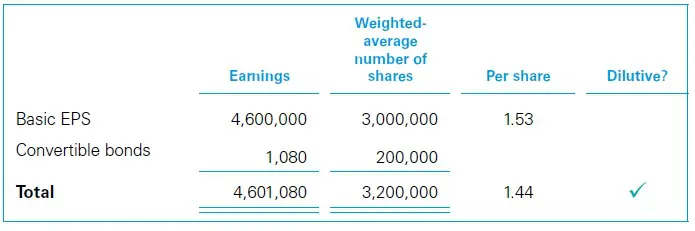
The potential impact of convertible bonds is determined as follows.

Contracts settled in shares or cash

Contracts settled in shares or cash

Accordingly, P includes the impact of the convertible bonds in diluted EPS.

Diluted EPS = 1.44

.uf3f3c2eddcbc430b88017675036d463a { padding:0px; margin: 0; padding-top:1em!important; padding-bottom:1em!important; width:100%; display: block; font-weight:bold; background-color:#ECF0F1; border:0!important; border-left:4px solid #141414!important; box-shadow: 0 1px 2px rgba(0, 0, 0, 0.17); -moz-box-shadow: 0 1px 2px rgba(0, 0, 0, 0.17); -o-box-shadow: 0 1px 2px rgba(0, 0, 0, 0.17); -webkit-box-shadow: 0 1px 2px rgba(0, 0, 0, 0.17); text-decoration:none; } .uf3f3c2eddcbc430b88017675036d463a:active, .uf3f3c2eddcbc430b88017675036d463a:hover { opacity: 1; transition: opacity 250ms; webkit-transition: opacity 250ms; text-decoration:none; } .uf3f3c2eddcbc430b88017675036d463a { transition: background-color 250ms; webkit-transition: background-color 250ms; opacity: 1; transition: opacity 250ms; webkit-transition: opacity 250ms; } .uf3f3c2eddcbc430b88017675036d463a .ctaText { font-weight:bold; color:#8E44AD; text-decoration:none; font-size: 16px; } .uf3f3c2eddcbc430b88017675036d463a .postTitle { color:#7F8C8D; text-decoration: underline!important; font-size: 16px; } .uf3f3c2eddcbc430b88017675036d463a:hover .postTitle { text-decoration: underline!important; }

Something else –   EPS Calculation – IAS 33 Best complete read

Case – Share-based payment – Counterparty has the settlement choice

The following basic facts relate to Company P.

  • Net profit for Year 1 is 4,600,000.
  • The number of ordinary shares outstanding on 1 January Year 1 is 3,000,000.

The following facts are also relevant for Year 1.

  • On 1 January, P grants the following share-based payment to its CEO, conditional on the CEO remaining in P’s employment for two years. On completion of the service period, the CEO can choose between:
    • 1,000,000 share appreciation rights (SARs) to be settled in cash at a price of 1 per SAR; or
    • 1,200,000 share options to be settled in P’s ordinary shares on payment of an exercise price that equals P’s share price at the grant date – i.e. 10.
  • The share-based payment is accounted for as a compound instrument under IFRS 2.
  • Assume that the fair values as determined under IFRS 2 were as follows for both the individual SAR and the individual share option:
    • 1 January: 1.00
    • 31 December: 1.30.
  • At the grant date, P determines the fair value of each component of the compound instrument as follows.
    • The liability component is measured as the fair value of the cash-settlement choice (SARs) – i.e. 1,000,000 x 1 = 1,000,000.
    • The equity component is measured as the difference between the equity-settlement choice (share options) and the cash-settlement choice – i.e. (1,200,000 x 1.0) – 1,000,000 = 200,000.
  • P recognises an expense for the portion of the services provided by the CEO during the year.
    • The expense for the liability component is recognised based on the reporting-date fair value – i.e. 1,000,000 x 1.30 x 1/2 = 650,000. The difference between the fair values at grant date and the reporting date is the portion recognised as a remeasurement expense – i.e. (1.30 – 1.00) x 1,000,000 x 1/2 = 150,000.
    • The expense for the equity component is recognised based on the grant-date fair value – i.e. 200,000 x 1/2 = 100,000. The equity component is not remeasured at the reporting date.
  • The remeasurement expense is tax-deductible. The applicable income tax rate is 40%.
  • The average market price of P’s ordinary shares during the year is 11.

Workings

The EPS computations for Year 1 are as follows.

Basic EPS

Diluted EPS

1. Determine the numerator

No adjustment is necessary. The numerator is 4,600,000.

1. Identify POSs

The share-based payment agreement is considered a POS, because it may entitle the CEO to P’s ordinary shares.

2. Determine the denominator

There is no change in the number of outstanding shares during the year. The denominator is therefore 3,000,000.

2. For each POS, calculate EPIS

For contracts that may be settled in ordinary shares or cash at the counterparty’s option, the entity uses the more dilutive manner of settlement of either the cash-settlement or the share-settlement.

Cash-settlement assumption

Under this assumption, there is no adjustment to the denominator because cash settlement would not result in any additional ordinary shares being issued. There is also no adjustment to the numerator, because the accounting for the liability under IFRS 2 is based on the fair value of the cash alternative – i.e. the cash-settlement would not result in consequential changes in profit or loss.

Share-settlement assumption

Under this assumption, the option can only be settled in ordinary shares.

Potential adjustment to the numerator for EPIS: The options, if they are exercised, would increase profit or loss for the year by the post-tax amount of the remeasurement expense:

(remeasurement expense on the options) x (1 – income tax rate) = (150,000) x (1 – 40%) = 90,000

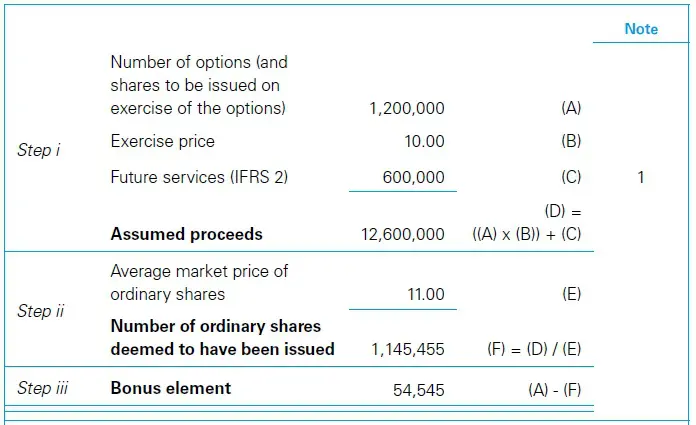
Potential adjustment to the denominator for EPIS: The adjustment is determined using the treasury share method (see 5.9.40) as follows.

Contracts settled in shares or cash

Contracts settled in shares or cash

Note

1. In this step, proceeds include the fair value of future services to be rendered by the CEO for the remaining period not vested. P applies Approach 1 in Example 5.17 and the assumed proceeds are the unearned IFRS 2 expense at 31 December Year 1:

1 x 1,200,000 x 1/2 = 600,000

EPIS is calculated as follows.

EPIS = 90,000 / 54,545 = 1.65

3. Determine basic EPS

Basic EPS = 4,600,000 / 3,000,000 = 1.53

3. Rank the POSs

This step does not apply, because there is only one class of POSs.

4. Determine basic EPS from continuing operations

Basic EPS is 1.53 (see Step 3 of basic EPS computation).

5. Identify dilutive POSs and determine diluted EPS

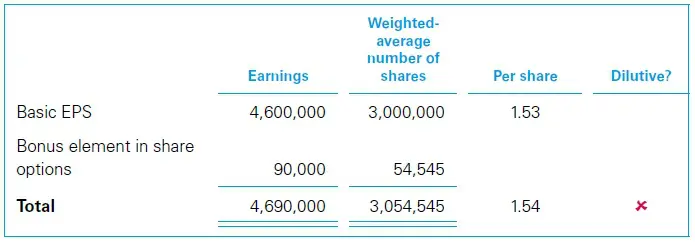
Under the equity-settlement assumption, the impact of the equity-settlement alternative is presented as follows.

Contracts settled in shares or cash

Contracts settled in shares or cash

Because the equity-settlement assumption is not dilutive and the cash-settlement assumption would not result in adjustments to the numerator and denominator, diluted EPS is the same amount as basic EPS.

Diluted EPS = 1.53

.u17df19fd683b583bd079c0d2cb6c3fdc { padding:0px; margin: 0; padding-top:1em!important; padding-bottom:1em!important; width:100%; display: block; font-weight:bold; background-color:#ECF0F1; border:0!important; border-left:4px solid #141414!important; box-shadow: 0 1px 2px rgba(0, 0, 0, 0.17); -moz-box-shadow: 0 1px 2px rgba(0, 0, 0, 0.17); -o-box-shadow: 0 1px 2px rgba(0, 0, 0, 0.17); -webkit-box-shadow: 0 1px 2px rgba(0, 0, 0, 0.17); text-decoration:none; } .u17df19fd683b583bd079c0d2cb6c3fdc:active, .u17df19fd683b583bd079c0d2cb6c3fdc:hover { opacity: 1; transition: opacity 250ms; webkit-transition: opacity 250ms; text-decoration:none; } .u17df19fd683b583bd079c0d2cb6c3fdc { transition: background-color 250ms; webkit-transition: background-color 250ms; opacity: 1; transition: opacity 250ms; webkit-transition: opacity 250ms; } .u17df19fd683b583bd079c0d2cb6c3fdc .ctaText { font-weight:bold; color:#8E44AD; text-decoration:none; font-size: 16px; } .u17df19fd683b583bd079c0d2cb6c3fdc .postTitle { color:#7F8C8D; text-decoration: underline!important; font-size: 16px; } .u17df19fd683b583bd079c0d2cb6c3fdc:hover .postTitle { text-decoration: underline!important; }

Something else –   Financial asset

Annualreporting provides financial reporting narratives using IFRS keywords and terminology for free to students and others interested in financial reporting. The information provided on this website is for general information and educational purposes only and should not be used as a substitute for professional advice. Use at your own risk. Annualreporting is an independent website and it is not affiliated with, endorsed by, or in any other way associated with the IFRS Foundation. For official information concerning IFRS Standards, visit IFRS.org or the local representative in your jurisdiction.

.u023bdb00d248ac0323d0e1daf1b4de57 { padding:0px; margin: 0; padding-top:1em!important; padding-bottom:1em!important; width:100%; display: block; font-weight:bold; background-color:#ECF0F1; border:0!important; border-left:4px solid #141414!important; box-shadow: 0 1px 2px rgba(0, 0, 0, 0.17); -moz-box-shadow: 0 1px 2px rgba(0, 0, 0, 0.17); -o-box-shadow: 0 1px 2px rgba(0, 0, 0, 0.17); -webkit-box-shadow: 0 1px 2px rgba(0, 0, 0, 0.17); text-decoration:none; } .u023bdb00d248ac0323d0e1daf1b4de57:active, .u023bdb00d248ac0323d0e1daf1b4de57:hover { opacity: 1; transition: opacity 250ms; webkit-transition: opacity 250ms; text-decoration:none; } .u023bdb00d248ac0323d0e1daf1b4de57 { transition: background-color 250ms; webkit-transition: background-color 250ms; opacity: 1; transition: opacity 250ms; webkit-transition: opacity 250ms; } .u023bdb00d248ac0323d0e1daf1b4de57 .ctaText { font-weight:bold; color:#8E44AD; text-decoration:none; font-size: 16px; } .u023bdb00d248ac0323d0e1daf1b4de57 .postTitle { color:#7F8C8D; text-decoration: underline!important; font-size: 16px; } .u023bdb00d248ac0323d0e1daf1b4de57:hover .postTitle { text-decoration: underline!important; }

Something else –   Accounting for mergers – Best 2 Read

Contracts settled in shares or cash Contracts settled in shares or cash Contracts settled in shares or cash Contracts settled in shares or cash Contracts settled in shares or cash Contracts settled in shares or cash Contracts settled in shares or cash Contracts settled in shares or cash Contracts settled in shares or cash Contracts settled in shares or cash  Contracts settled in shares or cash Contracts settled in shares or cash Contracts settled in shares or cash Contracts settled in shares or cash Contracts settled in shares or cash Contracts settled in shares or cash Contracts settled in shares or cash Contracts settled in shares or cash Contracts settled in shares or cash Contracts settled in shares or cash