Asset management or investment management
are closely related industries that in their core refer to the financial service of managing assets by means of financial instruments and/or other investments with the aim of increasing the invested assets.
An asset manager is a financial professional who analyses, collects and handles a client’s financial portfolio. Asset managers focus on specific asset investments, such as real estate, exchange-traded funds, stocks or fixed-income securities. An asset manager’s goal is to increase returns from client investments and restructure them when needed to gain their clients more profit.
An investment manager is a general term for a financial professional who uses risk assessment to ensure their clients receive a profitable return on their investments. Their duties include tax planning, estate planning, retirement planning, philanthropy and education. The main goal of an investment manager is to generate a steady flow of profit through investment strategies for their clients.
A primary difference between asset managers and investment managers is their customer base. Asset managers typically work with individuals or businesses that have extensive amounts of money, while investment managers often work with individuals or businesses with any size of income.
The two most significant IFRS accounting matters for asset management or investment management entities are:
- Timing of revenue and profit recognition
- Valuation of investments (assets) the entity holds or invests on behalf of its customers
- IFRS 9 Financial instruments, and
- IAS 40 Investment property.
Timing of revenue and profit recognition
The timing of revenue and profit recognition is the determining factor in IFRS reporting for asset management or investment management entities. IFRS 15 is more prescriptive in many areas relevant to the asset management or investment management industry.
Asset management or investment management entities apply the five-step model to determine when to recognise revenue, and at what amount. The model specifies that revenue is recognised when or as an entity transfers control of goods or services to a customer at the amount to which the entity expects to be entitled. Depending on whether certain criteria are met, revenue is recognised:
- over time, in a manner that best reflects the entity’s performance; or
- at a point in time, when control of the goods or services is transferred to the customer.
Step 1 – Determine the customer’s identity
Issue: Who are the customers?
The funds or the investors in those funds? >>> This may affect the timing of revenue recognition
An investment manager generally enters into contracts with a fund to provide services, but the funds are vehicles that enable investors to pool their money to benefit from an investment manager’s services. This situation raises the question of whether the customer’s identity is the fund or each individual investor in the fund.
Subtle differences in the structure of the arrangements may lead to different conclusions on whether a fund, or an investor in the fund, is the customer in a contract. This conclusion could affect the following:
- Timing of revenue recognition: For example, when an investment manager has multiple contracts or multiple promises in a contract that would be accounted for either separately or as a single performance obligation depending on who the customer is for each individual contract or promise – see Performance obligations.
- Accounting for certain costs: For example, costs associated with launching a new fund or obtaining new investors could be either expensed as incurred or capitalised depending on whether they are associated with obtaining customers or fulfilling performance obligations – see Contract costs.
Investment management companies need to consider the specific facts and circumstances of each arrangement when identifying the customer. However, the key when identifying the customer is to identify which party the company has enforceable rights and obligations with. For large retail funds, the fund is often the customer of the fund manager.
However, for smaller, boutique funds, the individual investor could be identified as the customer because, in these cases, it is more likely that enforceable rights and obligations will exist directly between the investor and the fund manager – e.g. a limited liability partnership set up by a fund manager that has a small number of investors, each of whom are limited partners.
The following characteristics may be helpful when determining whether a fund (rather than its investors) is the customer.
|
Attribute |
Benchmark |
|
Visibility of the ultimate investor |
|
|
Fee arrangements |
|
|
Fund governance |
|
|
Legal structure |
|
|
Termination clause |
|
|
Service providers |
|
|
Regulation |
|
|
Worked example – Identifying the fund as the customer |
|
Investment Management Company P establishes a closed-end fund (a fund with a fixed number of shares in issue) that issued its units through the local stock exchange. The number of participation units issued to the public is large and investor turnover is high. The fund’s terms, as determined by local regulation, are as follows.
P considers whether the fund or the investors in the fund is the customer in the arrangement. P notes that it has no direct contact with the investors. Instead, a trustee is appointed to represent the investors’ interests. P also identifies that a contract between it and the fund exists, which creates enforceable rights and obligations for the investment management services that it provides and the consideration that it receives for providing those services. Therefore, P concludes that the fund is its customer. This is supported by the following characteristics of the fund.
|
|
Worked example – Identifying the investors as the customer – Institutional clients |
|
Investment Management Company X establishes a single closed-end fund that serves multiple institutional clients – e.g. insurance companies. X negotiates a bespoke management agreement with each client separately. X’s fund issues a special institutional share class for each client in accordance with its management agreement. X evaluates the arrangement to identify the customer. X determines that each institutional client is a customer, in a separate contract (see Combining contracts). This is because X has a separate contract with each institutional client that sets out its enforceable rights and obligations. In addition, X can identify each institutional client, because it has negotiated a bespoke management agreement with each one of them. |
|
Worked example – Identifying the investors as the customer – Pension fund |
|
Pension Fund Manager F manages a pension fund. The fund’s investment policy is set and controlled by F. To invest in the fund, an investor enters into a contract with F that sets out the investment amount, the terms of redemption and the fee payable to F for its investment management services. Each investor can negotiate the management fee that it will pay to F as part of the contract. F keeps a record of all of the investors in the fund and their share of the fund’s assets. The management fees payable to F under the investors’ contracts are paid by the fund directly. F evaluates the arrangement to identify the customer. F determines that the individual investors are its customers. This is because it has separate contracts with each investor that set out its enforceable rights and obligations. Further, F can identify each individual investor in the fund and negotiates with them individually to agree the fee for its investment management services. |
Step 1 – Apply the contract combination guidance
Issue: When to combine one or more contracts and account for them as one
The following decision tree outlines the criteria in IFRS 15 for determining when an entity combines two or more contracts and accounts for them as a single contract.

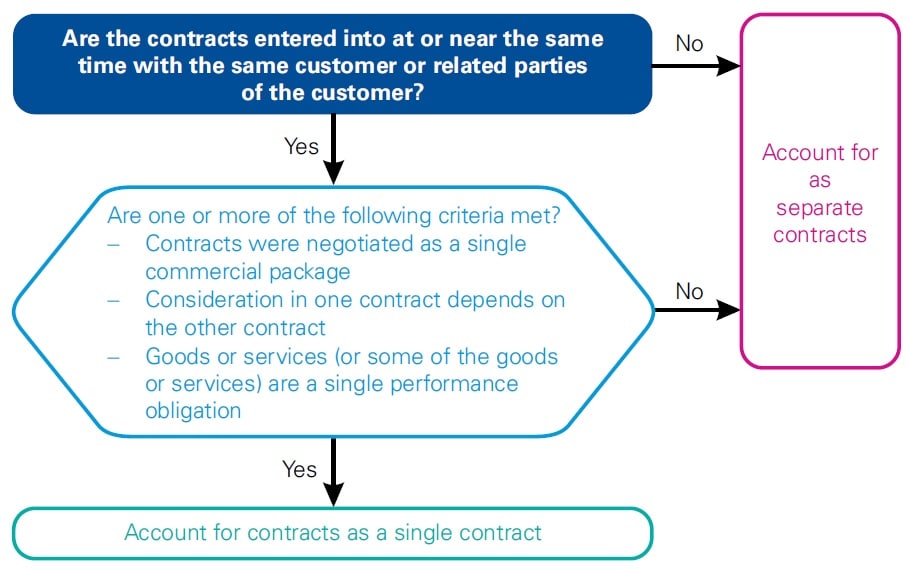
Reference is made to combining contracts for a comprehensive explanation.
Combining of contracts depends on the customer’s identity
For two or more contracts to be combined, the new standard requires that they need to be with the same customer (or a related party of the customer).
Therefore, if the investors in a fund are identified as the customer by a fund manager (see Identifying the customer), then the individual contracts with investors cannot be combined under the new standard.
However, the investment management company may be able to account for the contracts with individual investors together as a portfolio, using the portfolio practical expedient, if:
- those contracts have similar characteristics; and
- the company reasonably expects the outcome from applying the new standard to a portfolio of contracts, or to contracts individually, not to be materially different.
Conversely, if the fund is identified as the customer, then an investment management contract is accounted for as a single unit of account.
Separate agreements for different services may be combined
Some of the services provided by an investment manager may be included in separate contracts from the main investment management services agreement. For example, investment managers may sign separate contracts with a fund for administrative and distribution services.
In addition, investment managers may enter into side letter agreements to modify the contracts with their customers. If the contracts were signed at or near the same time, then they may be combined, depending on the investment manager’s specific facts and circumstances.
|
Worked example – Combining contracts |
|
Fund Manager M enters into a contract to provide investment management services to Fund F. Three days later, in a separate contract, M enters into a contract to prepare F’s financial statements and other regulatory reports. During the negotiations, M agrees to provide investment management services at a discount if it also provides administrative services to F. M concludes that the two contracts should be combined because they were entered into with the same customer at nearly the same time and they were negotiated as a single commercial package. |
Step 2/5 – Unbundling multiple service obligations within a single contract
Issue: Area in which management may have to exercise a significant level of judgement.
A performance obligation is the unit of account for revenue recognition. An entity assesses the goods or services promised in a contract with a customer and identifies as a performance obligation either:
- a good or service (or a bundle of goods or services) that is distinct; or
- a series of distinct goods or services that are substantially the same and have the same pattern of transfer to the customer – i.e. each distinct good or service in the series is satisfied over time and the same method is used to measure progress.
At contract inception, an entity evaluates the promised goods or services to determine which goods or services (or bundle of goods or services) are distinct and, therefore, constitute a performance obligation.

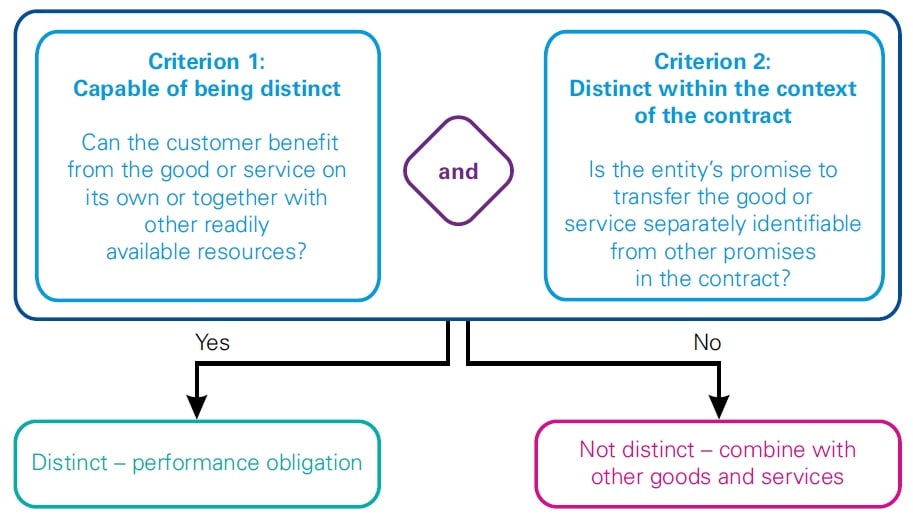
Promises to transfer a good or a service can be stated explicitly in a contract or implicitly, based on established business practices that create a valid expectation that the entity will transfer the good or service. Conversely, tasks that do not transfer a good or service to the customer are not separate performance obligations and are not included in the analysis – e.g. administrative set-up tasks (see IFRS 15 Scope).
In respect of this matter more detailed (generic) explanations are available at: Step 2: Identify the performance obligations in the contract.
Some contracts offered by investment management companies may integrate different services into a single package – e.g. administrative services, investment management services and custody services. When all of the identified services are performed concurrently for the same period, the impact of separating performance obligations may be limited to disclosure only. In other cases, the identification of performance obligations may impact the timing or amount of revenue recognised for a period, as illustrated below.
An investment management company’s conclusion on whether its customer for each service provided is the fund or its underlying investors (see Identifying the customer) may influence the outcome of a company’s assessment of the number of performance obligations in a contract. This is because contracts with different, unrelated customers cannot be combined (see Combining contracts) and, therefore, services granted to different customers cannot be considered as a single performance obligation.
Investment management services contracts are generally considered to meet the series guidance requirements. This is because they represent the delivery of a continuous service to the customer over the contract period with each time increment of service provided – e.g. each hour or each day – being distinct from the next.
Each time increment also meets the over-time criteria because the customer consumes the benefits of the service as the investment manager provides it and the measure of progress is the same – i.e. time-elapsed. Because the criteria to apply the series guidance are met, the company accounts for all of the services that make up the series as a single performance obligation.
|
Worked example – Up-front fees for distribution services |
|
Parent Company G consolidates Investment Management Company F and Broker B, which distributes F’s products. B charges investors up-front fees on subscription to F’s funds. Judgement is required to determine whether:
If the distribution services are a separate performance obligation satisfied at a point in time, then revenue is recognised up-front, even if G did not charge a fee for this service separately. If the distribution and investment management services are a single performance obligation, then any up-front fee is recognised over time (see Non-refundable up-front fees). A similar analysis would be required if F provided both the distribution service and the investment management services to the customers. |
|
Worked example – Series of distinct services |
|
Investment Management Company S enters into a five-year contract with a customer to provide investment management services. S receives a 2% quarterly management fee based on the assets under management at the end of each quarter. S concludes that the individual time increments of service within the five-year contract are distinct from each other. Criterion 1 is met because the customer can benefit from each time increment of service provided independently of the other. Criterion 2 is met because each time increment does not significantly modify or customise the other and S is not providing a service of combining the time increments together to create a single combined output for the customer. However, S concludes that all of the time increments during the five-year contract represent a series of distinct services. Therefore, the contract is treated as a single performance obligation. The distinct time increments meet the series criteria because:
Even though the series guidance applies and the entire contract is treated as a single performance obligation, S concludes that it can allocate the quarterly management fee to each quarter using the allocation guidance in the new standard, which allows an entity to allocate variable consideration to one or more distinct goods or services within the contract – see Allocation of transaction price. |
Step 3 – Treatment of upfront fees
Issue: Upfront fees may include fees received for sale of fund interests and initial sign up fees.
Recognition depends on whether a PO separate from the PO relative to the provision of management services has been identified.
In the investment management sector, it is common for entities to receive an initial ‘sign-on’ fee. Unless control of distinct goods and services is transferred to the customer at the outset, an upfront fee should be regarded as an advance payment for future goods and services and should be recognised as revenue when those future goods and services are provided.
Often, upfront fees are charged in order to cover initial sign-up costs, but this is not in itself sufficient to justify upfront revenue recognition.
An entity assesses whether a non-refundable up-front fee relates to the transfer of a promised good or service to the customer. In many cases, even though a non-refundable up-front fee relates to an activity that the entity is required to undertake to fulfil the contract, that activity does not result in the transfer of a promised good or service to the customer. Instead, it is an administrative task.
If the activity does not result in the transfer of a promised good or service to the customer, then the non-refundable up-front fee is an advance payment for performance obligations to be satisfied in the future and is recognised as revenue when those future goods or services are provided.
If the non-refundable up-front fee gives rise to a material right for future goods or services, then an entity attributes all of it to the goods and services to be transferred, including the material right associated with the up-front payment.

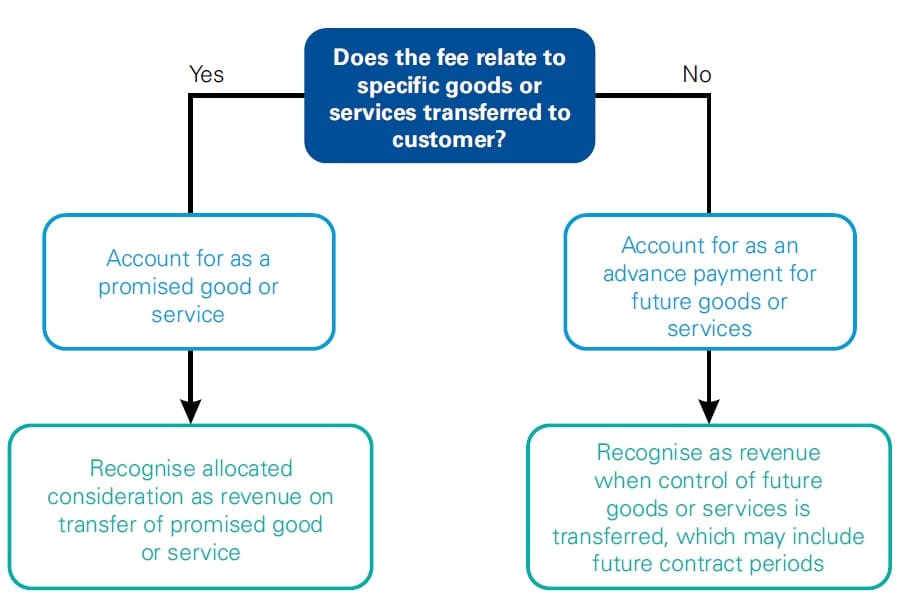
Determining whether a non-refundable up-front fee relates to the transfer of a promised service
In many cases, even though a non-refundable up-front fee relates to an activity that an investment management company is required to undertake at or near contract inception to fulfil the contract, that activity does not result in the transfer of a promised service to the customer. IFRS 15 specifically notes that administrative set-up activities do not represent a service that is transferred to a customer and, therefore, revenue cannot be recognised when these activities are undertaken.
When assessing whether the non-refundable up-front fee relates to the transfer of a promised service, an investment management company considers all relevant facts and circumstances, including:
- whether a service is transferred to the customer in exchange for the non-refundable up-front fee and the customer is able to realise a benefit from the service received. If no service is received by the customer or if it is of little or no value to the customer without obtaining other services from the company, then the non-refundable up-front fee is likely to represent an advance payment for future services; and
- if the company does not separately price and sell the activities covered by the non-refundable up-front fee, then it may not relate to the transfer of a promised service.
Non-refundable up-front fee may give rise to a material right
Investment management companies may grant their customers a contractual option to extend their investment management contracts. Alternatively, a customer may have the right to terminate a contract without a penalty (see Contract term). Combined with a non-refundable up-front fee, these clauses may give rise to material rights to extend a contract, which are accounted for as a separate performance obligation (see Performance obligations).
A non-refundable up-front fee may provide the customer with a material right if it is of such significance that it is likely to impact the customer’s decision on whether to extend the service or not exercise a termination clause.
An investment management company considers both quantitative and qualitative factors when assessing whether a non-refundable up-front fee provides the customer with a material right, because it would probably impact the customer’s decision on whether to exercise the option to continue receiving the company’s services.
These could be, for example, the customer’s ability to obtain similar investment management services from other companies without having to pay a non-refundable up-front fee, or regulatory or administrative restrictions that make it inconvenient for the customer to change investment manager.
Considering whether a non-refundable up-front fee gives rise to a significant financing component
An investment management company may also need to consider whether the receipt of a non-refundable up-front payment gives rise to a significant financing component within the contract. This is because significant financing components arise when there is a timing difference between a company providing the service to the customer and receiving the consideration for that service. When determining if the contract includes a significant financing component, all relevant facts and circumstances need to be evaluated.
|
Worked example – Non-refundable up-front fees |
|
Investment Management Company U enters into a one-year contract to provide investment management services to an investor. In addition to a monthly fee of 1% of the managed assets, U charges a one-time subscription fee of 50. U determines that this is a set-up activity that does not transfer a service to the investor, but instead is an administrative task. U expects to earn a monthly fee of 10 from the contract. At the end of the year, the investor can renew the contract on a month-to-month basis, at a similar monthly rate. The investor will not be charged another fee on renewal. U considers both quantitative and qualitative factors when determining whether the up-front fee provides an incentive for the investor to renew the contract beyond the stated contract term.
These factors are also reflected in a strong history of renewals and an average customer life that is longer than one year. U concludes that the up-front fee results in a contract that includes a customer option that is a material right. Therefore, it allocates the up-front fee between the one-year investment management services and the material right to renew the contract. The consideration allocated to the material right will be recognised as revenue when that right is exercised or expires. |
Step 3 – Variable consideration: the recognition of Management fees and Performance fees
Issue: Requires the exercise of judgement and may change pattern of revenue recognition for fund managers.
IFRS 15 requires an entity to apply a constraint on variable consideration. The magnitude and likelihood of a revenue reversal need to be considered.
Contracts in the investment management sector include significant variable elements, such as performance bonuses or penalties. For example, a performance bonus may be payable if and when certain conditions are met, or based on net assets under management.
There are specific requirements in respect of variable consideration such that it is only included in the transaction price if it is highly probable that the amount of revenue recognised would not be subject to significant future reversals as a result of subsequent re-estimation.
Items such as price concessions, incentives, performance bonuses, completion bonuses, price adjustment clauses, penalties, discounts, refunds, rights of return, credits or similar items may result in variable consideration.
The following decision tree sets out how an entity accounts for variable consideration.

 The method used by an entity to estimate variable consideration is not an accounting policy choice. The entity selects the method that best predicts the amount of consideration it expects to receive.
|
Expected value |
The entity considers the sum of probability-weighted amounts for a range of possible consideration amounts. This may be an appropriate estimate of the amount of variable consideration if the entity has a large number of contracts with similar characteristics. |
|
Most likely amount |
The entity considers the single most likely amount from a range of possible consideration amounts. This may be an appropriate estimate of the amount of variable consideration if the contract has only two (or perhaps a few) possible outcomes. |
After estimating the variable consideration, an entity may include some or all of it in the transaction price – but only to the extent that it is highly probable that a significant reversal in the amount of cumulative revenue will not occur when the uncertainty associated with the variable consideration is subsequently resolved.
To assess whether – and to what extent – it should apply this ‘constraint’, an entity considers both:
- the likelihood of a revenue reversal arising from an uncertain future event; and
- the potential magnitude of the revenue reversal when the uncertainty related to the variable consideration has been resolved.
When making this assessment, an entity uses judgement, giving consideration to all facts and circumstances – including the following factors, which could increase the likelihood or magnitude of a revenue reversal.
- The amount of consideration is highly susceptible to factors outside the entity’s influence – e.g. volatility in a market.
- The uncertainty about the amount of consideration is not expected to be resolved for a long period of time.
- The entity’s experience with (or other evidence from) similar types of contracts is limited, or has limited predictive value.
- The contract has a large number and a broad range of possible consideration amounts.
This assessment needs to be updated at each reporting date.
In respect of this matter more detailed (generic) explanations are available at: Step 3: Determine the transaction price.
Constraining variable consideration depends on the nature of the fee
For investment management contracts, the majority of the consideration in the contract will generally be variable consideration. Variable consideration may take many forms. A management fee based on net asset value (NAV) at the end of each quarter and performance fees payable when a specified return level is achieved are both examples of variable consideration. In addition, fees that vary depending on whether a fund under- or over-performs compared with a benchmark (often referred to as ‘fulcrum fees’) are also a form of variable consideration.
The most appropriate approach for estimating these types of variable consideration is the expected value method because there are a large number of possible outcomes. However, if the variable consideration is a one-off bonus payment when a specified level of returns is achieved, then the most likely amount approach may be appropriate.
Variable consideration in investment management contracts may be constrained to zero until the uncertainty is resolved. This is because the magnitude of the variability is generally significant. In addition, market volatility is outside the control of the company and previous contracts may have a limited predictive value regarding the outcome of the current contract.
For example, if the contract includes a performance fee that is paid based on performance over the entire contract period, then the company may not be able to recognise revenue for this element of the transaction price until the end of the contract period.
This may be the case for ‘carried interest’ arrangements, where the fund manager is compensated only after the fund returns all of its investors’ capital contributions and an agreed-on rate of return. Similarly, if a fee is subject to claw-back, then the company may not be able to recognise revenue for the fee that is subject to the claw-back until the claw-back period has expired.
However, a company may be able to recognise revenue for management fees that are based on NAV at specified dates during the contract period, and not subject to subsequent claw-back, because the variability for these fees is generally resolved at the specified date. For a discussion of the allocation of variable fees to distinct time increments within a performance obligation, see Allocation of transaction price.
Fee waivers and fee caps may be either variable consideration or a contract modification
Accounting for fee waivers and fee caps depends on the specific facts and circumstances of the investment management contract in which they are included. These clauses may be:
- variable consideration: if they are part of the original terms of the investment management agreement (or a contract that is combined with the original investment management agreement (see Combining contracts)). This evaluation includes an assessment of the investment management company’s past practice and other activities that could give rise to an expectation at contract inception that the transaction price includes a variable component; or
- a contract modification: if a customer and an investment management company agree to amend the consideration in an existing investment management contract (or enter into a new contract that amends the consideration in an existing investment management contract). More details are provided in contract modifications.
|
Worked example – Applying the constraint and allocating variable consideration |
||||||||
|
Investment Manager M enters into a two-year contract to provide investment management services to its customer, Fund N. N’s investment objective is to invest in equity instruments issued by large listed companies. M receives the following fees in cash for providing the investment management services.
M determines that the contract includes a single performance obligation (series of distinct services) that is satisfied over time and identifies that both the management fee and the performance fee are variable consideration. Before including the estimates of consideration in the transaction price, M considers whether the constraint should be applied to either the management fee or the performance fee. At contract inception, M determines that the cumulative amount of consideration is constrained because the promised consideration for both the management fee and the performance fee is highly susceptible to factors outside its own influence. In addition, M observes that its experience with similar contracts has little predictive value in determining the future performance of this fund. At each subsequent reporting date, M makes the following assessment of whether any portion of the consideration continues to be constrained.
As a result, M determines that the revenue recognised during the reporting period is limited to the quarterly management fees for completed quarters. This is determined at each reporting date and could change towards the end of the contract period. |
|
Worked example – Applying the constraint |
|
Investment Manager M enters into a three-year contract to provide investment management services to Fund L. L is nearing its final liquidation and M is asked to execute the investment policy during the run-off period. M will be entitled to a significant bonus at the end of the contract if the proceeds from the liquidation of L’s assets exceed 2,000,000. M notes that:
Therefore, during the third year, M may be able to conclude that it is sufficiently likely that:
If this is the case, then M may include the expected bonus in the transaction price during the third year of the contract, before the final resolution of the uncertainty. |
Contract costs
Issue: Certain costs may need to be capitalised, amortised and regularly checked for impairment. IFRS 15 requirements for contract costs may change current practice for some asset managers.
Proper customer identification is a key part to this analysis.
Costs to obtain a contract
Capitalise costs of obtaining a contract if they are incremental and expected to be recovered (e.g., sales commissions), unless the expected amortisation period (noted below) is one year or less (i.e., practical expedient can be applied and cost is expensed).
Costs to fulfill a contract
Recognise assets in accordance with other standards (i.e., IAS 2, IAS 16, IAS 38, etc.), otherwise capitalise costs that meet all of the following:
- Relate directly to the contract (or specific anticipated contract)
- Generate/enhance a resource that will be used to satisfy obligations in the future, and
- Are expected to be recovered.
IFRS 15 introduced specific criteria for determining whether to capitalise certain costs, distinguishing between those costs associated with obtaining a contract (e.g. sales commissions) and those costs associated with fulfilling a contract.
In the investment management sector, significant costs are incurred that are directly attributable to obtaining contracts with customers, for example through ‘success fees’ (i.e. commissions that are only payable if a contract is obtained). IFRS 15 requires entities to capitalise success fees, which will have an impact on operating profits.
In addition, IFRS 15 requires capitalised contract costs to be amortised on a systematic basis that is consistent with the pattern of transfer of the goods or services. Entities need to exercise judgement to determine the appropriate basis and time period for this amortisation.
An entity recognises an impairment loss in relation to capitalised contract costs to the extent that the carrying amount of the asset exceeds the recoverable amount. The ‘recoverable amount’ is the:
- remaining amount of consideration expected to be received in exchange for the goods or services to which the asset relates. This amount is determined using the same principles for determining the transaction price. However, any variable consideration is not constrained and the amount is adjusted to reflect the customer’s credit risk; less
- costs that relate directly to providing those goods or services and that have not been recognised as expenses.
In respect of this matter more detailed (generic) explanations are available at: Contract costs.
Capitalisation of costs to obtain a contract may depend on the customer’s identity
Some fund managers pay commissions to distributors – e.g. banks or brokers – when a new investor is introduced to a fund. Fund managers need to evaluate whether these costs are incremental costs of obtaining the contract. This may not always be the case, especially when the fund, rather than the investors in the fund, is identified as the customer.
For example, if a fund manager identifies the fund as its customer in an arrangement, then commissions paid to brokers when an investor purchases shares in the fund may not be considered as incremental costs of obtaining the contract. This is because the contract with the customer (the fund) already exists and, in this case, the costs would not qualify to be capitalised as the costs of obtaining a contract.
Application of the practical expedient
Under the new standard, investment management companies can choose to expense the costs of obtaining a contract as incurred when the amortisation period for the asset created is one year or less. When determining the amortisation period, a company considers the period over which the good or services to which the costs relate will be provided under existing and anticipated future contracts. That is, when making this assessment a company takes into account expected renewals.
For example, if an investment manager incurs incremental costs to obtain contracts with customers that have an initial term of one year, but a significant proportion of these customers renew their contracts at the end of the initial term, then it cannot assume that it is eligible for the practical expedient. Instead, it determines the amortisation period, which is longer than one year.
Renewal commissions may affect capitalisation
Investment management companies frequently pay commissions to distributors for both initial and renewal contracts. Sometimes the commissions paid for the initial contract are substantially greater than those paid for a renewal contract.
If the renewal commission is considered ‘commensurate’ with the initial commission, then the commission relates to services over a period up to the payment of the renewal commission. For example, if a renewal commission is payable annually and the subsequent commissions are considered commensurate with the initial commission, then the amortisation period for the initial commission is one year.
When making the ‘commensurate’ evaluation, a company considers whether the economic benefits that it expects to obtain from the commission − i.e. the margin that it expects to earn from providing the service – is commensurate with the commission paid. Therefore, when a company’s expected economic benefits from providing services during a renewal period are commensurate with those from providing the same services during the initial period, the renewal and initial commissions that will be paid will be roughly equal if they are considered ‘commensurate’ with each other.
Specific anticipated contracts are considered in the impairment test
The new standard specifies that an asset relating to contract costs is impaired if its carrying amount exceeds the remaining amount of consideration that an investment management company expects to receive, less the costs that relate directly to providing those goods or services and that have not been recognised as expenses.
Under IFRS 15, an investment management company considers specific, anticipated contracts when capitalising contract costs. Consequently, it includes cash flows from both existing contracts and specific, anticipated contracts when determining the consideration expected to be received when performing the impairment analysis.
However, the investment management company excludes from the amount of consideration the portion that it does not expect to collect, based on an assessment of the customer’s credit risk.
|
Worked example – Costs incurred to obtain a contract |
||||||||
|
Investment Management Company T provides management services to private customers. Following a competitive tender process, T wins a contract to provide services to a new customer. T incurred the following costs to obtain the contract.
The success fees payable to sales employees are incremental costs to obtain the contract, because they are payable only on successfully obtaining the contract. Therefore, T recognises an asset of 10, subject to recoverability. Conversely, the legal fees and travel costs are incurred regardless of whether the contract is obtained. Therefore, T expenses these costs as they are incurred. |
|
Worked example – Costs of bringing new investors to an existing fund |
|
Investment Management Company P establishes a closed-end fund that issues its units in the local stock exchange. P has identified the fund, and not the investor, as the customer in its investment management contract. P paid Underwriter U a 1,000 success fee for the initial distribution of the fund’s units. It has also entered into an agreement to pay Broker B a fee of 0.1 for every unit of the fund that is subsequently marketed to a new investor. P concludes that:
The costs capitalised under the new standard are subject to its amortisation and impairment requirements. |
|
Worked example – Renewal commissions |
||||||||||||||||||||
|
Pension Fund Manager M provides investment management services to employees for a variable annual fee of 1% of the managed assets’ value. Employees have the option to move their savings freely between pension funds every year. M concludes that:
M pays an insurance agency 500 for securing the initial contract with each employee and will pay 100 to the insurance agency for each renewal – i.e. extending the contract for an additional year. M determines that the payments to the insurance agency represent incremental costs of obtaining contracts. Securing an initial contract generally requires a significant amount of effort from the insurance agency. Less effort is generally required to secure the renewal, which may only involve making a few phone calls or sending an email to confirm that the employee wants to keep their savings in the fund. M concludes that the renewal commission is not commensurate with the initial commission. This is because the commission paid initially is five times greater than the renewal commission, but the economic benefits – i.e. the margin – that M expects to obtain from the renewal are roughly the same as those that it expects to obtain from the initial contract. Therefore, the initial commission is a partial prepayment for the economic benefits that M expects to receive from subsequent renewal periods. This cost is not subject to the practical expedient and is capitalised as an incremental cost of obtaining the contract.
|
|
Worked example – Costs of obtaining a contract with a fund and a fund’s investors |
|
Investment Management Company L was appointed as the investment manager of two funds:
L manages a single pool of assets within a single legal entity, which it does not consolidate, for the two contracts. The legal entity issues a separate ‘institutional share class’ to facilitate the investment management contract with P. Step 1 of the model – Identity of the customer (see Identifying the customer) L identifies two contracts with two different customers.
L notes that the contracts cannot be combined, because C and P are not related parties. Step 3 of the model – Determine the transaction price Even though L is expected to receive a single stream of fees from managing a pool of assets within a single legal entity, these cash flows represent the transaction price of the contracts with both C and P. Therefore, L allocates the fees between the two contracts when applying IFRS 15. Contract costs L employs distribution staff who are paid, in addition to fixed employee benefits, a percentage of the new funds added to the managed assets. L pays its employees:
L concludes that:
The costs capitalised under the new standard are subject to its amortisation and impairment requirements. |
Annualreporting provides financial reporting narratives using IFRS keywords and terminology for free to students and others interested in financial reporting. The information provided on this website is for general information and educational purposes only and should not be used as a substitute for professional advice. Use at your own risk. Annualreporting is an independent website and it is not affiliated with, endorsed by, or in any other way associated with the IFRS Foundation. For official information concerning IFRS Standards, visit IFRS.org or the local representative in your jurisdiction.


Asset management Asset management Asset management Asset management Asset management Asset management Asset management Asset management Asset management Asset management Asset management Asset management Asset management Asset management Asset management Asset management Asset management Asset management Asset management Asset management
Asset management Asset management Asset management Asset management Asset management Asset management Asset management Asset management Asset management Asset management Asset management Asset management Asset management Asset management Asset management Asset management Asset management Asset management Asset management Asset management Asset management Asset management Asset management Asset management Asset management Asset management Asset management
Asset management Asset management Asset management Asset management Asset management Asset management Asset management Asset management Asset management Asset management Asset management Asset management Asset management Asset management Asset management Asset management Asset management Asset management Asset management Asset management Asset management Asset management Asset management Asset management Asset management Asset management Asset management