(adsbygoogle = window.adsbygoogle || []).push({});
Best guide IFRS 16 Lessee modifications
summarises the process surrounding changes in lease contracts that identify as lease modification.
A lessee that chooses not to apply the practical expedient (IFRS 16 option for rent concessions arising directly from the COVID-19 pandemic that are not going to be accounted for as lease modifications), or agrees changes to its lease contracts that do not qualify for the practical expedient, assesses whether there is a lease modification.
Overview
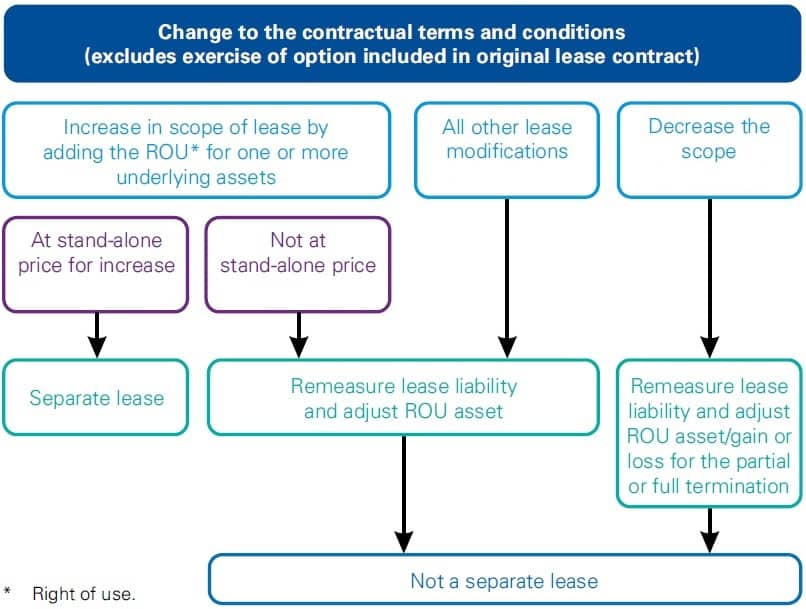
A change in the scope of a lease, or the consideration for a lease, that was not part of the original terms and conditions meets the standard’s definition of a lease modification.
A lessee accounts for a lease modification as a separate lease if both of the following conditions exist:
- the modification increases the scope of the lease by adding the right to use one or more underlying assets; and
- the consideration for the lease increases by an amount equivalent to the stand- alone price for the increase in scope and any appropriate adjustments to that stand-alone price to reflect the circumstances of the particular contract.
For a modification that is not a separate lease, at the effective date of the modification the lessee accounts for it by remeasuring the lease liability using a discount rate determined at that date and:
- for modifications that decrease the scope of the lease: decreasing the carrying amount of the right-of-use asset to reflect the partial or full termination of the lease, and recognising a gain or loss that reflects the proportionate decrease in scope; and
- for all other modifications: making a corresponding adjustment to the right-of- use asset.
The following diagram summarises the accounting for lease modifications by a lessee.
Discount rates
Reference: IFRS 16.45, BC202–BC203
When a lease modification is accounted for as a new lease, the lessee accounts for the separate lease in the same way as any new lease, using a new discount rate.
A lessee revises the discount rate when there is a modification that is not accounted for as a separate lease. The use of a revised discount rate in remeasuring the lease liability reflects the fact that the lease modification has changed the economics of the lease – because of the change in scope and/or price – which the discount rate is intended to reflect.
The revised discount rate is the interest rate implicit in the lease for the remainder of the lease term, unless this cannot be readily determined. If the implicit rate cannot be readily determined, then the revised discount rate is the lessee’s incremental borrowing rate at the effective date of the lease modification.
|
In which modification scenarios does a lessee revise the discount rate? Reference: IFRS 16.44-45 |
||||||
|
A lessee determines a new or revised discount rate each time a lease is modified. Although the lease modification guidance is complex, there are essentially two possible outcomes, as follows:
|
Separate lease
A lessee accounts for a lease modification as a separate lease if both of the following conditions exist:
- the modification increases the scope of the lease by adding the right to use one or more underlying assets; and
- the consideration for the lease increases by an amount equivalent to the stand- alone price for the increase in scope and any appropriate adjustments to that stand-alone price to reflect the circumstances of the particular contract.
In this case, the lessee:
- accounts for the separate lease in the same way as any new lease; and
- makes no adjustment to the initial lease.
|
Worked example – Increase in scope by adding the right to use one or more underlying assets and corresponding increase in consideration (IFRS 16.44, IFRS 16 Ex 15) |
|
Lessee Z entered into a lease contract with Lessor L to lease one floor in an office building for 10 years. Z’s business has since expanded and Z now requires additional office space. At the beginning of Year 7, Z and L amend the contract to grant Z the right to use an additional floor of office space in the same building for four years. The new office space is the same size as the original office space and similar in all significant respects. The lease payments for the new office space are commensurate with market rentals for office space of that size and characteristic. However, Z receives a 5% discount for the new office rentals because its existing relationship with L enabled L to forego costs that it would have incurred if the additional floor had been leased to a new tenant – e.g. marketing costs, rental agent’s commission, costs for undertaking credit checks etc. The lease of the additional office space was not part of the original terms and conditions of the contract. Therefore, this is a lease modification. Z accounts for this modification as a separate lease at the effective date of the lease modification because:
Z does not modify the accounting for the original office space lease. |
Not a separate lease
Reference: IFRS 16.45–46
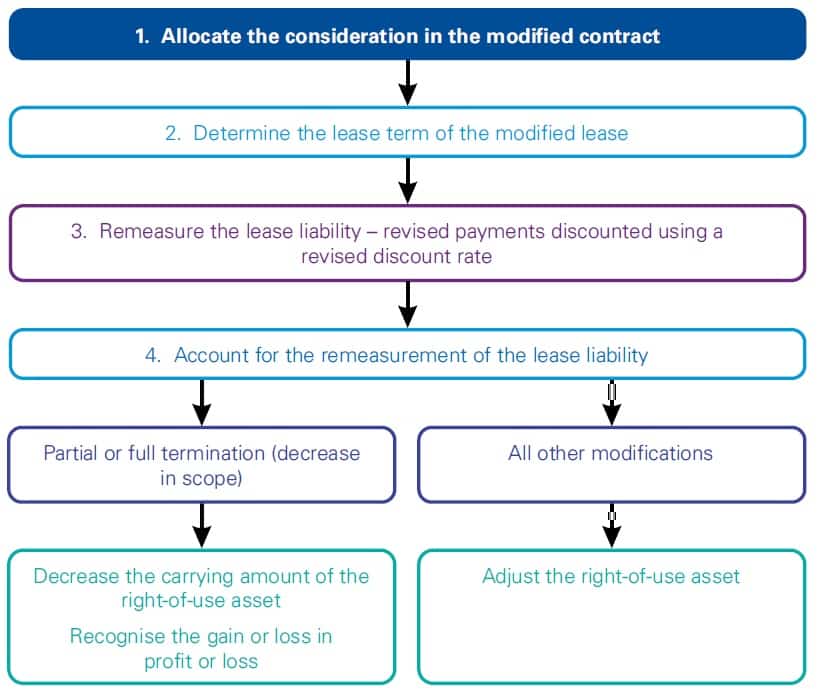
The following flowchart summarises the steps for accounting for a modification that is not a separate lease at the effective date of the modification.
Increase in scope not at stand-alone price
Reference: IFRS 16.45–46
A lessee accounts for a lease modification that increases the scope by adding the right to use one or more underlying assets but for which the consideration is not at a stand-alone price as follows:
- allocate the consideration to each lease component on the basis of the relative stand-alone price of the lease components and the aggregate stand-alone price of the non-lease components;
- determine the lease term;
- remeasure the lease liability by discounting the revised lease payments at the revised discount rate; and
- make a corresponding adjustment to the right-of-use asset.
|
Worked example – Increase in scope by adding the right to use one or more underlying assets with no corresponding increase in consideration (IFRS 16.45) |
|
Assume the same facts as in the above example, except that the lease payments for the new office space are discounted by 20% of the original lease payments, which are not considered to be market rentals for a similar separate lease. Although the modification increases the scope of the lease by adding the right to use an additional underlying asset – i.e. the additional floor of office space – the increase in consideration for the lease is not commensurate with the stand- alone price for the increase in office space even after considering the factors that enabled L to forego the costs that it would have incurred if the additional floor had been leased to a new tenant. Therefore, this lease modification is not accounted for as a separate lease. At the effective date of the modification, Z remeasures the lease liability by discounting the revised lease payments using a revised discount rate and makes a corresponding adjustment to the right-of-use asset. In this scenario, because the lease of the new office space commences immediately, and both leases have the same lease term, it does not matter whether Z accounts for the lease of the original office space and the new office space as separate lease components. However, the accounting would be more complex if the lease of the new office space commenced at the beginning of Year 8, rather than at the beginning of Year 7 |
Decrease in scope
Reference: IFRS 16.45–46
A lessee accounts for a lease modification that decreases the scope – i.e. removes the right to use one or more underlying assets or shortens the contractual lease term – as follows:
- allocate the consideration to each lease component on the basis of the relative stand-alone price of the lease components and the aggregate stand-alone price of the non-lease components;
- determine the lease term;
- remeasure the lease liability by discounting the revised lease payments at the revised discount rate;
- decrease the pre-modification right-of-use asset (and pre-modification lease liability) and recognise any gain or loss in profit or loss to reflect partial or full termination; and
- adjust the remaining right-of-use asset for the difference between the remaining lease liability and modified lease liability.
|
Worked example – Decrease in scope and consideration |
|||||||||||||||||||||||||
|
Lessee E entered into a 10-year lease for 10,000m2 of office space with Lessor F. The rental payments are 100,000 per annum payable in arrears. The incremental borrowing rate at commencement of the lease is 7% (assume that the interest rate implicit in the lease cannot be readily determined). Assuming no initial direct costs, lease incentives or dismantlement costs, E records a right-of-use asset and a lease liability of 702,358 at the commencement date. Subsequently, E downscales its operations and requires less office space. Therefore, at the beginning of Year 7, E and F agree to reduce the space to 7,500m2 (i.e. a reduction of 2,500m2). E and F also agree to reduce the lease payments to 75,000 per annum, payable in arrears for the remaining four years. The incremental borrowing rate at this date is 8% (assume that the interest rate implicit in the lease cannot be readily determined). The decreases in scope (office space) and consideration were not included in the original terms and conditions of the lease. Therefore, this is a lease modification. At the beginning of Year 7 (the effective date of the modification), the carrying amount of the right-of-use asset is 280,943 and the lease liability is 338,721. There are two elements to be accounted for:
Remeasurement of the lease liability At the effective date of the modification – i.e. the beginning of Year 7 – E remeasures the lease liability at 248,410 based on:
E accounts separately for the reduction of space and change in consideration. Accounting for the remeasurement of the lease liability 1. Partial termination of the lease As a first step, E accounts for the partial termination of the lease (reduction of 2,500m2) by reducing the carrying amount of the right-of-use asset and lease liability and recognising any resulting gain or loss as follows. E determines the proportionate decrease in the carrying amount of the right-of- use asset based on the remaining right-of-use asset.
E therefore reduces the carrying amount of the right-of-use asset and lease liability to reflect the 25% decrease in scope. The remaining right-of-use asset is measured as 210,707 (280,943 x 75%). The remaining lease liability for the original office space is 254,041 – i.e. the present value of four annual lease payments of 75,000, discounted at the original rate of 7%. E recognises the difference between the decrease in the right-of-use asset and the decrease in the lease liability as a gain in profit or loss at the effective date of the modification (i.e. the beginning of Year 7).
2. Change in consideration As a second step, at the effective date of the modification – i.e. the beginning of Year 7 – E recognises the difference between the remaining carrying amount of the lease liability after Step 1 of 254,041 and the modified lease liability of 248,410 (i.e. 5,631) as an adjustment to the right-of-use asset. This reflects the change in the consideration paid for the lease and the revised discount rate. |
Other lease modifications
Increase in lease term
Reference: IFRS 16.45–46
A lessee accounts for a modification that is an increase in the lease term as follows:
- allocate the consideration to each lease component on the basis of the relative stand-alone price of the lease components and the aggregate stand-alone price of the non-lease components;
- determine the lease term;
- remeasure the lease liability by discounting the revised lease payments at the revised discount rate; and
- make a corresponding adjustment to the right-of-use asset.
|
Worked example – Increase in lease term (IFRS 16 Ex 16) |
|
Lessee X enters into a 20-year lease of a plant in an industrial area with Lessor Y with no renewal/termination options. X does not provide any residual value guarantee. There are no initial direct costs, lease incentives or other payments between X and Y. The annual lease payments are 150,000 payable in arrears and the incremental borrowing rate at commencement of the lease is 5% (assume that the interest rate implicit in the lease cannot be readily determined). Therefore, X initially recognises the lease liability and right-of-use asset at 1,869,332. At the end of Year 17 (i.e. three years before expiry of the lease), Y approaches X indicating that other parties are interested in leasing the plant. X is well established in the industrial area and there is continued demand for its products. Therefore, X wants to extend the lease term. X and Y enter into negotiations and at the end of Year 18 they agree to extend the lease term by an additional 10 years – i.e. the lease term will be 30 years in total. The annual lease payments remain unchanged. There are no initial direct costs, lease incentives or other payments between X and Y as a result of the modification. Because there were no renewal options in the original lease, this is not a reassessment of the lease term. This is a lease modification that increases the lease term only – i.e. it does not grant X the right to use an additional underlying asset. Therefore, it cannot be accounted for as a separate lease. The effective date of the modification is the end of Year 18 (see Chapter 5). At this date, the lease liability is 278,912, the right-of-use asset is 186,933 and X’s incremental borrowing rate is 8% (assume that the interest rate implicit in the lease cannot be readily determined). X remeasures the lease liability at 1,130,412 based on:
X recognises the difference between the carrying amount of the lease liability before the modification (278,912) and the carrying amount of the modified lease liability (1,130,412) of 851,500 as an adjustment to the right-of-use asset. |
|
How does an increase in the lease term impact a restoration obligation included in the right-of-use asset? |
|
At the commencement date, a lessee measures the right-of-use asset at cost and includes an estimate of costs to be incurred in dismantling and removing the underlying asset, restoring the site on which it is located or restoring the underlying asset to the conditions required by the terms and conditions of the lease, unless those costs are incurred to produce inventories. The obligation for these costs is recognised and measured in accordance with IAS 37 Provisions, Contingent Liabilities and Contingent Assets. References: IFRS 16.24(d), 25, IAS 37.36, IAS37.59, IFRIC 1.4, IFRIC 5 |
|
Under IAS 37, provisions are reviewed at each reporting date and adjusted to reflect the current best estimate. Changes to the best estimate of the settlement amount may result from changes in the amount or timing of the outflows or changes in discount rates. A lease modification may result in a change to a lessee’s obligations to restore the underlying asset at the end of the lease. This may be the case if, for example, the modification changes the scope of the lease by adding or terminating the right to use one or more underlying assets or changing the lease term. In this case, a change to the provision for restoration costs due to the change in scope will be recognised in the right-of-use asset and accounted for prospectively over the remaining useful life of the right-of-use asset. |
Change in consideration only
Reference: IFRS 16.45–46
A lessee accounts for a lease modification that is a change in consideration only as follows:
- allocate the consideration to each lease component on the basis of the relative stand-alone price of the lease components and the aggregate stand-alone price of the non-lease components;
- determine the lease term;
- remeasure the lease liability by discounting the revised lease payments at the revised discount rate; and
- make a corresponding adjustment to the right-of-use asset.
Reduction of the consideration can also take the form of a rental rebate.
|
Worked example – Rental rebates |
|
Retailer J leases a store in a shopping mall from Lessor K under a six-year agreement. The annual lease payments are 120,000 payable in arrears (i.e. a monthly payment of 10,000). Due to a slow-down in the market in Year 3 following the holiday period, K agrees to give J a rental rebate for a period of three months starting at the beginning of Year 4 – i.e. the lease payments for Year 4 are reduced to 90,000 and then return to 120,000 per annum. This was not included in the original agreement. The rental rebate represents a reduction in the lease payments that was not included in the original agreement. Therefore, it is a lease modification. (For an illustration of a reduction in consideration, see ‘Reduction in rent (consideration)’ above.) |
More complex combinations of modifications
Reference: IFRS 16.45–46
When there are multiple elements to a modification – e.g. a change in scope and consideration of the original lease – each element needs to be addressed separately, as follows:
- account for the separate lease as described in ‘Separate lease’; and
- account for the modified lease as described in ‘Not a separate lease’.
|
Modification that adds the right to use an underlying asset and increases the term but decreases the consideration (‘blend and extend’) |
|
Lessee C enters into a 10-year lease of a floor of office space with Lessor D. The annual payments are 150,000 payable in arrears and C’s incremental borrowing rate at commencement of the lease is 5% (assume that the interest rate implicit in the lease cannot be readily determined). Due to high vacancy rates in the real estate market, D would like to encourage C to commit to staying in the office space for longer. Further, market rentals for similar office space in the area have declined to 120,000 per annum. At the end of Year 6, D and C enter into negotiations and agree to:
At the end of Year 6, the carrying amount of the right-of-use asset is 463,304 and the carrying amount of the lease liability is 531,893. The annual lease payments of 120,000 are considered to be commensurate with the stand-alone price for the increase in the scope of the lease. At this date, C’s incremental borrowing rate is 6% (assume that the interest rate implicit in the lease cannot be readily determined). Additional floor The lease of the additional office space was not part of the original terms and conditions of the contract. Therefore, this is a lease modification. C accounts for this modification as a separate lease at the effective date of the lease modification because:
Therefore, C recognises a lease liability and right-of-use asset of 816,203 based on:
|
|
Original lease of floor – Increase in lease term and decrease in consideration The original agreement did not include renewal options or decrease-in- consideration clauses. Therefore, this is a lease modification. The modification includes an increase in the lease term and change in the consideration for the lease that were not part of the original terms and conditions of the lease. These elements of the modification do not add the right to use more underlying assets, although the consideration has changed. Therefore, this is not accounted for as a separate lease. At the effective date of the modification – i.e. end of Year 6 – C remeasures the lease liability at 816,203 based on:
C recognises the difference between the pre-modification lease liability of 531,893 and the modified lease liability of 816,203 (i.e. 284,310) as an adjustment to the right-of-use asset. |
|
Co-terminous lease term and the same terms and conditions Although the lease of the additional floor is a separate lease, because the right to use the new space commences on the effective date of the modification and the lease terms of the original lease and those for the additional floor space end at the same time and have the same terms and conditions, C could account for the modifications together. |
|
Does extending the term of a lease give rise to a separate lease? |
|
No, because there is no additional right-of-use asset (see ‘Increase in lease term’). |
|
Can you rely on the stated payments in the modified contract when assessing whether the lessee should account for the modification as a separate lease? |
|
No. The lessee cannot make the separate lease assessment on the basis of just the stated price for the additional right of use. If the additional right to use an underlying asset is part of a larger contract modification, then the substance of the changes needs to be considered and the allocation of the consideration of the modified contract should be done first. In the ‘blend and extend’ example above, given that the payments are the same as for what appears to be an equivalent existing right of use this may have little practical effect. However, if the modification had been structured so as to leave the original lease payments of 150,000 unchanged and to introduce lease payments of 90,000 for the additional space, then the total charge for the lessee would have been the same total of 240,000. In this case, the lessee could not have made the separate lease assessment on the basis of just the stated price in the contract and concluded that the increase is not commensurate with the stand- alone price for the increase in scope. Rather, the total new consideration would have needed to be allocated to the components of the larger contract. The lessee should have reached the same conclusion as in the ‘blend and extend’ example above. |
|
Worked example – Modification that adds the right to use an underlying asset and decreases the lease term |
|
Assume the same pre-modification facts as in ‘Reduction in rent (consideration)‘ above. At the end of Year 10, X and Y agree to:
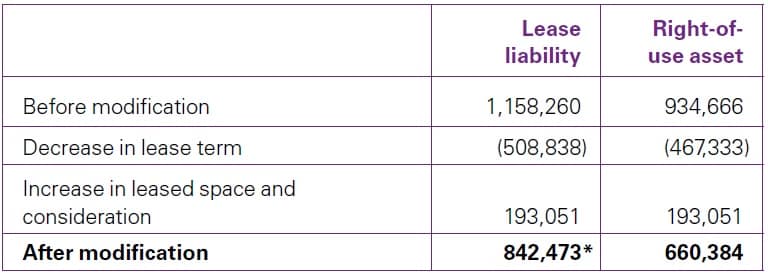
The effective date of the modification is the end of Year 10 (see ‘Reduction in rent (consideration)’ above). At this date, the lease liability is 1,158,260, the right-of-use asset is 934,666 and X’s incremental borrowing rate is 6% (assume that the interest rate implicit in the lease cannot be readily determined). The decrease in lease term, increase in office space and increase in consideration were not part of the original terms and conditions of the lease. Therefore, this is a lease modification. Although the modification adds the right to use an underlying asset, the increase in consideration is not commensurate with the stand-alone price for the increase in scope and therefore it is not accounted for as a separate lease. Remeasurement of the lease liability At the effective date of the modification, X remeasures the lease liability at 842,473 based on:
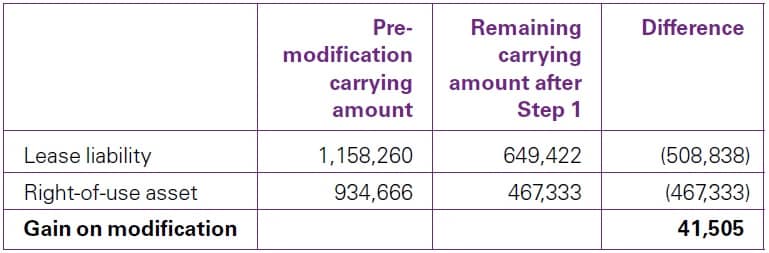
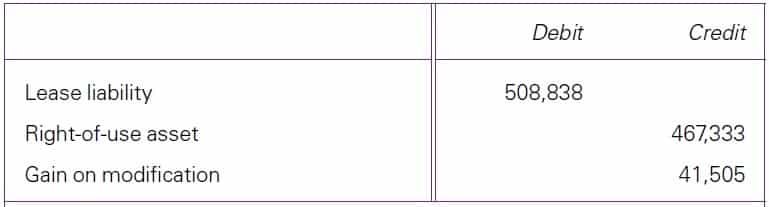
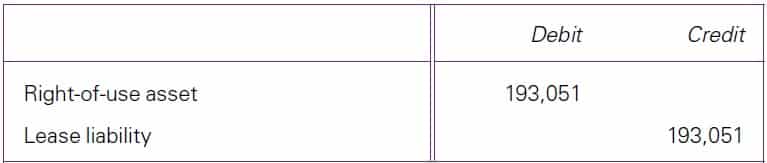
X accounts separately for the decrease in lease term and the increase in the office space and consideration. Accounting for the remeasurement of the lease Partial termination of the lease As a first step, X accounts for the partial termination of the lease (reduction of the lease term to five years) by reducing the pre-modification right-of-use asset and lease liability and recognising any resulting gain or loss as follows. X determines the proportionate decrease in carrying amount of the right-of-use asset based on the remaining right-of-use asset for the original office space. The remaining right-of-use asset is measured as 467,333 (934,666 x 5 / 10 – i.e. based on five years remaining). The remaining lease liability for the original office space is 649,422 – i.e. present value of five annual lease payments of 150,000, discounted at the original discount rate of 5%. X recognises the difference between the decrease in the lease liability and the decrease in the right-of-use asset as a gain in profit or loss at the effective date of the modification (i.e. end of Year 10).
X records the following entries.
To recognise partial termination of lease Increase in leased space and consideration As a second step, at the effective date of the modification X recognises the difference between the remaining carrying amount of the lease liability after Step 1 of 649,422 and the modified lease liability of 842,473 (i.e. 193,051) as an adjustment to the right-of-use asset. This reflects the increase in the lease payments and the revised discount rate. X records the following entries.
To recognise increase in leased space and consideration Similar to Example 2, there is no need to account for the lease of the original office space and the new office space as separate lease components because the lease of the new office space commences immediately and both components have the same lease term. However, the accounting becomes more complex when the effective date of the modification precedes the date on which the additional office space is available to the lessee (see. Summary Based on the above accounting, X recognises the following at the effective date of the modification.
* Annual lease payments of 200,000, discounted at 6% over five years. |
Termination or break of a lease
Sometimes a lessee terminates a lease earlier than the term contemplated in the original agreement. In these circumstances, the lessee will often pay to the lessor a termination penalty (also referred to as a ‘break clause’), even if one was not included in the original contract, to compensate the lessor for the loss of revenue.
Lease payments include penalties for terminating the lease. However, unlike a termination penalty considered in the initial measurement and determination of the lease term, some break clauses or termination penalties are not contemplated in the original agreement. They result from negotiation between the lessee and the lessor when they reach a modified agreement. It appears that these termination penalties should be considered part of the revised lease payments.
The following example illustrates a typical scenario.
|
Worked example – Termination/break of the lease clause not included in original contract |
||||||||||||||||||||||||||||||||||||||||||||||||||||||||||
|
Lessee L enters into a 10-year contract with Lessor M to lease a building. The annual payments are 100,000 payable in arrears and L’s incremental borrowing rate at commencement of the lease is 5% (assume that the interest rate implicit in the lease cannot be readily determined). There are no termination or break clauses in the original contract. During Year 5, L begins experiencing financial difficulties and wants to end the lease earlier than originally planned. At the end of Year 5, L and M enter into negotiations and agree to ‘break’ or terminate the lease at the end of Year 7 (i.e. in two years’ time, three years earlier than the original expiry of the lease). In addition, L agrees to pay M a termination or break fee of 120,000 at the end of Year 6. At the end of Year 5, the carrying amount of the right-of-use asset is 386,087 and the carrying amount of the lease liability is 432,948. At that date, L’s incremental borrowing rate is 9% (assume that the interest rate implicit in the lease cannot be readily determined). Lease modification The original terms and conditions of the lease did not include an option to terminate or break the lease or reduce the lease term. Therefore, L treats it as a lease modification that is not accounted for as a separate lease. Further, the reduction in the lease term represents a partial termination of the lease (see previous example ‘Modification that adds the right to use an underlying asset and decreases the lease term‘). Remeasurement of the lease liability At the effective date of the modification, L remeasures the lease liability at 286,003 based on:
In this case, the lease contains only a single lease component; therefore, the break fee forms part of the revised lease payments. L accounts separately for the decrease in lease term and change in consideration. Accounting for the remeasurement of the lease Partial termination of the lease As a first step, L accounts for the partial termination of the lease by reducing the pre-modification right-of-use asset and lease liability and recognising any resulting gain or loss as follows. L determines the proportionate decrease in carrying amount of the right-of-use asset based on the remaining right-of-use asset for the building. The remaining right-of-use asset is measured as 154,435 (386,087 x 2 / 5 – i.e. based on two years remaining). The remaining lease liability for the original lease payments is 185,941 – i.e. present value of two annual lease payments of 100,000, discounted at the original discount rate of 5%. L recognises the difference between the decrease in the lease liability and the decrease in the right-of-use asset as a gain in profit or loss at the effective date of the modification.
L records the following entries
To recognise the partial termination of the lease Change in consideration As a second step, at the effective date of the modification L recognises the effect of remeasuring the remaining lease liability based on the revised discount rate of 9% as an adjustment to the right-of-use asset.
L records the following entries.
To recognise remeasurement of remaining lease liability Summary Based on the above accounting, L recognises the following at the effective date of the modification.
* Lease payments of 220,000 at the end of Year 6 and 100,000 at the end of Year 7, discounted at 9%. |
The following example illustrates how the scenario in the above example compares with one in which a termination penalty clause was included in the original terms of the contract.
|
Worked example – Termination/break of the lease clause was included in original contract |
|||||||||||||||||||||||||||
|
Assume the same facts as the above example, except that the original lease agreement included an option for L to terminate the lease at the end of Year 7, subject to a termination penalty of 120,000 payable at the end of Year 6. Therefore, when L exercises its termination option there is no lease modification. |
|||||||||||||||||||||||||||
|
At commencement of the original lease, L and M assessed whether it was reasonably certain that L would not exercise the termination or break option. This was included in the determination of the lease term.
|
|||||||||||||||||||||||||||
|
On the assumption that at commencement of the original lease it was reasonably certain that L would not exercise the termination option (i.e. the lease term was assessed as 10 years), L revises the lease term when it exercises the termination or break option – i.e. at the end of Year 5. This results in a remeasurement of the lease liability at 286,003 by discounting the revised lease payments (including the termination or break penalty), using a revised discount rate of 9% on the basis of the revised lease term (i.e. two years remaining as at the end of Year 5). L recognises the effect of remeasuring the lease liability as an adjustment to the right-of-use asset.
L records the following entries.
To recognise remeasurement of remaining lease liability Summary Based on the above accounting, L recognises the following at the end of Year 5.
* Lease payments of 220,000 at the end of Year 6 and 100,000 at the end of Year 7, discounted at 9%. |
Master lease agreements
When applying the new standard, the approach to performing the analysis can be summarised as follows:
- identify the contract(s);
- identify the lease components; and
- assess whether each draw-down under the terms and conditions of the master lease agreement is a lease component or a modification that should be accounted for as a separate lease component.
The standard does not specifically address master lease agreements.
Generally, a master lease agreement permits the lessee to gain control over the use of additional underlying assets during the term of the agreement but does not require it to do so. When the lessee takes control over the use of an additional underlying asset, at its stand-alone price, the lessee accounts for a separate lease (IFRS 16.B32). This is illustrated in the following example.
|
Worked example – Master lease agreement with no minimum commitment and each right-of-use asset priced at stand-alone price |
|
Lessee C enters into a master lease agreement (MLA) with Lessor D under which Lessor D will provide up to 30 vehicles of the same type over a five-year period; the period begins with delivery of the first vehicle. Delivery of all of the vehicles will take place at different times over the five-year period, as C requires them. The lease payment is fixed at 5,000 per vehicle per annum, which is the stand-alone price for such a vehicle, and is pro-rated if a vehicle is delivered during the year. There is no requirement for C to take any vehicles – i.e. if no vehicles are taken, then no payment is due. As each vehicle is delivered, C applies separate lease accounting for its right to use that vehicle. One rationale for this conclusion is that the MLA does not create enforceable rights and obligations between C and D – i.e. the MLA is not itself a contract. Instead, it is the combination of the MLA and C’s order that creates a contract. Application of the lease modification guidance leads to the same conclusion. The scope of the lease is increased because C receives the right to use another underlying asset. The consideration for the lease increases by an amount commensurate with the stand-alone price for the increase in scope. Therefore, C accounts for a separate lease. |
However, in certain cases the agreement may specify a minimum number of units or currency value of equipment that the lessee is required to take into use during the term of the agreement. In this case, the contract includes a number of lease components, as illustrated in the following example.
|
Worked example – Master lease agreement with minimum commitment and same commencement date, and each additional right-of-use asset priced at stand-alone price |
|
Lessee C enters into an MLA with Lessor E to lease 30 vehicles for a fixed monthly payment of 5,000 per vehicle for a total term of five years from delivery of the first vehicle. The monthly per-vehicle payment does not change depending on how many vehicles are delivered to C. In this case, the MLA creates enforceable rights and obligations and is itself a contract. C takes delivery of the 30 vehicles immediately. C applies the guidance in the new standard on identifying separate lease components and allocates the consideration in the contract to those components. |
In certain scenarios, delivery of the underlying assets takes place over a period of time, resulting in different commencement dates. In this case, the entity (whether a lessee or a lessor) does not apply the lease modification guidance when it gains control over the use of those additional underlying assets. Rather, the entity identifies the separate lease components and allocates the consideration in the contract to those components, and accounts for each separate lease component from its commencement date.
|
Worked example – Master lease agreement with minimum commitment and different commencement dates, and each additional right-of-use asset priced at stand-alone price |
|
Lessee C enters into an MLA with Lessor E to lease up to 50 vehicles for a fixed monthly payment of 5,000 per vehicle for a total term of five years from delivery of the first vehicle. The monthly payment per vehicle is the stand-alone price and does not change depending on how many vehicles are delivered to C. C is required to take delivery of 20 vehicles immediately and to take delivery of a minimum of 10 additional vehicles from E by the end of Year 2. Again, the MLA creates enforceable rights and obligations and is itself a contract. When C takes delivery of any of the 10 mandated additional vehicles, there is no lease modification. That is, for draw-downs up to the minimum required quantity of 30 there is no lease modification. For these vehicles, C applies the guidance in the new standard on identifying separate lease components and allocating the consideration in the contract to those components. C accounts for each vehicle lease from its commencement date. However, if C takes delivery of more than 30 vehicles in total (the minimum required), then, as each additional vehicle is delivered, C applies separate lease accounting for its right to use that vehicle. This is consistent with the first example in this section above. |
|
How does a lessee measure the consideration in a contract under a master lease arrangement when there are draw-downs but a lease modification does not occur? |
|
When there are draw-downs under a master lease agreement up to the minimum required quantity, there is no lease modification. Instead, the lessee applies the guidance in the standard on identifying separate lease components and allocating the consideration in the contract to those components. Therefore, in the last example above although there would be no lease modification resulting from drawing down 10 additional vehicles after taking delivery of the first 20, some measurement and allocation complexities could arise if there were, for example, residual value guarantees or if the monthly lease payments escalated during the lease term based on an index or rate – e.g. consumer price index. Additional complications arise if the lease contains a number of lease components but with different commencement dates – e.g. when there is a price inter-dependency (e.g. a volume discount) or other non-lease components (e.g. maintenance costs). It appears that in this case a lessee should make a preliminary estimate of the consideration in the contract. This includes doing all of the following at the point in time when the parties need to begin their accounting:
As a result an entity should subsequently make the adjustments to the initial estimate. |
See also: Other sources – Lessee modifications
Best guide IFRS 16 Lessee modifications
Best guide IFRS 16 Lessee modifications Best guide IFRS 16 Lessee modifications Best guide IFRS 16 Lessee modifications Best guide IFRS 16 Lessee modifications Best guide IFRS 16 Lessee modifications Best guide IFRS 16 Lessee modifications Best guide IFRS 16 Lessee modifications Best guide IFRS 16 Lessee modifications Best guide IFRS 16 Lessee modifications
Annualreporting.info provides financial reporting narratives using IFRS keywords and terminology for free to students and others interested in financial reporting. The information provided on this website is for general information and educational purposes only and should not be used as a substitute for professional advice. Use at your own risk. Annualreporting.info is an independent website and it is not affiliated with, endorsed by, or in any other way associated with the IFRS Foundation. For official information concerning IFRS Standards, visit IFRS.org.