Last update 20/11/2019
What is hedge accounting IFRS 9 provides the explanations on all aspects of IFRS 17 in this website.
The new hedge accounting model
The new hedge accounting model aims to provide greater cohesion between an entity’s risk management strategy, their objectives for entering into hedging transactions and relationships, and the final impact of hedging on their financial statements. Improved disclosures are provided with the new model regarding the effect of hedge accounting on an entity’s financial statements and risk management strategy as well as details about derivatives entered into and their impact on an entity’s future cash flows.
Risk management
Risk management strategy and areas to cover are:
- Whether the hedge accounting documentation sufficiently links each individual hedging relationship and the related risk management objective.
- Whether the hedged item is transaction-related or time period-related.
- Whether the hedge effectiveness criteria are met, and
- When rebalancing versus discontinuation of a hedging relationship is appropriate.
Types of hedges
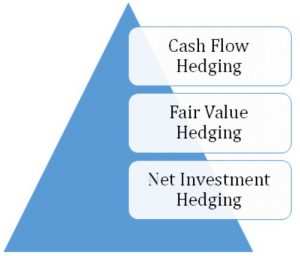
There are three types of hedges:
- Cash flow hedges;
- Fair value hedges; and
- Hedges of net investments in self-sustaining foreign operations.
Risk management strategy versus risk management objective
Linking hedge accounting with an entity’s risk management activities requires an understanding of what those risk management activities are. IFRS 9 distinguishes between the risk management strategy and the risk management objective:
Understanding the difference between the risk management strategy and the risk management objective is critical for assessing whether to continue applying hedge accounting for a particular hedging relationship.
- The risk management strategy is established at the highest level of an entity and identifies the risks to which the entity is exposed and whether and how the risk management activities should address those risks. For example, a risk management strategy could identify changes in interest rates of loans as a risk and define a specific target range for the fixed to floating rate ratio for those loans. The strategy is typically maintained for a relatively long period of time. However, it may include some flexibility to react to changes in circumstances.
IFRS 9 refers to the risk management strategy as normally being set out in ‘a general document that is cascaded down through an entity through policies containing more specific guidelines.’
The Board added specific disclosure requirements to IFRS 7 Financial Instruments: Disclosures that should allow users of the financial statements to understand the risk management activities of an entity and how they affect the financial statements:
- The risk management objective, on the contrary, is set at the level of an individual hedging relationship and defines how a particular hedging instrument is designated to hedge a particular hedged item. For example, this would define how a specific interest rate swap is used to ‘convert’ a specific fixed rate liability into a floating rate liability. Hence, a risk management strategy would usually be supported by many risk management objectives.
The broader perspective: What can go wrong?
Hedge accounting
IFRS 9 requires that an entity assess at the inception of the hedging relationship, and on an ongoing basis, whether it expects the hedge to be effective. At a minimum, entities are required to perform this ongoing and forward-looking assessment at the earliest of: a) Each reporting date; or b) When a significant change in circumstances that could affect the hedging relationship’s ability to meet the hedge effectiveness criteria occurs.
More complex hedges and the related IFRS 9 requirements are: Aggregated Exposures as a Hedged Item, Hedging Groups of Items, Hedging a Component of an Item, Accounting for the Time Value, and Designating a Credit Exposure at FVTPL
IFRS 9 Hedge accounting content

See also: The IFRS Foundation
What is hedge accounting IFRS 9
What is hedge accounting IFRS 9 What is hedge accounting IFRS 9 What is hedge accounting IFRS 9 What is hedge accounting IFRS 9
What is hedge accounting IFRS 9 What is hedge accounting IFRS 9 What is hedge accounting IFRS 9 What is hedge accounting IFRS 9