Last update 27/11/2019
Inflation as a risk component – Under IAS 39, inflation cannot be designated as a hedged risk component for financial instruments, unless the inflation risk component is contractually specified. For non-financial instruments, inflation risk cannot be designated under IAS 39 as a risk component at all. Inflation as a risk component
Highlight – For financial instruments, IFRS 9 opens the door for designating a non-contractually specified inflation component as a hedged risk component – but only in limited circumstances. For non-financial instruments, the inflation component will be eligible for designation as the hedged item in a hedging relationship provided that it is separately identifiable and reliably measurable.
For financial instruments, IFRS 9 introduces a rebuttable presumption that, unless contractually specified, inflation is not separately identifiable and reliably measurable. This means that there are limited cases under which it is possible to identify a risk component for inflation and designate that inflation component in a hedging relationship. Similar to other non-contractually specified risk components, the analysis would have to be based on the particular circumstances in the respective market, which is, in this case, the debt market.
However, IFRS 9 standard notes that in limited cases it is possible to designate non-contractually specified inflation as a risk component of a financial instrument because of the particular circumstances of the inflation environment and the relevant debt market.
Qualifying items: inflation
If an entity wishes to hedge non-contractually specified inflation as a risk component, then it will have to determine whether it is capable of constructing an inflation curve based on observable real interest rates from a liquid market for the hedge period to rebut the presumption that non-contractually specified inflation is not separately identifiable and reliably measurable. This may be challenging in some environments.
The existence of a government-sponsored price index for a country – e.g. a consumer price index or producer price index – is not sufficient to construct an inflation curve using real interest rates for the hedge period. This is because price indexes are generally developed using historical and current prices, whereas an inflation curve represents expectations of future prices.
And here is also an example below, derived from the application guidance of IFRS 9, explains a situation in which the presumption that inflation does not qualify as a risk component of a financial instrument can be rebutted.
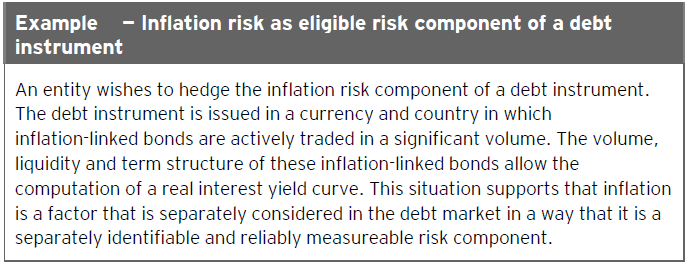
There are not many currencies with a liquid market for inflation-linked debt instruments, therefore, limiting the availability of designating non-contractually specified inflation risk of financial instruments. Inflation as a risk component
IFRS 9 does not specify whether the analysis of inflation as eligible risk component has to be made by currency or by country, or both. This is particularly relevant for countries forming a monetary union together with other countries, but having different inflation rates (e.g., within the Eurozone). The relevant ‘market structure’ for inflation will usually be given by the currency.
While IFRS 9 defines in what circumstances inflation can be a risk component for a financial instrument, inflation can, in future, be treated as a risk component for non-financial items in the same manner as any other risk component (as described in ‘Contractually specified risk components‘ and ‘Non-contractually specified risk components‘, i.e., the rebuttable presumption applies only to financial instruments). For example, a contractually specified inflation risk component would normally qualify as a hedged item (e.g., a sales contract with a price formula linked to the consumer price index) under IFRS 9, whereas it would not under IAS 39. Inflation as a risk component
The Board believes that there is a rebuttable presumption that, unless inflation risk is contractually specified, it is not separately identifiable and reliably measurable, and so it cannot be designated as a risk component of a financial instrument. However, the Board considers that, in limited cases, it might be possible to identify a risk component for inflation risk, and provides the example of environments in which inflation-linked bonds have a volume and term structure that result in a sufficiently liquid market that allows a term structure of zero-coupon real interest rates to be constructed.
Non-contractually specified inflation: Entities will have to determine whether they are capable of constructing an inflation curve based on observable real interest rates from a liquid market to assert that an inflation component of a fixed-rate debt instrument is separately identifiable and reliably measurable.
Read more on FAQ | IFRS:
Hedge Risk components General requirements
Contractually specified risk components
Non-contractually specified risk components
The ‘sub-LIBOR issue’
See also this external site : The IFRS Foundation