Last update 31/08/2019
An intangible asset is an identifiable non-monetary asset without physical substance.
Intangible assets can be grouped into three broad categories — rights, relationships and intellectual property:
- Rights. Leases, distribution agreements, employment contracts, covenants, financing arrangements, supply contracts, licences, certifications, franchises.
- Relationships. Trained and assembled workforce, customer and distribution relationships.
- Intellectual property. Patents; copyrights; trademarks; proprietary technology (for example, formulas, recipes, specifications, formulations, training programmes, marketing strategies, artistic techniques, customer lists, demographic studies, product test results); business knowledge — such as suppliers’ lead times, cost and pricing data, trade secrets and knowhow.
Internally generated intangibles cannot be disclosed on the balance sheet, but are often significant in value, and should be understood and managed appropriately. Under IFRS 3, only intangible assets that have been acquired can be separately disclosed on the acquiring company’s consolidated balance sheet (disclosed intangible assets).
The following diagram illustrates how intangible value is made up of both disclosed and undisclosed value.
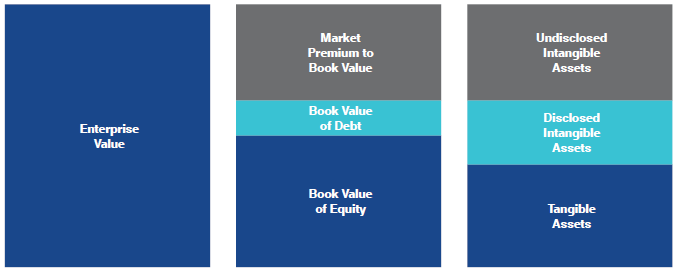
‘Undisclosed intangible assets’, are often more valuable than the disclosed intangibles. The category includes ‘internally generated goodwill’, and it accounts for the difference between the fair market value of a business and the value of its identifiable tangible and intangible assets.
Although not an intangible asset in a strict sense — that is, a controlled ‘resource’ expected to provide future economic benefits — this residual goodwill value is treated as an intangible asset in a business combination on the acquiring company’s balance sheet. Current accounting practice does not allow for internally generated intangible assets to be disclosed on a balance sheet. Under current IFRS only the value of acquired intangible assets can be recognised.
|
Marketing related intangible assets |
Customer related intangible assets |
Contract related intangible assets |
Technology related intangible assets |
Artistic related intangible assets |
|
Trademarks, trade names Service marks, collective marks, certification marks Trade dress (unique colour, shape, or package design) Newspapers Internet domain names Mastheads Non-competition agreements |
Customer lists Order or production backlog Customer contracts & related customer relationships Non-contractual customer relationships |
Licensing, royalty, standstill agreements Advertising, construction, management, service or supply contracts Lease agreements Construction permits Permits Franchise agreements Operating and broadcasting rights Use rights such as drilling, water, air, mineral, timber cutting & route authorities Servicing contracts such as mortgage servicing contracts Employment contracts |
Patented technology Computer software and mask works Unpatented technology Databases Trade secrets, such as secret formulas, processes, recipes (think of Coca Cola) |
Plays, operas and ballets Books, magazines, newspapers and other literary works Musical works such as compositions, song lyrics and advertising jingles Pictures and photographs Video and audio-visual material including films, music, videos, etc. |
In order to be ‘identifiable’ intangible assets must either be separable (capable of being separated from the entity and sold, transferred or licensed) or it must arise from contractual or legal rights (irrespective of whether those rights are themselves ‘separable’).
Therefore, intangible assets that may be recognised on a balance sheet under IFRS are only a fraction of what are often considered to be ‘intangible assets’ in a broader sense.
However, the picture has improved since 2001, when IFRS 3 in Europe, and FAS 141 in the US, started to require companies to break down the value of the intangibles they acquire as a result of a takeover into five different categories — including customer- and market related intangibles — rather than lumping them together under the catch-all term ‘goodwill’ as they had in the past. But because only acquired intangibles, and not those internally generated, can be recorded on the balance sheet, this results in a lopsided view of a company’s value. What is more, the value of those assets can only stay the same or be revised downwards in each subsequent year, thus failing to reflect the additional value that the new stewardship ought to be creating.

Intangible assets
Intangible assets
Intangible assets Intangible assets Intangible assets Intangible assets Intangible assets